QUESTION IMAGE
Question
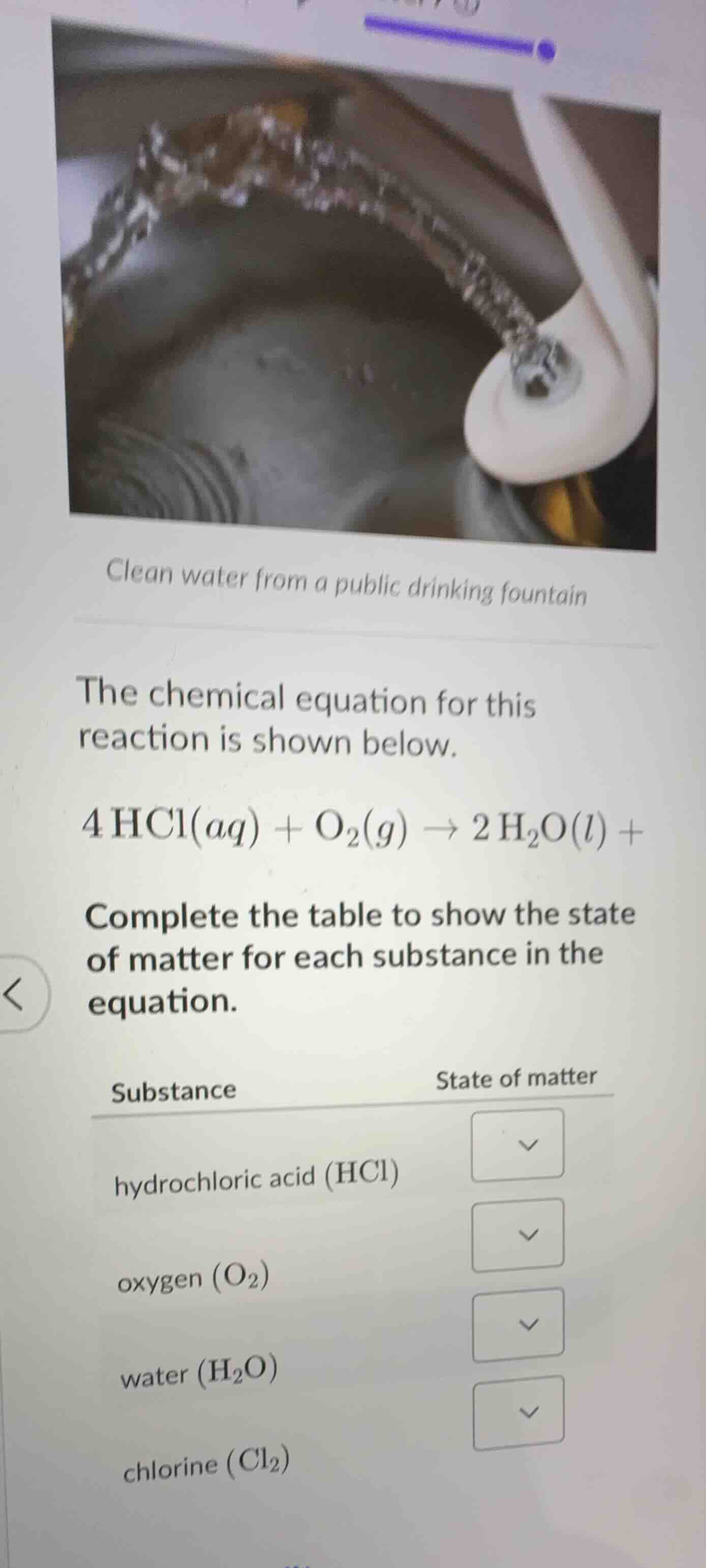
clean water from a public drinking fountain
the chemical equation for this
reaction is shown below.
\\(4\\,\mathrm{hcl}(aq) + \mathrm{o}_2(g) \
ightarrow 2\\,\mathrm{h}_2\mathrm{o}(l) +
\\)complete the table to show the state
of matter for each substance in the
equation.
| substance | state of matter |
|---|---|
| oxygen (\\(\mathrm{o}_2\\)) | \\(\boldsymbol{\downarrow}\\) |
| water (\\(\mathrm{h}_2\mathrm{o}\\)) | \\(\boldsymbol{\downarrow}\\) |
| chlorine (\\(\mathrm{cl}_2\\)) | \\(\boldsymbol{\downarrow}\\) |
Step1: Analyze HCl state
Hydrochloric acid (HCl) in the equation is labeled (aq), which stands for aqueous (dissolved in water). So HCl is aqueous.
Step2: Analyze O₂ state
Oxygen (O₂) is labeled (g), meaning gas. So O₂ is gas.
Step3: Analyze H₂O state
Water (H₂O) is labeled (l), meaning liquid. So H₂O is liquid.
Step4: Analyze Cl₂ state (assuming the reaction produces Cl₂, and from typical reactions, Cl₂ is a gas at room temp)
Chlorine (Cl₂) is a gas under standard conditions, so its state is gas.

Snap & solve any problem in the app
Get step-by-step solutions on Sovi AI
Photo-based solutions with guided steps
Explore more problems and detailed explanations
| Substance | State of matter |
|---|---|
| oxygen (O₂) | gas (g) |
| water (H₂O) | liquid (l) |
| chlorine (Cl₂) | gas (g) |
(Note: The chemical equation in the problem seems to be incomplete, but assuming the full reaction is \( 4\text{HCl}(aq) + \text{O}_2(g)
ightarrow 2\text{H}_2\text{O}(l) + 2\text{Cl}_2(g) \) based on common redox reactions, we determine the states as above.)