QUESTION IMAGE
Question
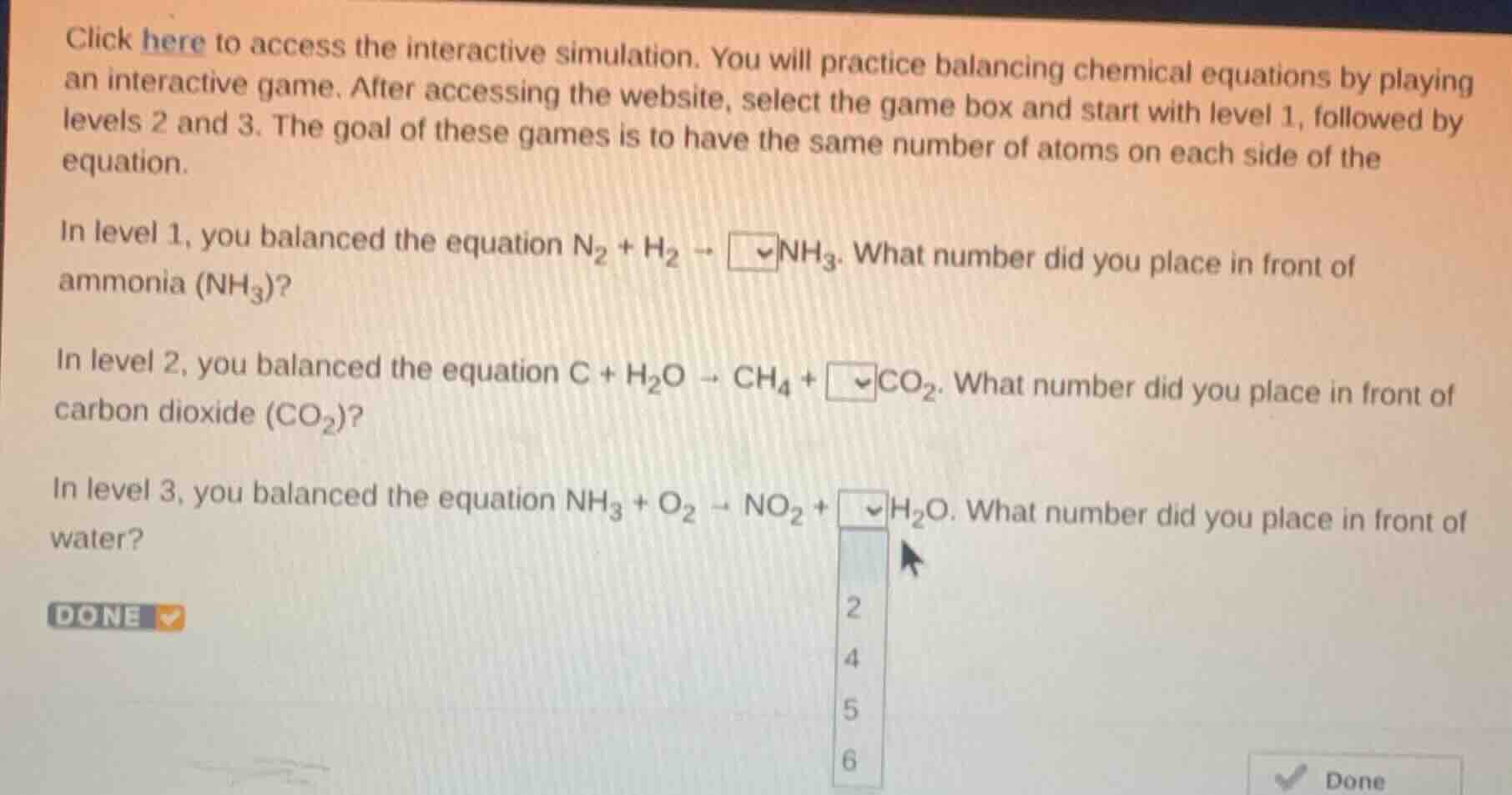
click here to access the interactive simulation. you will practice balancing chemical equations by playing an interactive game. after accessing the website, select the game box and start with level 1, followed by levels 2 and 3. the goal of these games is to have the same number of atoms on each side of the equation.
in level 1, you balanced the equation $\ce{n_{2} + h_{2} -> \square nh_{3}}$. what number did you place in front of ammonia ($\ce{nh_{3}}$)?
in level 2, you balanced the equation $\ce{c + h_{2}o -> ch_{4} + \square co_{2}}$. what number did you place in front of carbon dioxide ($\ce{co_{2}}$)?
in level 3, you balanced the equation $\ce{nh_{3} + o_{2} -> no_{2} + \square h_{2}o}$. what number did you place in front of water?
Level 1: Balancing \( \boldsymbol{\ce{N2 + H2 -> NH3}} \)
Step1: Balance Nitrogen atoms
On the left, there are 2 N atoms (from \( \ce{N2} \)). On the right, each \( \ce{NH3} \) has 1 N atom. Let the coefficient of \( \ce{NH3} \) be \( x \). So, \( 2 = x \times 1 \)? Wait, no—wait, we need to balance N first. Wait, \( \ce{N2} \) has 2 N, so \( \ce{NH3} \) must have 2 N, so \( x = 2 \) for N? Wait, no, let's do H next. Wait, no, let's use the standard method.
The unbalanced equation: \( \ce{N2 + H2 -> NH3} \)
- Nitrogen: Left has 2, right has 1 per \( \ce{NH3} \). So coefficient of \( \ce{NH3} \) should be 2 to make 2 N on right. But then H: \( \ce{NH3} \) with coefficient 2 has \( 2 \times 3 = 6 \) H. Left has \( \ce{H2} \), so coefficient of \( \ce{H2} \) is 3 (since \( 3 \times 2 = 6 \) H). Let's check:
\( \ce{N2 + 3H2 -> 2NH3} \)
N: 2 on left, 2 on right (2 \( \ce{NH3} \) → 2 N). H: 3×2=6 on left, 2×3=6 on right. Balanced. So coefficient of \( \ce{NH3} \) is 2.
Step2: Verify
Left: \( \ce{N2} \) (2 N), \( 3\ce{H2} \) (6 H). Right: \( 2\ce{NH3} \) (2 N, 6 H). Balanced. So the number in front of \( \ce{NH3} \) is 2.
Step1: Balance Carbon atoms
Left: 1 C (from \( \ce{C} \)). Right: 1 C in \( \ce{CH4} \) and 1 C in \( \ce{CO2} \). Wait, no—wait, let's list atoms:
Unbalanced: \( \ce{C + H2O -> CH4 + CO2} \)
C: Left = 1, Right = 1 (from \( \ce{CH4} \)) + 1 (from \( \ce{CO2} \)) = 2. So coefficient of \( \ce{C} \) on left should be 2? Wait, no, let's do H first. Wait, \( \ce{CH4} \) has 4 H. Left has \( \ce{H2O} \), so each \( \ce{H2O} \) has 2 H. So to get 4 H, coefficient of \( \ce{H2O} \) is 2 (2×2=4 H). Now, H: left (2 \( \ce{H2O} \)) → 4 H; right (\( \ce{CH4} \)) → 4 H. Good. Now O: left (2 \( \ce{H2O} \)) → 2 O; right (\( \ce{CO2} \)) → 2 O. Good. Now C: left (let's see, we have \( \ce{C} \) and \( \ce{CH4} \) and \( \ce{CO2} \)). Wait, right has \( \ce{CH4} \) (1 C) and \( \ce{CO2} \) (1 C) → total 2 C. So left \( \ce{C} \) must have coefficient 2. So equation: \( \ce{2C + 2H2O -> CH4 + CO2} \)? Wait, no, wait:
Wait, let's rebalance:
Start over:
Equation: \( \ce{C + H2O -> CH4 + CO2} \)
- H: \( \ce{CH4} \) has 4 H. So \( \ce{H2O} \) needs 2 molecules (2×2=4 H). So coefficient of \( \ce{H2O} \) is 2.
- O: \( \ce{H2O} \) (2 molecules) has 2 O. So \( \ce{CO2} \) must have 2 O, so coefficient of \( \ce{CO2} \) is 1? Wait, no, 2 O in \( \ce{CO2} \) would need 1 \( \ce{CO2} \) (1×2=2 O). Correct.
- C: Right has \( \ce{CH4} \) (1 C) + \( \ce{CO2} \) (1 C) = 2 C. So left \( \ce{C} \) must have coefficient 2.
So balanced equation: \( \ce{2C + 2H2O -> CH4 + CO2} \)? Wait, no, wait:
Wait, \( \ce{2C + 2H2O -> CH4 + CO2} \):
- C: 2 vs 1+1=2 ✔️
- H: 2×2=4 vs 4 ✔️
- O: 2×1=2 vs 2 ✔️
Wait, but the original equation has \( \ce{C} \) (not 2C). Wait, maybe I made a mistake. Wait, let's check again.
Wait, the problem is \( \ce{C + H2O -> CH4 + CO2} \). Let's use trial:
Let coefficient of \( \ce{CO2} \) be \( x \), \( \ce{CH4} \) be \( y \), \( \ce{H2O} \) be \( z \), \( \ce{C} \) be \( w \).
C: \( w = y + x \)
H: \( 2z = 4y \) → \( z = 2y \)
O: \( z = 2x \)
From H: \( z = 2y \); from O: \( z = 2x \) → \( 2y = 2x \) → \( y = x \)
From C: \( w = y + x = 2x \)
Let’s take \( x = 1 \) (coefficient of \( \ce{CO2} \)):
Then \( y = 1 \), \( z = 2(1) = 2 \), \( w = 2(1) = 2 \)
So equation: \( \ce{2C + 2H2O -> CH4 + CO2} \)
Wait, but the problem's equation is \( \ce{C + H2O -> CH4 + [ ]CO2} \). So the coefficient of \( \ce{CO2} \) is 1? Wait, no, wait:
Wait, when \( x = 1 \), \( \ce{CO2} \) coefficient is 1. Let's check:
Left: 2 C, 2 H2O (4 H, 2 O)
Right: CH4 (1 C, 4 H), CO2 (1 C, 2 O)
Total C: 2 (left) vs 2 (right: 1+1). Total H: 4 vs 4. Total O: 2 vs 2. So balanced. So the coefficient of \( \ce{CO2} \) is 1? Wait, but the problem's equation is \( \ce{C + H2O -> CH4 + [ ]CO2} \). Wait, maybe I messed up. Wait, let's check with the coefficients:
Wait, if we have \( \ce{2C + 2H2O -> CH4 + CO2} \), then the coefficient of \( \ce{CO2} \) is 1. Yes. So the number in front of \( \ce{CO2} \) is 1? Wait, no, wait:
Wait, let's count again:
Left: C (2), H2O (2) → H: 4, O: 2
Right: CH4 (1 C, 4 H), CO2 (1 C, 2 O)
So C: 2 (left) = 2 (right: 1+1). H: 4 = 4. O: 2 = 2. So yes, \( \ce{CO2} \) has coefficient 1. So the answer is 1? Wait, no, wait, maybe I made a mistake. Wait, let's try another approach.
Alternative: Let's balance step by step.
- Balance H: \( \ce{CH4} \) has 4 H. So \( \ce{H2O} \) needs 2 molecules (2×2=4 H). So put 2 in front of \( \ce{H2O} \).
- Balance O: \( \ce{H2O} \) (2 molecules) has 2 O. So \( \ce{CO2} \) needs 2 O, so put 1 in front of \( \ce{CO2} \) (1×2=2 O).
- Balance C: \( \ce{CO2} \) (1) has 1 C, \( \ce{CH4} \) (1)…
Step1: Balance H atoms
\( \ce{NH3} \) has 3 H, \( \ce{H2O} \) has 2 H. Find LCM of 3 and 2, which is 6. So coefficient of \( \ce{NH3} \) is 2 (2×3=6 H), coefficient of \( \ce{H2O} \) is 3 (3×2=6 H). Now equation: \( \ce{2NH3 + O2 -> NO2 + 3H2O} \)
Step2: Balance N atoms
Left: 2 N (from \( 2\ce{NH3} \)). Right: 1 N per \( \ce{NO2} \). So coefficient of \( \ce{NO2} \) is 2. Now equation: \( \ce{2NH3 + O2 -> 2NO2 + 3H2O} \)
Step3: Balance O atoms
Left: \( \ce{O2} \) (let coefficient be \( x \)) → \( 2x \) O.
Right: \( 2\ce{NO2} \) (2×2=4 O) + \( 3\ce{H2O} \) (3×1=3 O) → total 7 O. Wait, 2x = 7? No, that's not possible. Wait, I must have messed up. Let's start over.
Correct method:
Unbalanced: \( \ce{NH3 + O2 -> NO2 + H2O} \)
- Balance N: \( \ce{NH3} \) → \( \ce{NO2} \). So coefficient of \( \ce{NH3} \) = coefficient of \( \ce{NO2} \) = let's say \( a \).
- Balance H: \( \ce{NH3} \) has 3 H, \( \ce{H2O} \) has 2 H. So \( 3a = 2b \) (where \( b \) is coefficient of \( \ce{H2O} \)). So \( a \) must be even, \( b \) must be multiple of 3. Let's take \( a = 4 \) (so 4 NH3 → 12 H), then \( b = 6 \) (6 H2O → 12 H).
- Now N: 4 NH3 → 4 NO2. So coefficient of \( \ce{NO2} \) is 4.
- Balance O: Left: \( \ce{O2} \) (let coefficient be \( c \)) → \( 2c \) O.
Right: 4 NO2 (4×2=8 O) + 6 H2O (6×1=6 O) → total 14 O. So \( 2c = 14 \) → \( c = 7 \).
So equation: \( \ce{4NH3 + 7O2 -> 4NO2 + 6H2O} \)
Now check:
- N: 4 (left) vs 4 (right) ✔️
- H: 12 (left: 4×3) vs 12 (right: 6×2) ✔️
- O: 14 (left: 7×2) vs 14 (right: 4×2 + 6×1 = 8 + 6 = 14) ✔️
So coefficient of \( \ce{H2O} \) is 6. Wait, but the options are 2,4,5,6. So 6 is an option. So the number in front of water is 6.

Snap & solve any problem in the app
Get step-by-step solutions on Sovi AI
Photo-based solutions with guided steps
Explore more problems and detailed explanations
(Level 1): 2