QUESTION IMAGE
Question
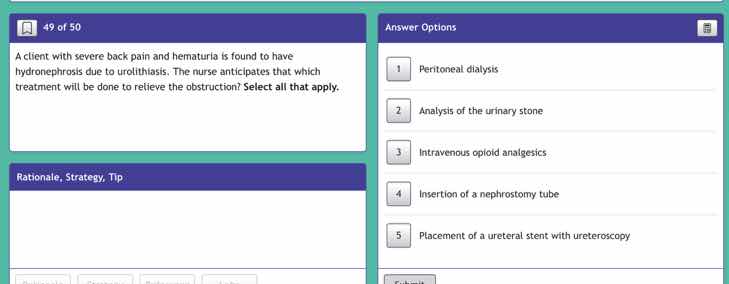
a client with severe back pain and hematuria is found to have hydronephrosis due to urolithiasis. the nurse anticipates that which treatment will be done to relieve the obstruction? select all that apply.
answer options
1 peritoneal dialysis
2 analysis of the urinary stone
3 intravenous opioid analgesics
4 insertion of a nephrostomy tube
5 placement of a ureteral stent with ureteroscopy
Brief Explanations
- Analysis of the urinary stone (Option 2): Analyzing the urinary stone helps determine its composition, which guides treatment (e.g., dietary changes, specific medications) to prevent recurrence and inform removal methods.
- Intravenous opioid analgesics (Option 3): Severe back pain (renal colic) from urolithiasis requires strong pain relief; IV opioids are effective for acute, severe pain management.
- Insertion of a nephrostomy tube (Option 4): Hydronephrosis (urine backup in the kidney) due to obstruction needs drainage; a nephrostomy tube bypasses the obstruction to drain urine from the kidney, relieving pressure and preventing kidney damage.
- Placement of a ureteral stent with ureteroscopy (Option 5): Ureteroscopy allows stent placement to keep the ureter open, relieving obstruction and facilitating stone passage or removal. Ureteral stents also help drain urine around the stone.
- Peritoneal dialysis (Option 1): Peritoneal dialysis is for kidney failure (renal replacement therapy), not for relieving obstruction from urolithiasis. It has no role in treating the obstruction or stone - related issues here.

Snap & solve any problem in the app
Get step-by-step solutions on Sovi AI
Photo-based solutions with guided steps
Explore more problems and detailed explanations
- Analysis of the urinary stone, 3. Intravenous opioid analgesics, 4. Insertion of a nephrostomy tube, 5. Placement of a ureteral stent with ureteroscopy