QUESTION IMAGE
Question
close read
annotate: in paragraph 4,
mark words and phrases
related to luck or wonder.
question: why do
references to luck and
wonder appear so
frequently?
conclude: what effect do
these repeated references
have, particularly on how
readers see jonathan?
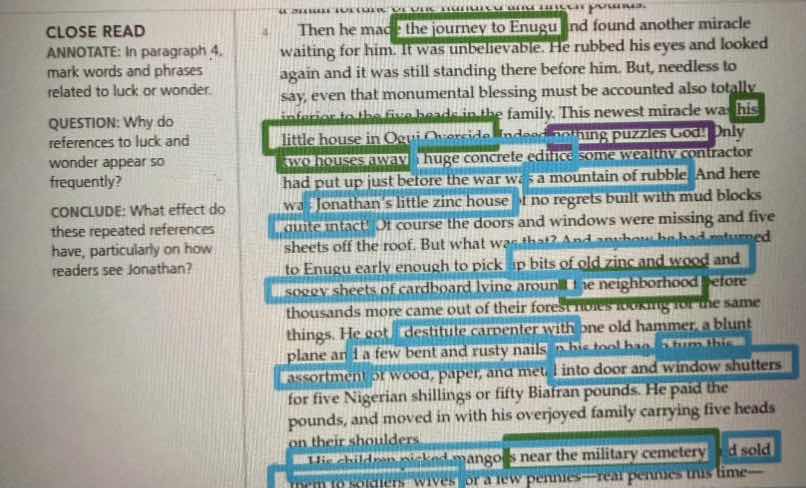
then he ma the journey to enugu nd found another miracle
waiting for him. it was unbelievable. he rubbed his eyes and looked
again and it was still standing there before him. but, needless to
say, even that monumental blessing must be accounted totally
inferior to the five heads in the family. this newest miracle was his
little house in owerri overside ndess nothing puzzles god! nly
two houses away. huge concrete edifice some wealthy contractor
had put up just before the war w; a mountain of rubble. and here
was jonathan’s little zinc house |no regrets built with mud blocks
quite intact )! of course the doors and windows were missing and five
sheets off the roof. but what was that? and anyhow he had returned
to enugu early enough to pick p bits of old zinc and wood
soggy sheets of cardboard lying around |e neighborhood before
thousands more came out of their forest holes looking for the same
things. he got destitute carpenter with ne old hammer, a blunt
plane an i a few bent and rusty nails into tool bar. x from this
assortment of wood, paper, and met, he made door and window shutters
for five nigerian shillings or fifty biafran pounds. he paid the
pounds, and moved in with his overjoyed family carrying five heads
on their shoulders.
his children picked mango : near the military cemetery d sold
to soldiers’ wives or a few pennies—real pennies this time—
To address the questions about the references to luck and wonder, and their effect on how readers see Jonathan, we analyze as follows:
For "Why do references to luck and wonder appear so frequently?"
In the story (likely from Civil Peace by Chinua Achebe), Jonathan’s experiences after the Nigerian Civil War are filled with unexpected good fortune (e.g., his house surviving, finding materials to rebuild, or providing for his family). These “miracles” and “luck” emphasize the absurdity of post - war life, where survival and small joys feel like extraordinary blessings. The frequent references highlight the fragility of normalcy and the role of chance in a devastated society, showing how people grasp onto hope in chaos.
For "What effect do these repeated references have, particularly on how readers see Jonathan?"
The repeated “luck” and “wonder” frame Jonathan as a resilient, optimistic figure. Despite the war’s destruction, he finds “miracles” in small victories (like his house standing, getting materials, or supporting his family). Readers see him as someone who embraces hope, adapts to adversity, and finds meaning in seemingly random good fortune. The references humanize his struggle, making his perseverance and gratitude feel both heroic and relatable—he is not defeated by tragedy but uplifted by life’s unexpected kindnesses.
Final Answers (Structured for Each Question):
- Why do references to luck and wonder appear so frequently?
To highlight the chaotic, unpredictable post - war context, where survival and small joys feel like extraordinary blessings, emphasizing the role of chance in a devastated society and the human need for hope.
- What effect do these repeated references have on how readers see Jonathan?
They portray Jonathan as resilient, optimistic, and grateful—someone who finds hope in “miracles” of survival and small victories, making his perseverance in adversity both heroic and relatable.

Snap & solve any problem in the app
Get step-by-step solutions on Sovi AI
Photo-based solutions with guided steps
Explore more problems and detailed explanations
To address the questions about the references to luck and wonder, and their effect on how readers see Jonathan, we analyze as follows:
For "Why do references to luck and wonder appear so frequently?"
In the story (likely from Civil Peace by Chinua Achebe), Jonathan’s experiences after the Nigerian Civil War are filled with unexpected good fortune (e.g., his house surviving, finding materials to rebuild, or providing for his family). These “miracles” and “luck” emphasize the absurdity of post - war life, where survival and small joys feel like extraordinary blessings. The frequent references highlight the fragility of normalcy and the role of chance in a devastated society, showing how people grasp onto hope in chaos.
For "What effect do these repeated references have, particularly on how readers see Jonathan?"
The repeated “luck” and “wonder” frame Jonathan as a resilient, optimistic figure. Despite the war’s destruction, he finds “miracles” in small victories (like his house standing, getting materials, or supporting his family). Readers see him as someone who embraces hope, adapts to adversity, and finds meaning in seemingly random good fortune. The references humanize his struggle, making his perseverance and gratitude feel both heroic and relatable—he is not defeated by tragedy but uplifted by life’s unexpected kindnesses.
Final Answers (Structured for Each Question):
- Why do references to luck and wonder appear so frequently?
To highlight the chaotic, unpredictable post - war context, where survival and small joys feel like extraordinary blessings, emphasizing the role of chance in a devastated society and the human need for hope.
- What effect do these repeated references have on how readers see Jonathan?
They portray Jonathan as resilient, optimistic, and grateful—someone who finds hope in “miracles” of survival and small victories, making his perseverance in adversity both heroic and relatable.