QUESTION IMAGE
Question
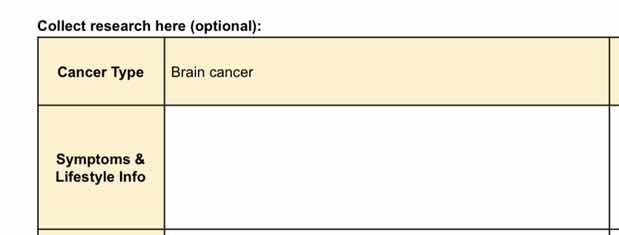
collect research here (optional):
cancer type\tbrain cancer
symptoms & lifestyle info\t
To fill in the "Symptoms & Lifestyle Info" for brain cancer, we can refer to medical knowledge:
Symptoms of Brain Cancer:
- Headaches: Often severe, worse in the morning or with coughing/sneezing.
- Neurological issues: Seizures, weakness/numbness in limbs, difficulty with balance, speech problems, vision changes (blurred, double vision).
- Cognitive/mood changes: Memory loss, confusion, personality shifts, fatigue.
- Nausea/Vomiting: Especially in the morning (due to increased intracranial pressure).
Lifestyle Info (Risk Factors & Management):
- Risk Factors: Family history of brain tumors, exposure to radiation (e.g., certain medical treatments), age (some tumors are more common in older adults, others in children), genetic syndromes (e.g., neurofibromatosis).
- Lifestyle Management:
- Avoid unnecessary radiation exposure.
- Maintain a healthy diet (anti - inflammatory foods like fruits, vegetables, whole grains may be beneficial, though no diet cures cancer).
- Manage stress (chronic stress can impact overall health, including immune function).
- Regular medical check - ups, especially if at high risk (e.g., family history, genetic predisposition).
If you need more detailed or specific research - based info, academic medical databases (e.g., PubMed, JAMA) or resources from organizations like the American Brain Tumor Association can be consulted.

Snap & solve any problem in the app
Get step-by-step solutions on Sovi AI
Photo-based solutions with guided steps
Explore more problems and detailed explanations
To fill in the "Symptoms & Lifestyle Info" for brain cancer, we can refer to medical knowledge:
Symptoms of Brain Cancer:
- Headaches: Often severe, worse in the morning or with coughing/sneezing.
- Neurological issues: Seizures, weakness/numbness in limbs, difficulty with balance, speech problems, vision changes (blurred, double vision).
- Cognitive/mood changes: Memory loss, confusion, personality shifts, fatigue.
- Nausea/Vomiting: Especially in the morning (due to increased intracranial pressure).
Lifestyle Info (Risk Factors & Management):
- Risk Factors: Family history of brain tumors, exposure to radiation (e.g., certain medical treatments), age (some tumors are more common in older adults, others in children), genetic syndromes (e.g., neurofibromatosis).
- Lifestyle Management:
- Avoid unnecessary radiation exposure.
- Maintain a healthy diet (anti - inflammatory foods like fruits, vegetables, whole grains may be beneficial, though no diet cures cancer).
- Manage stress (chronic stress can impact overall health, including immune function).
- Regular medical check - ups, especially if at high risk (e.g., family history, genetic predisposition).
If you need more detailed or specific research - based info, academic medical databases (e.g., PubMed, JAMA) or resources from organizations like the American Brain Tumor Association can be consulted.