QUESTION IMAGE
Question
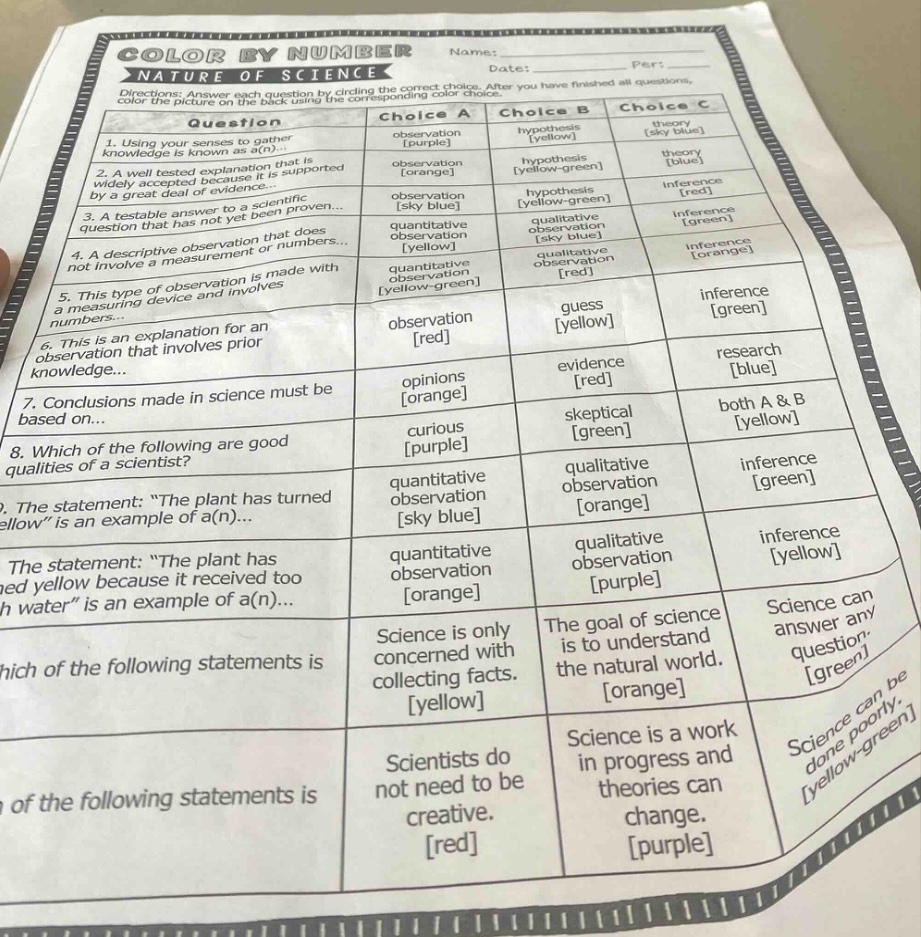
color by number nature of science name: date: per: directions: answer each question by circling the correct choice. after you have finished all questions, color the picture on the back using the corresponding color choice. question choice a choice b choice c 1. using your senses to gather knowledge is known as a(n)... observation purple hypothesis yellow theory sky blue 2. a well tested explanation that is well accepted because it is supported by a great deal of evidence... observation orange hypothesis yellow - green theory blue 3. a testable answer to a scientific question that has not yet been proven... observation sky blue hypothesis yellow - green inference red 4. a descriptive observation that does not involve a measurement or numbers... observation yellow qualitative observation sky blue inference green 5. this type of observation is made with a measuring device and involves numbers... quantitative observation yellow - green qualitative observation red inference orange 6. this is an explanation for an observation that involves prior knowledge... observation red guess yellow inference green 7. conclusions made in science must be based on... opinions orange evidence red research blue 8. which of the following are good qualities of a scientist? curious purple skeptical green both a & b yellow 9. the statement: \the plant has turned yellow\ is an example of a(n)... quantitative observation sky blue qualitative observation orange inference green 10. the statement: \the plant has turned yellow because it received too much water\ is an example of a(n)... quantitative observation orange qualitative observation purple inference yellow 11. which of the following statements is... science is only concerned with collecting facts. yellow the goal of science is to understand the natural world. orange science can answer any question. green 12. which of the following statements is... scientists do not need to be creative. red science is a work in progress and theories can change. purple science can be done poorly. yellow - green
To solve these "Nature of Science" questions, we analyze each one based on scientific method concepts:
Question 1
Concept: Using senses to gather knowledge is observation.
- Choice A: observation (purple) ✔️
- Choice B: hypothesis (yellow) ❌ (hypothesis is a prediction, not sensory gathering)
- Choice C: theory (sky blue) ❌ (theory is a well - supported explanation, not sensory gathering)
Question 2
Concept: A well - tested explanation supported by evidence is a theory.
- Choice A: observation (orange) ❌ (observation is gathering data)
- Choice B: hypothesis (yellow - green) ❌ (hypothesis is untested)
- Choice C: theory (blue) ✔️
Question 3
Concept: A testable answer to a scientific question (not yet proven) is a hypothesis.
- Choice A: sky blue (no label, likely incorrect) ❌
- Choice B: hypothesis (yellow - green) ✔️
- Choice C: inference (green) ❌ (inference is a conclusion from data)
Question 4
Concept: A description without measurement/numbers is a qualitative observation.
- Choice A: quantitative observation (yellow) ❌ (quantitative uses numbers)
- Choice B: qualitative observation (sky blue) ✔️
- Choice C: inference (orange) ❌ (inference is a conclusion)
Question 5
Concept: A measurement - based observation (involves numbers) is a quantitative observation.
- Choice A: quantitative observation (yellow - green) ✔️
- Choice B: qualitative observation (red) ❌ (qualitative is non - numerical)
- Choice C: guess (yellow) ❌ (guess is unsubstantiated)
Question 6
Concept: An explanation for an observation using prior knowledge is an inference.
- Choice A: observation (red) ❌ (observation is direct sensory data)
- Choice B: guess (yellow) ❌ (guess is random)
- Choice C: inference (green) ✔️
Question 7
Concept: Scientific conclusions must be based on evidence (not opinions).
- Choice A: opinions (orange) ❌ (science relies on evidence, not opinions)
- Choice B: evidence (red) ✔️
- Choice C: research (blue) ❌ (research is the process, conclusions need evidence)
Question 8
Concept: Good scientist qualities include being curious and skeptical (both A & B).
- Choice A: curious (purple) ✔️ (curiosity drives exploration)
- Choice B: skeptical (green) ✔️ (skepticism ensures critical thinking)
- Choice C: both A & B (yellow) ✔️ (combines both good qualities)
Question 9 (partial: "The plant has turned yellow")
Concept: A description of a trait (color) is a qualitative observation.
- Choice A: quantitative observation (sky blue) ❌ (no numbers)
- Choice B: qualitative observation (orange) ✔️
- Choice C: inference (green) ❌ (inference is a conclusion, not direct observation)
Question 10 (partial: "The plant has turned yellow because it received too much water")
Concept: A conclusion about cause (using prior knowledge) is an inference.
- Choice A: quantitative observation (orange) ❌ (no numbers)
- Choice B: qualitative observation (purple) ❌ (not a description)
- Choice C: inference (yellow) ✔️
Question 11 (partial: "Which statement about science is correct?")
Concept: The goal of science is to understand the natural world.
- Choice A: Science is only about collecting facts (yellow) ❌ (science seeks understanding, not just facts)
- Choice B: The goal of science is to understand the natural world (orange) ✔️
- Choice C: Science can answer any question (green) ❌ (science has limits, e.g., moral questions)
Question 12 (partial: "Which statement about science is correct?")
Concept: Science is iterative (theories change with new e…

Snap & solve any problem in the app
Get step-by-step solutions on Sovi AI
Photo-based solutions with guided steps
Explore more problems and detailed explanations
To solve these "Nature of Science" questions, we analyze each one based on scientific method concepts:
Question 1
Concept: Using senses to gather knowledge is observation.
- Choice A: observation (purple) ✔️
- Choice B: hypothesis (yellow) ❌ (hypothesis is a prediction, not sensory gathering)
- Choice C: theory (sky blue) ❌ (theory is a well - supported explanation, not sensory gathering)
Question 2
Concept: A well - tested explanation supported by evidence is a theory.
- Choice A: observation (orange) ❌ (observation is gathering data)
- Choice B: hypothesis (yellow - green) ❌ (hypothesis is untested)
- Choice C: theory (blue) ✔️
Question 3
Concept: A testable answer to a scientific question (not yet proven) is a hypothesis.
- Choice A: sky blue (no label, likely incorrect) ❌
- Choice B: hypothesis (yellow - green) ✔️
- Choice C: inference (green) ❌ (inference is a conclusion from data)
Question 4
Concept: A description without measurement/numbers is a qualitative observation.
- Choice A: quantitative observation (yellow) ❌ (quantitative uses numbers)
- Choice B: qualitative observation (sky blue) ✔️
- Choice C: inference (orange) ❌ (inference is a conclusion)
Question 5
Concept: A measurement - based observation (involves numbers) is a quantitative observation.
- Choice A: quantitative observation (yellow - green) ✔️
- Choice B: qualitative observation (red) ❌ (qualitative is non - numerical)
- Choice C: guess (yellow) ❌ (guess is unsubstantiated)
Question 6
Concept: An explanation for an observation using prior knowledge is an inference.
- Choice A: observation (red) ❌ (observation is direct sensory data)
- Choice B: guess (yellow) ❌ (guess is random)
- Choice C: inference (green) ✔️
Question 7
Concept: Scientific conclusions must be based on evidence (not opinions).
- Choice A: opinions (orange) ❌ (science relies on evidence, not opinions)
- Choice B: evidence (red) ✔️
- Choice C: research (blue) ❌ (research is the process, conclusions need evidence)
Question 8
Concept: Good scientist qualities include being curious and skeptical (both A & B).
- Choice A: curious (purple) ✔️ (curiosity drives exploration)
- Choice B: skeptical (green) ✔️ (skepticism ensures critical thinking)
- Choice C: both A & B (yellow) ✔️ (combines both good qualities)
Question 9 (partial: "The plant has turned yellow")
Concept: A description of a trait (color) is a qualitative observation.
- Choice A: quantitative observation (sky blue) ❌ (no numbers)
- Choice B: qualitative observation (orange) ✔️
- Choice C: inference (green) ❌ (inference is a conclusion, not direct observation)
Question 10 (partial: "The plant has turned yellow because it received too much water")
Concept: A conclusion about cause (using prior knowledge) is an inference.
- Choice A: quantitative observation (orange) ❌ (no numbers)
- Choice B: qualitative observation (purple) ❌ (not a description)
- Choice C: inference (yellow) ✔️
Question 11 (partial: "Which statement about science is correct?")
Concept: The goal of science is to understand the natural world.
- Choice A: Science is only about collecting facts (yellow) ❌ (science seeks understanding, not just facts)
- Choice B: The goal of science is to understand the natural world (orange) ✔️
- Choice C: Science can answer any question (green) ❌ (science has limits, e.g., moral questions)
Question 12 (partial: "Which statement about science is correct?")
Concept: Science is iterative (theories change with new evidence).
- Choice A: Scientists do not need to be creative (red) ❌ (creativity is essential in science)
- Choice B: Science is a work in progress and theories can change (purple) ✔️
- Choice C: Science can be done poorly (yellow - green) ❌ (this describes execution, not a core concept)
Final Answers (by question):
- A. observation [purple]
- C. theory [blue]
- B. hypothesis [yellow - green]
- B. qualitative observation [sky blue]
- A. quantitative observation [yellow - green]
- C. inference [green]
- B. evidence [red]
- C. both A & B [yellow]
- B. qualitative observation [orange]
- C. inference [yellow]
- B. The goal of science is to understand the natural world [orange]
- B. Science is a work in progress and theories can change [purple]