QUESTION IMAGE
Question
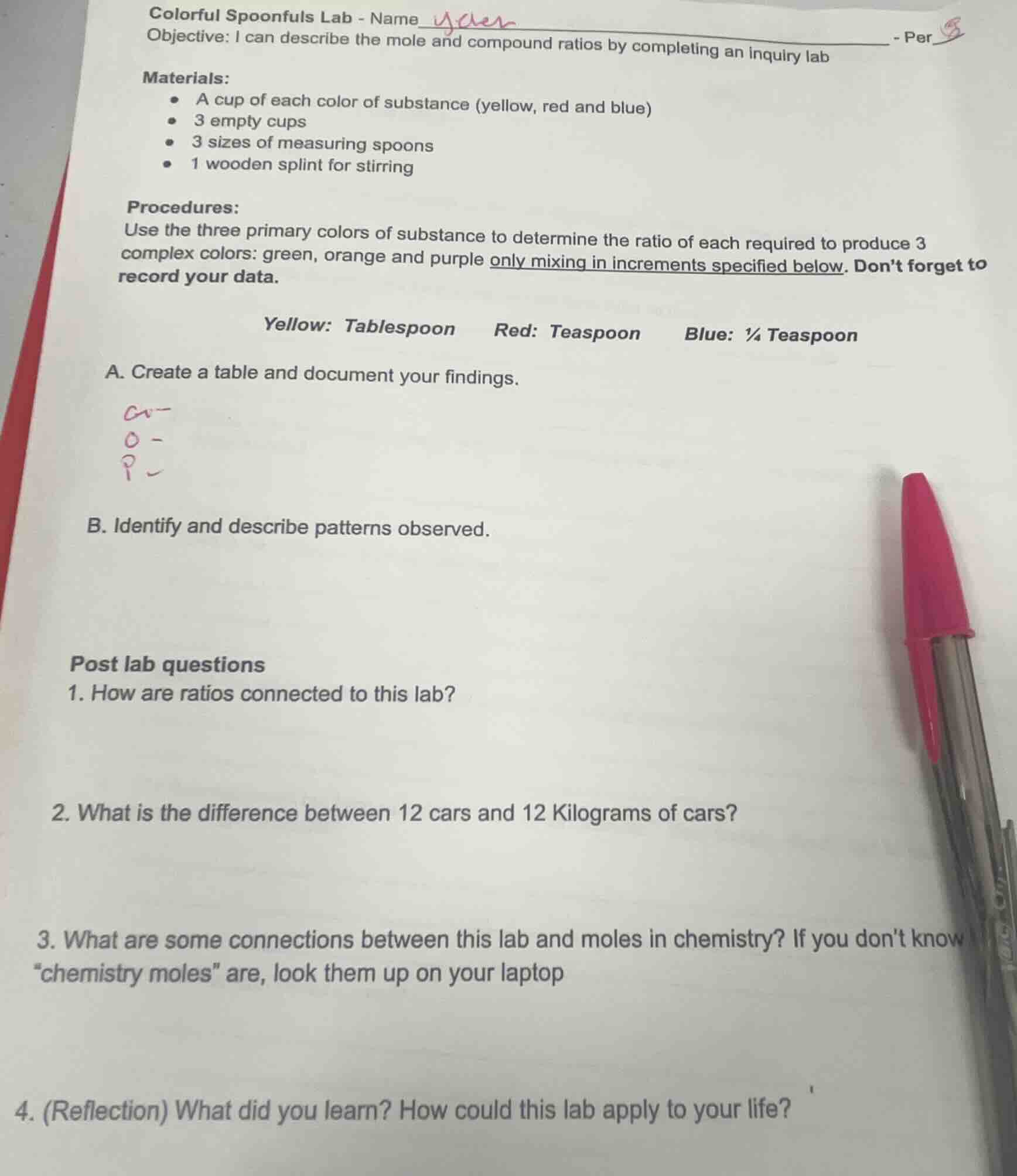
colorful spoonfuls lab - name ______ - per 3objective: i can describe the mole and compound ratios by completing an inquiry labmaterials:• a cup of each color of substance (yellow, red and blue)• 3 empty cups• 3 sizes of measuring spoons• 1 wooden splint for stirringprocedures:use the three primary colors of substance to determine the ratio of each required to produce 3complex colors: green, orange and purple only mixing in increments specified below. dont forget torecord your data.yellow: tablespoon red: teaspoon blue: ¼ teaspoona. create a table and document your findings.b. identify and describe patterns observed.post lab questions1. how are ratios connected to this lab?2. what is the difference between 12 cars and 12 kilograms of cars?3. what are some connections between this lab and moles in chemistry? if you dont know\chemistry moles\ are, look them up on your laptop4. (reflection) what did you learn? how could this lab apply to your life?
A. First, define the standard increments: 1 Tablespoon (yellow) = 3 Teaspoons, so yellow = 3 tsp, red = 1 tsp, blue = 0.25 tsp. The standard color mixing ratios are used to build the table:
- Green: Yellow + Blue, requires equal visual intensity, so scale blue to match yellow's volume.
- Orange: Yellow + Red, uses a 3:1 ratio of yellow to red.
- Purple: Red + Blue, scales blue to match red's volume.
B. The pattern is that to create consistent secondary colors, the volume of each primary substance must be adjusted to maintain a fixed proportional ratio, based on their assigned measurement increments.
- Ratios define the fixed proportional amounts of each primary substance needed to consistently produce the same secondary color, just like fixed ratios define compound compositions.
- 12 cars counts the number (quantity) of individual car objects, while 12 Kilograms of cars measures the total mass (weight) of a group of cars, which depends on the size/type of the cars.
- In chemistry, moles represent a fixed count of particles (atoms/molecules), and compounds require fixed mole ratios of elements to form, just like this lab requires fixed volume ratios of primary substances to form consistent secondary colors. The ratios ensure a consistent "composition" of the final product (color or compound).
- Learned that fixed proportional ratios are essential for consistent results in mixtures. This applies to daily life when baking (using fixed ingredient ratios for consistent food), mixing cleaning products, or even mixing paint for a consistent color.

Snap & solve any problem in the app
Get step-by-step solutions on Sovi AI
Photo-based solutions with guided steps
Explore more problems and detailed explanations
A.
| Secondary Color | Yellow (Tablespoon) | Red (Teaspoon) | Blue (¼ Teaspoon) | Simplified Ratio (Yellow:Red:Blue) |
|---|---|---|---|---|
| Orange | 1 | 1 | 0 | 3:1:0 |
| Purple | 0 | 1 | 4 | 0:4:1 |
B. Consistent secondary colors require fixed volume ratios of primary substances, scaled to their assigned measurement increments.
- Ratios dictate the fixed proportional amounts of each primary substance needed to create a consistent secondary color, mirroring how ratios define consistent mixtures or compounds.
- 12 cars is a count of individual objects (quantity), while 12 Kilograms of cars is a measurement of total mass (weight) of a collection of cars.
- Just as this lab uses fixed volume ratios of primary substances to make consistent secondary colors, chemistry uses fixed mole ratios of elements to make consistent compounds; moles and the lab's measurement increments both act as standardized units to define these fixed proportions.
- I learned that fixed proportional ratios are critical for reliable, consistent results when creating mixtures. This applies to daily tasks like baking (using precise ingredient ratios for consistent baked goods), mixing homemade cleaning solutions, or adjusting paint colors to match a desired shade.