QUESTION IMAGE
Question
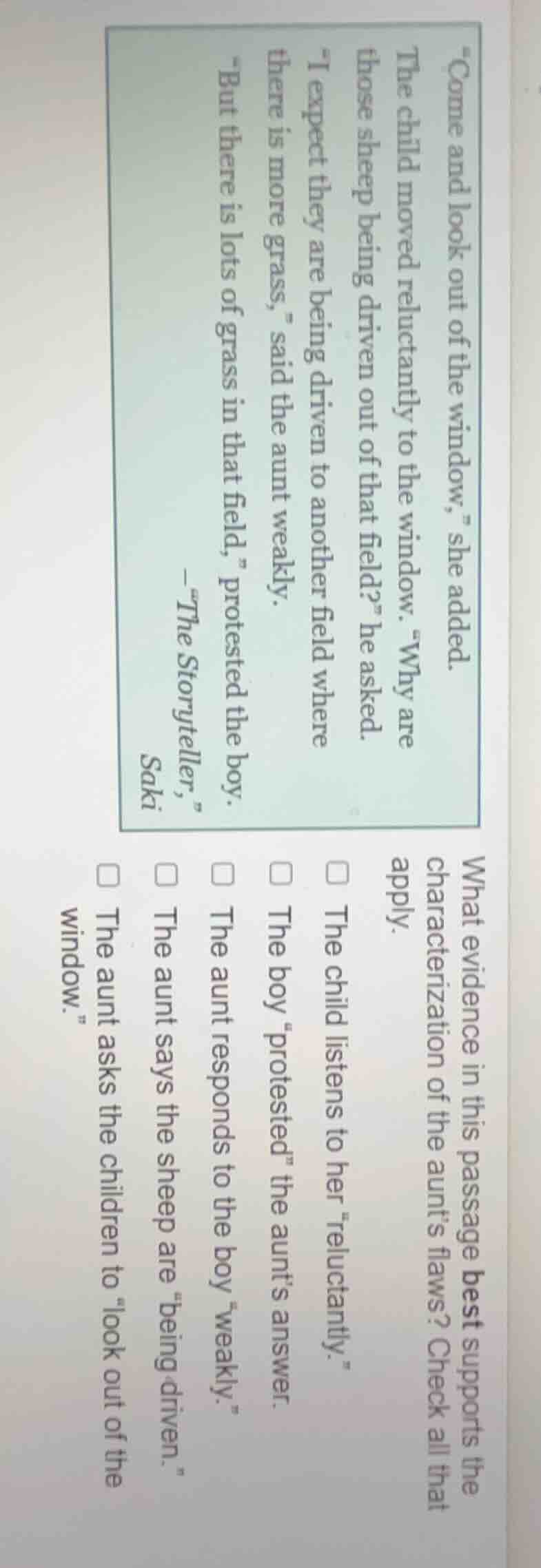
come and look out of the window, she added. the child moved reluctantly to the window. why are those sheep being driven out of that field? he asked. i expect they are being driven to another field where there is more grass, said the aunt weakly. but there is lots of grass in that field, protested the boy. —the storyteller, saki what evidence in this passage best supports the characterization of the aunts flaws? check all that apply. the child listens to her reluctantly. the boy protested the aunts answer. the aunt responds to the boy weakly. the aunt says the sheep are being driven. the aunt asks the children to look out of the window.
Para identificar la evidencia que respalda los defectos de la tía en su caracterización, analizamos cada opción:
- "The boy 'protested' the aunt’s answer": La protesta del niño sugiere que la respuesta de la tía no es convincente, mostrando su debilidad al argumentar.
- "The aunt responds to the boy 'weakly'": El adjetivo "weakly" (débilmente) describe su forma de responder, indicando su falta de convicción o capacidad para argumentar bien.
- "The aunt says the sheep are 'being driven'": Su explicación sobre la ovejas puede ser insuficiente o poco creíble, lo que refleja su debilidad en convencer.
Las otras opciones ("The child listens to her 'reluctantly'") se refiere a la actitud del niño, no a los defectos de la tía; y "The aunt asks the children to 'look out of the window'" es solo una petición, no una evidencia de sus defectos.

Snap & solve any problem in the app
Get step-by-step solutions on Sovi AI
Photo-based solutions with guided steps
Explore more problems and detailed explanations
- The boy "protested" the aunt’s answer.
- The aunt responds to the boy "weakly".
- The aunt says the sheep are "being driven".