QUESTION IMAGE
Question
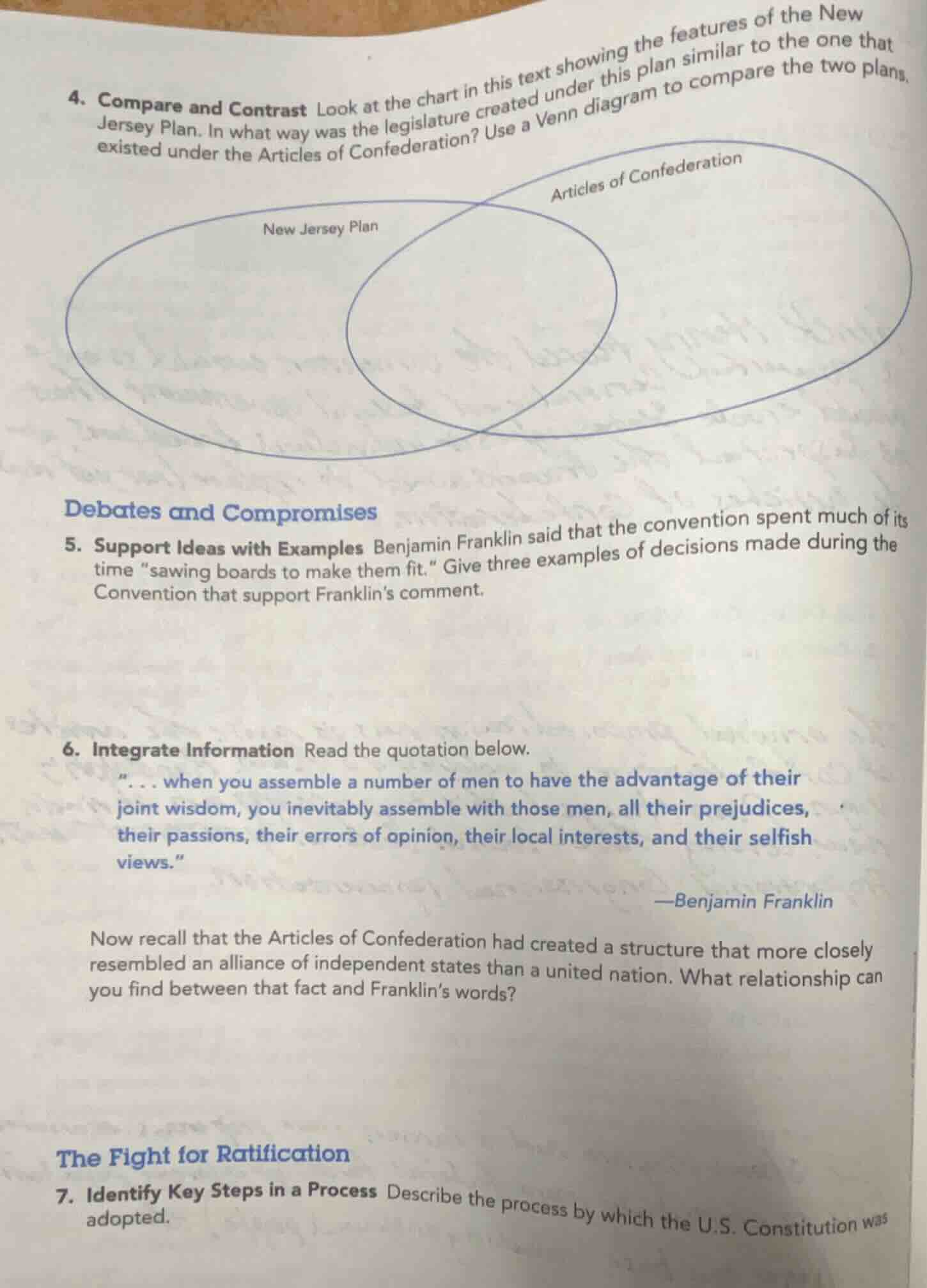
- compare and contrast look at the chart in this text showing the features of the new jersey plan. in what way was the legislature created under this plan similar to the one that existed under the articles of confederation? use a venn diagram to compare the two plans.
debates and compromises
- support ideas with examples benjamin franklin said that the convention spent much of its time \sawing boards to make them fit.\ give three examples of decisions made during the convention that support franklin’s comment.
- integrate information read the quotation below.
\... when you assemble a number of men to have the advantage of their joint wisdom, you inevitably assemble with those men, all their prejudices, their passions, their errors of opinion, their local interests, and their selfish views.\
—benjamin franklin
now recall that the articles of confederation had created a structure that more closely resembled an alliance of independent states than a united nation. what relationship can you find between that fact and franklin’s words?
the fight for ratification
- identify key steps in a process describe the process by which the u.s. constitution was adopted.
Question 4
- New Jersey Plan only: Proposed a unicameral legislature with equal representation for all states, regardless of population; gave Congress the power to tax and regulate commerce.
- Articles of Confederation only: Had a unicameral legislature where each state had one vote, but Congress lacked the power to tax or regulate interstate commerce; had a weak central government with no executive or judicial branch.
- Similarities (Overlap): Both featured a unicameral legislative body with equal representation for each state, ensuring small states had equal political power in the national legislature.
Question 5
Franklin's comment refers to the convention's need to compromise to reach agreement. Three examples:
- Great Compromise: Merged the Virginia Plan (bicameral legislature based on population) and New Jersey Plan (unicameral with equal state representation) to create a bicameral Congress: the House of Representatives (population-based) and the Senate (equal representation per state).
- Three-Fifths Compromise: Resolved disputes over counting enslaved people for representation and taxation by counting each enslaved person as three-fifths of a person.
- Commerce Compromise: Agreed that Congress could regulate interstate and foreign commerce, but could not tax exports, and the slave trade could not be banned for 20 years.
Question 6
The structure of the Articles of Confederation reflected Franklin's words directly. Under the Articles, each state prioritized its own local interests, prejudices, and selfish views over a unified national agenda. The weak central government had no power to enforce collective decisions, as state representatives prioritized their state's needs over joint national wisdom, leading to ineffective governance and the need for the Constitutional Convention.
Question 7
The adoption process of the U.S. Constitution:
- Drafting: The Constitutional Convention finalized the document on September 17, 1787.
- Ratification Campaign: The Constitution required ratification by 9 of 13 states. Federalists (supporters) and Anti-Federalists (opponents) debated the document; Federalists published the Federalist Papers to build support.
- State Ratification: Delaware became the first state to ratify in December 1787. New Hampshire became the 9th state to ratify in June 1788, meeting the requirement.
- Implementation: The new government began operations in March 1789, with George Washington sworn in as president. The Bill of Rights (first 10 amendments) was ratified in 1791 to address Anti-Federalist concerns.

Snap & solve any problem in the app
Get step-by-step solutions on Sovi AI
Photo-based solutions with guided steps
Explore more problems and detailed explanations
Question 4
- New Jersey Plan only: Unicameral legislature, Congress with tax/ commerce power
- Articles of Confederation only: No tax/ commerce power, no executive/judicial branch
- Overlap: Unicameral, equal state representation
Question 5
- Great Compromise (bicameral Congress structure)
- Three-Fifths Compromise (enslaved population counting)
- Commerce Compromise (trade regulation rules)
Question 6
The Articles' weak structure stemmed from state representatives prioritizing local/selfish interests over national unity, exactly as Franklin described: state leaders focused on their own priorities rather than joint national wisdom, leading to a dysfunctional national government.
Question 7
- Drafted at the 1787 Constitutional Convention
- Debated by Federalists and Anti-Federalists
- Ratified by 9 states (New Hampshire was the 9th in 1788)
- New government launched in 1789; Bill of Rights ratified in 1791