QUESTION IMAGE
Question
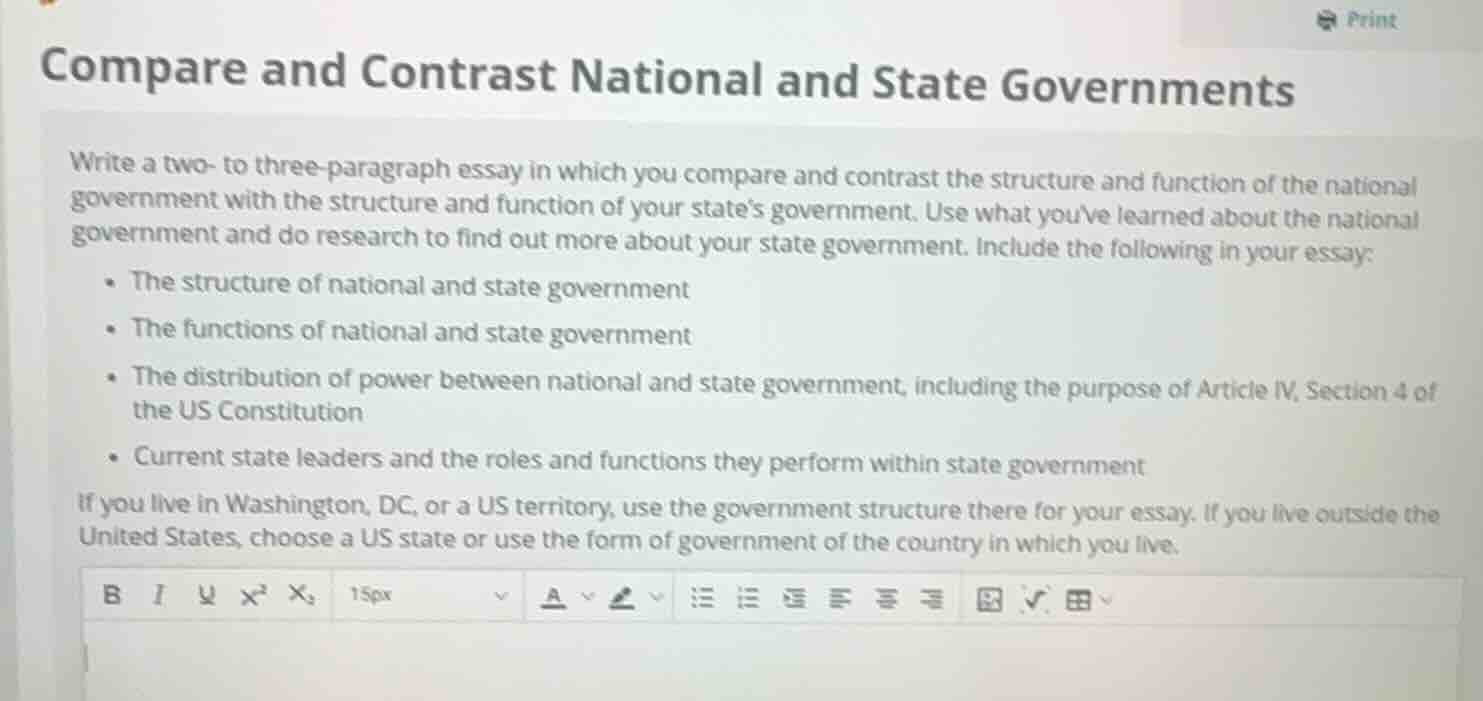
compare and contrast national and state governments
write a two- to three-paragraph essay in which you compare and contrast the structure and function of the national government with the structure and function of your state’s government. use what you’ve learned about the national government and do research to find out more about your state government. include the following in your essay:
- the structure of national and state government
- the functions of national and state government
- the distribution of power between national and state government, including the purpose of article iv, section 4 of the us constitution
- current state leaders and the roles and functions they perform within state government
if you live in washington, dc, or a us territory, use the government structure there for your essay. if you live outside the united states, choose a us state or use the form of government of the country in which you live.
This essay compares the U.S. national government and California state government, covering structure, functions, power distribution, and current state leadership.
- Structure: Both follow the separation of powers into executive, legislative, and judicial branches. The national government has a bicameral Congress (Senate, House of Representatives), a President as executive, and a Supreme Court as the top judicial body. California has a bicameral State Legislature (State Senate, State Assembly), a Governor as executive, and a California Supreme Court as the state's highest court.
- Functions: The national government handles federal-level matters like national defense, foreign policy, currency regulation, and interstate commerce. California's state government manages state-specific issues such as public K-12 and higher education, state transportation infrastructure, state law enforcement, and environmental regulations tailored to the state's needs.
- Power Distribution: Power is split via federalism. The Supremacy Clause establishes federal law as supreme, but states retain reserved powers under the 10th Amendment. Article IV, Section 4 of the U.S. Constitution mandates the national government guarantee every state a republican form of government, protecting states from authoritarian rule and ensuring they maintain a representative governing system.
- Current State Leaders: As of 2024, Gavin Newsom is California's Governor, responsible for executing state laws, proposing the state budget, and leading state executive agencies. The State Legislature is led by Senate President pro Tempore Toni Atkins and Assembly Speaker Robert Rivas, who oversee the drafting and passage of state legislation. The California Supreme Court is led by Chief Justice Patricia Guerrero, who presides over the court's rulings on state legal matters.

Snap & solve any problem in the app
Get step-by-step solutions on Sovi AI
Photo-based solutions with guided steps
Explore more problems and detailed explanations
Comparing and Contrasting U.S. National and California State Governments
The U.S. national government and California state government share a core structural foundation rooted in the separation of powers, but their scales and specific frameworks differ. Both operate with three coequal branches: executive, legislative, and judicial. At the national level, the legislative branch is the bicameral Congress, made up of the 100-member Senate (two per state) and 435-member House of Representatives (based on population), while the executive branch is led by the President, who serves as head of state and government, and the judicial branch is capped by the U.S. Supreme Court. California’s government mirrors this tripartite structure but is tailored to state needs: its legislative branch is the California State Legislature, with a 40-member State Senate and 80-member State Assembly; the executive branch is led by the Governor, and the state’s judicial system is headed by the California Supreme Court. This parallel structure ensures checks and balances in both levels of government, but the national government’s scope is national, while California’s is focused on state-specific governance.
The functions of the two governments divide along federal and state lines, defined by the U.S. Constitution. The national government handles powers explicitly granted to it, including national defense, foreign policy, regulating interstate and international commerce, printing currency, and establishing federal courts. These powers address issues that require a unified national approach. In contrast, California’s state government exercises reserved powers under the 10th Amendment, managing public education (from K-12 to the University of California system), state transportation infrastructure like highways and public transit, state law enforcement agencies such as the California Highway Patrol, and environmental regulations tailored to the state’s unique ecosystems, like wildfire management and coastal protection. Some functions, such as tax collection and law enforcement, are shared, but the national government collects federal income taxes for federal programs, while California collects state income and sales taxes for state services.
The distribution of power between the two levels is governed by federalism, with key constitutional safeguards. The Supremacy Clause in Article VI establishes that federal law takes precedence over state law when there is a conflict, but states retain significant autonomy over their internal affairs. A critical provision is Article IV, Section 4 of the U.S. Constitution, which requires the national government to guarantee every state a "republican form of government." This ensures no state can adopt a monarchical or authoritarian system, protecting the representative governance that underpins U.S. democracy. As of 2024, California’s top leaders embody these state functions: Governor Gavin Newsom oversees the execution of state laws, proposes the annual state budget, and leads state agencies addressing issues like housing affordability and climate action. The State Legislature, led by Senate President pro Tempore Toni Atkins and Assembly Speaker Robert Rivas, drafts and passes state legislation, while Chief Justice Patricia Guerrero leads the California Supreme Court, which interprets state law and resolves legal disputes specific to California. Together, these leaders carry out the state government’s core role of addressing the unique needs of California’s 39 million residents, while the national government focuses on broader national priorities.