QUESTION IMAGE
Question
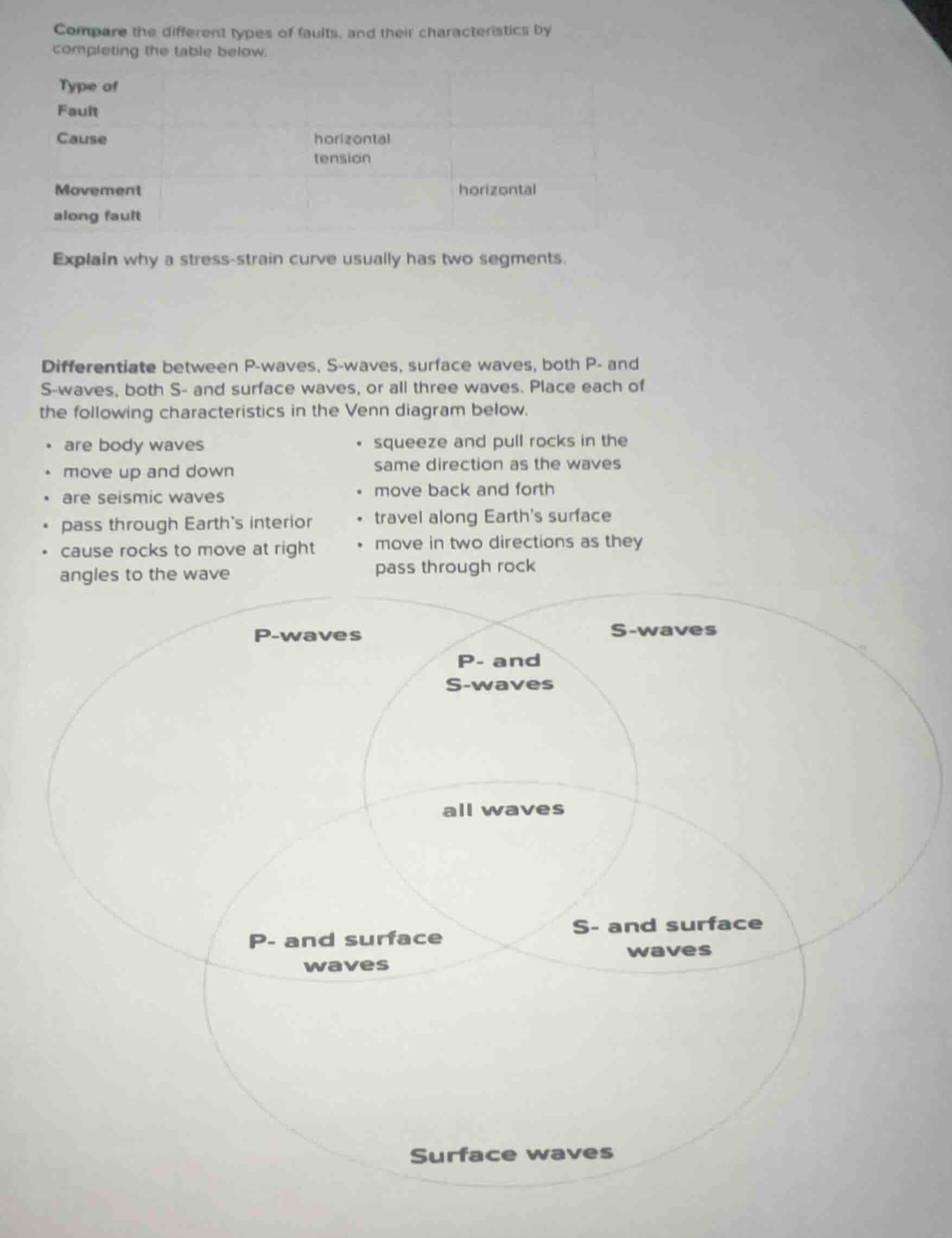
compare the different types of faults, and their characteristics by completing the table below.
type of
fault
cause \t horizontal
\t tension
movement
\t horizontal
along fault
explain why a stress - strain curve usually has two segments.
differentiate between p - waves, s - waves, surface waves, both p - and
s - waves, both s - and surface waves, or all three waves. place each of
the following characteristics in the venn diagram below.
- are body waves \t - squeeze and pull rocks in the
\t \t same direction as the waves
- move up and down \t - move back and forth
- are seismic waves \t - travel along earth’s surface
- pass through earth’s interior \t - move in two directions as they
- cause rocks to move at right \t pass through rock
angles to the wave
venn diagram with circles labeled p - waves, s - waves, p - and s - waves, all waves, p - and surface waves, s - and surface waves, surface waves
Part 1: Comparing Fault Types (Table Completion, assuming common fault types: Normal, Reverse, Strike - Slip)
Normal Fault
- Cause: Vertical tension (Note: The given "horizontal tension" might be a typo or for a different fault, but normal faults are caused by tensional forces that pull the crust apart vertically).
- Movement along fault: Vertical (hanging wall moves down relative to the footwall)
Reverse Fault
- Cause: Horizontal compression (compressive forces push the crust together horizontally)
- Movement along fault: Vertical (hanging wall moves up relative to the footwall)
Strike - Slip Fault
- Cause: Shear stress (forces that cause rocks to slide past each other horizontally)
- Movement along fault: Horizontal (rocks on either side of the fault move horizontally past each other, which matches the "horizontal" movement given in the table)
Part 2: Stress - Strain Curve Segments
A stress - strain curve has two main segments: the elastic region and the plastic (or inelastic) region. In the elastic segment, when stress is applied, the material (like rock or a structural material) deforms elastically. This means that if the stress is removed, the material will return to its original shape. The relationship between stress and strain in this region is often linear (obeying Hooke's law, $\sigma = E\epsilon$, where $\sigma$ is stress, $E$ is Young's modulus, and $\epsilon$ is strain). In the plastic segment, the material undergoes permanent deformation. Once the stress exceeds the yield strength (the stress at which the elastic limit is reached), the material deforms plastically, and even if the stress is removed, it will not return to its original shape. This permanent deformation occurs due to the rearrangement of the internal structure of the material (e.g., in rocks, it could be due to the movement of mineral grains or the development of micro - fractures).

Snap & solve any problem in the app
Get step-by-step solutions on Sovi AI
Photo-based solutions with guided steps
Explore more problems and detailed explanations
A stress - strain curve has two segments: the elastic segment (where deformation is reversible, stress - strain is often linear) and the plastic segment (where deformation is permanent, occurring after the yield strength is exceeded).
Part 3: Venn Diagram for Seismic Waves
P - waves (Primary waves)
- Unique to P - waves: "squeeze and pull rocks in the same direction as the waves" (compressive, longitudinal motion)
- In P - and S - waves (body waves): "are body waves", "pass through Earth's interior", "are seismic waves"
- In all waves: "are seismic waves"
S - waves (Secondary waves)
- Unique to S - waves: "cause rocks to move at right angles to the wave" (shear, transverse motion), "move up and down" (a type of transverse motion)
- In P - and S - waves (body waves): "are body waves", "pass through Earth's interior", "are seismic waves"
- In all waves: "are seismic waves"
Surface waves
- Unique to Surface waves: "travel along Earth's surface", "move in two directions as they pass through rock" (a combination of transverse and longitudinal motion along the surface)
- In S - and surface waves: "move up and down" (surface waves can have vertical motion similar to S - waves' transverse motion)
- In all waves: "are seismic waves"
All waves (P, S, Surface)
- "are seismic waves" (all are types of seismic waves generated by earthquakes)
P - and surface waves
- No unique characteristics here (P - waves are body waves, surface waves are surface - based, so the only commonality is being seismic waves, which is in the "all waves" section)
S - and surface waves
- "move up and down" (S - waves have transverse (up - down) motion, surface waves can also have vertical (up - down) motion as part of their complex motion)
Filling the Venn Diagram (Summary of Placement)
- P - waves only: "squeeze and pull rocks in the same direction as the waves"
- S - waves only: "cause rocks to move at right angles to the wave", "move up and down" (the "move up and down" can also be in S - and surface waves)
- Surface waves only: "travel along Earth's surface", "move in two directions as they pass through rock"
- P - and S - waves (body waves) only: "are body waves", "pass through Earth's interior"
- All waves: "are seismic waves"
- S - and surface waves: "move up and down" (shared between S - waves and surface waves)