QUESTION IMAGE
Question
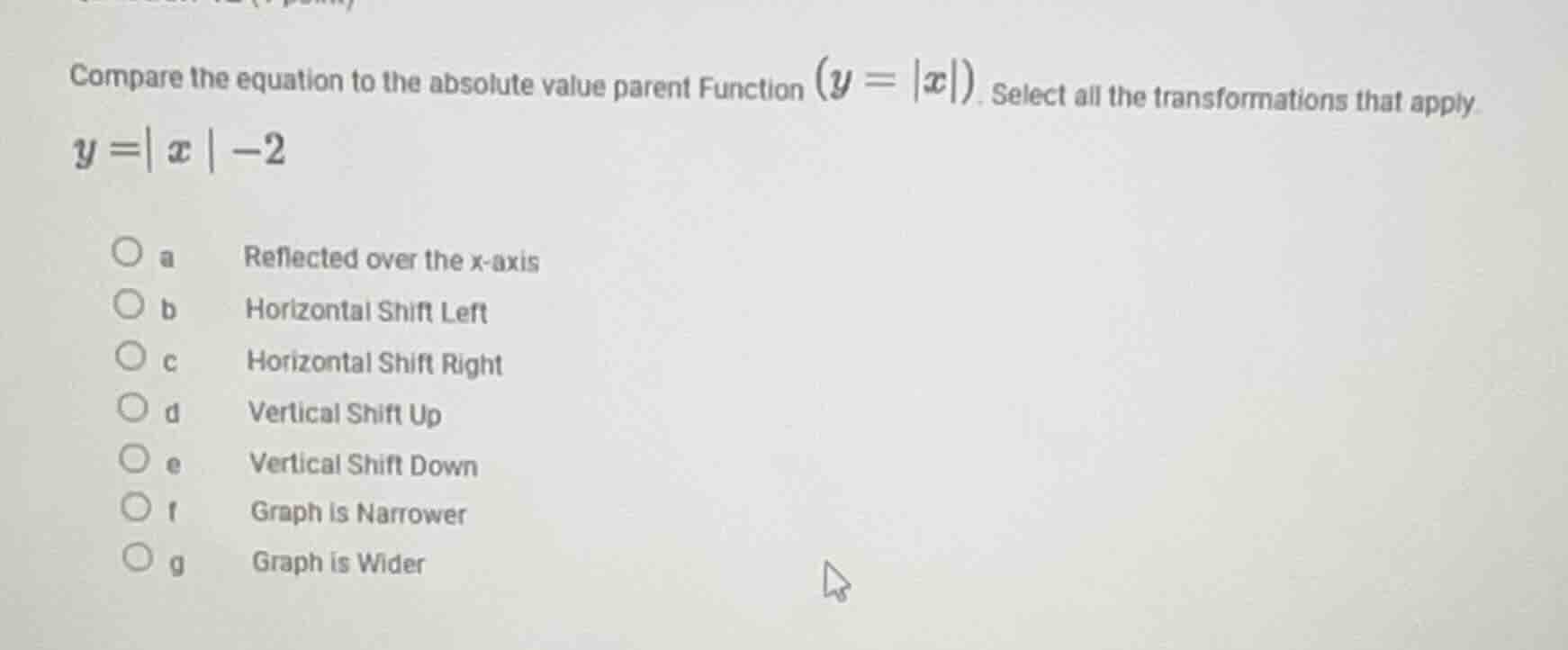
compare the equation to the absolute value parent function ($y = |x|$). select all the transformations that apply. $y = |x| - 2$
a reflected over the x - axis
b horizontal shift left
c horizontal shift right
d vertical shift up
e vertical shift down
f graph is narrower
g graph is wider
Step1: Recall transformation rules
For a function \( y = |x| + k \) (or \( y = |x| - k \) where \( k>0 \)), the transformation is vertical. If \( k>0 \), \( y = |x| + k \) is a vertical shift up by \( k \) units; if \( k>0 \), \( y = |x| - k \) is a vertical shift down by \( k \) units. Also, reflection over x - axis would be \( y=-|x| \), horizontal shift left is \( y = |x + h| \) (\( h>0 \)), horizontal shift right is \( y=|x - h| \) (\( h>0 \)), and for vertical stretch/compression (narrower/wider), the form is \( y = a|x| \) where \( |a|>1 \) is narrower and \( 0<|a|<1 \) is wider.
Step2: Analyze \( y = |x|-2 \)
- For option a: The function is \( y = |x|-2 \), not \( y=-|x| \), so no reflection over x - axis.
- For option b: There is no \( x + h \) form (h>0) in \( |x| \), so no horizontal shift left.
- For option c: There is no \( x - h \) form (h>0) in \( |x| \), so no horizontal shift right.
- For option d: The function is \( y = |x|-2 \), which is not a shift up (shift up would be \( y = |x|+2 \)).
- For option e: Since the function is \( y = |x|-2 \), comparing to \( y = |x| \), we subtract 2 from the output of \( |x| \), so it is a vertical shift down by 2 units.
- For option f: The coefficient of \( |x| \) is 1, so it is not narrower (narrower would require \( |a|>1 \)).
- For option g: The coefficient of \( |x| \) is 1, so it is not wider (wider would require \( 0<|a|<1 \)).

Snap & solve any problem in the app
Get step-by-step solutions on Sovi AI
Photo-based solutions with guided steps
Explore more problems and detailed explanations
e. Vertical Shift Down