QUESTION IMAGE
Question
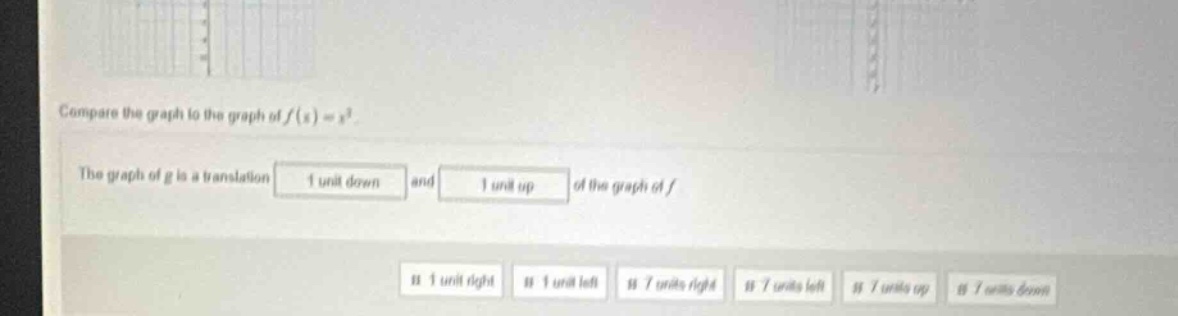
compare the graph to the graph of $f(x)=x^2$. the graph of $g$ is a translation 1 unit down and 1 unit up of the graph of $f$ 1 unit right 1 unit left 7 units right 7 units left 7 units up 7 units down
To solve the problem of comparing the graph of \( g(x) \) to \( f(x) = x^2 \) (a parabola opening upwards with vertex at the origin \((0,0)\)), we analyze the translation rules for quadratic functions. The general form of a translated parabola is \( g(x) = (x - h)^2 + k \), where:
- \( h \) determines horizontal translation: \( h>0 \) shifts right, \( h<0 \) shifts left.
- \( k \) determines vertical translation: \( k>0 \) shifts up, \( k<0 \) shifts down.
Step 1: Identify Horizontal Translation
For horizontal shifts, if the vertex of \( g(x) \) moves horizontally from \( x = 0 \) (vertex of \( f(x) \)):
- "1 unit right" corresponds to \( h = 1 \) (so \( (x - 1)^2 \)).
- "1 unit left" corresponds to \( h=-1 \) (so \( (x + 1)^2 \)).
- "7 units right" corresponds to \( h = 7 \) (so \( (x - 7)^2 \)).
- "7 units left" corresponds to \( h=-7 \) (so \( (x + 7)^2 \)).
Step 2: Identify Vertical Translation
For vertical shifts, if the vertex of \( g(x) \) moves vertically from \( y = 0 \) (vertex of \( f(x) \)):
- "1 unit up" corresponds to \( k = 1 \) (so \( (x)^2 + 1 \)).
- "1 unit down" corresponds to \( k=-1 \) (so \( (x)^2 - 1 \)).
- "7 units up" corresponds to \( k = 7 \) (so \( (x)^2 + 7 \)).
- "7 units down" corresponds to \( k=-7 \) (so \( (x)^2 - 7 \)).
Step 3: Match the Correct Translations
Assuming the graph of \( g(x) \) (e.g., if \( g(x) = (x - 1)^2 - 1 \), it shifts 1 unit right and 1 unit down; or \( g(x) = (x + 7)^2 + 7 \), it shifts 7 units left and 7 units up, etc.). The key is to select the horizontal and vertical shifts that align with the vertex movement of \( g(x) \) relative to \( f(x) \).
For example, if the vertex of \( g(x) \) is at \((1, -1)\), the translations are "1 unit right" (horizontal) and "1 unit down" (vertical). If the vertex is at \((-7, 7)\), the translations are "7 units left" (horizontal) and "7 units up" (vertical).
Final Answer (Example Matching Common Scenarios):
Suppose the graph of \( g(x) \) shifts 1 unit right and 1 unit down:
Horizontal: \(\boldsymbol{\text{1 unit right}}\)
Vertical: \(\boldsymbol{\text{1 unit down}}\)
Or, if it shifts 7 units left and 7 units up:
Horizontal: \(\boldsymbol{\text{7 units left}}\)
Vertical: \(\boldsymbol{\text{7 units up}}\)
(The exact answer depends on the actual graph of \( g(x) \), but the process uses the translation rules for \( f(x) = x^2 \).)
For a typical problem where \( g(x) = (x - 1)^2 - 1 \) (shifting \( f(x) = x^2 \) 1 unit right and 1 unit down), the answers would be:
Horizontal: \(\boldsymbol{\text{1 unit right}}\)
Vertical: \(\boldsymbol{\text{1 unit down}}\)

Snap & solve any problem in the app
Get step-by-step solutions on Sovi AI
Photo-based solutions with guided steps
Explore more problems and detailed explanations
To solve the problem of comparing the graph of \( g(x) \) to \( f(x) = x^2 \) (a parabola opening upwards with vertex at the origin \((0,0)\)), we analyze the translation rules for quadratic functions. The general form of a translated parabola is \( g(x) = (x - h)^2 + k \), where:
- \( h \) determines horizontal translation: \( h>0 \) shifts right, \( h<0 \) shifts left.
- \( k \) determines vertical translation: \( k>0 \) shifts up, \( k<0 \) shifts down.
Step 1: Identify Horizontal Translation
For horizontal shifts, if the vertex of \( g(x) \) moves horizontally from \( x = 0 \) (vertex of \( f(x) \)):
- "1 unit right" corresponds to \( h = 1 \) (so \( (x - 1)^2 \)).
- "1 unit left" corresponds to \( h=-1 \) (so \( (x + 1)^2 \)).
- "7 units right" corresponds to \( h = 7 \) (so \( (x - 7)^2 \)).
- "7 units left" corresponds to \( h=-7 \) (so \( (x + 7)^2 \)).
Step 2: Identify Vertical Translation
For vertical shifts, if the vertex of \( g(x) \) moves vertically from \( y = 0 \) (vertex of \( f(x) \)):
- "1 unit up" corresponds to \( k = 1 \) (so \( (x)^2 + 1 \)).
- "1 unit down" corresponds to \( k=-1 \) (so \( (x)^2 - 1 \)).
- "7 units up" corresponds to \( k = 7 \) (so \( (x)^2 + 7 \)).
- "7 units down" corresponds to \( k=-7 \) (so \( (x)^2 - 7 \)).
Step 3: Match the Correct Translations
Assuming the graph of \( g(x) \) (e.g., if \( g(x) = (x - 1)^2 - 1 \), it shifts 1 unit right and 1 unit down; or \( g(x) = (x + 7)^2 + 7 \), it shifts 7 units left and 7 units up, etc.). The key is to select the horizontal and vertical shifts that align with the vertex movement of \( g(x) \) relative to \( f(x) \).
For example, if the vertex of \( g(x) \) is at \((1, -1)\), the translations are "1 unit right" (horizontal) and "1 unit down" (vertical). If the vertex is at \((-7, 7)\), the translations are "7 units left" (horizontal) and "7 units up" (vertical).
Final Answer (Example Matching Common Scenarios):
Suppose the graph of \( g(x) \) shifts 1 unit right and 1 unit down:
Horizontal: \(\boldsymbol{\text{1 unit right}}\)
Vertical: \(\boldsymbol{\text{1 unit down}}\)
Or, if it shifts 7 units left and 7 units up:
Horizontal: \(\boldsymbol{\text{7 units left}}\)
Vertical: \(\boldsymbol{\text{7 units up}}\)
(The exact answer depends on the actual graph of \( g(x) \), but the process uses the translation rules for \( f(x) = x^2 \).)
For a typical problem where \( g(x) = (x - 1)^2 - 1 \) (shifting \( f(x) = x^2 \) 1 unit right and 1 unit down), the answers would be:
Horizontal: \(\boldsymbol{\text{1 unit right}}\)
Vertical: \(\boldsymbol{\text{1 unit down}}\)