QUESTION IMAGE
Question
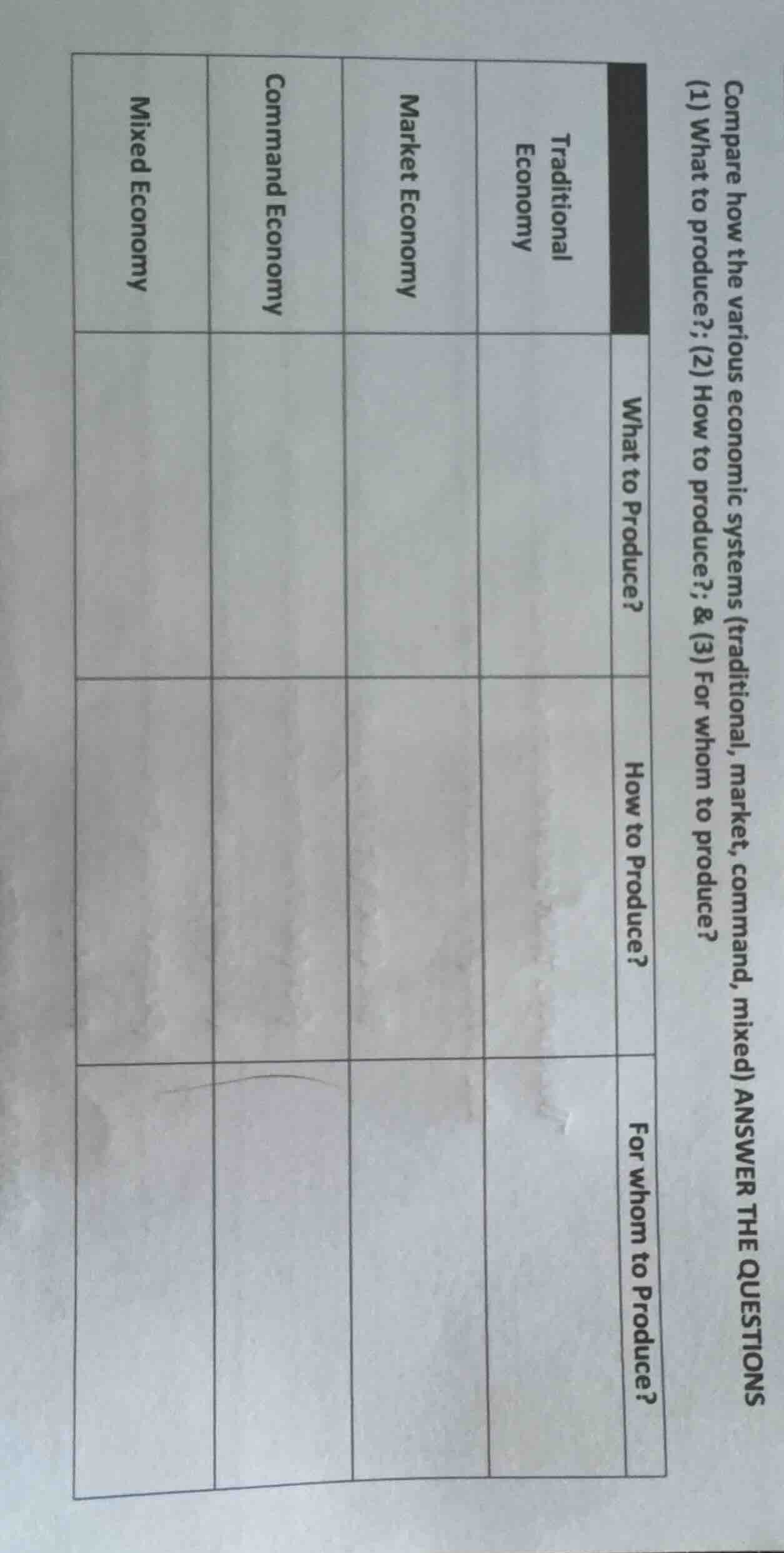
compare how the various economic systems (traditional, market, command, mixed) answer the questions (1) what to produce?; (2) how to produce?; & (3) for whom to produce?
| traditional economy | market economy | command economy | mixed economy | |
|---|---|---|---|---|
| how to produce? | ||||
| for whom to produce? |
Response
To solve this, we analyze each economic system across the three questions:
1. Traditional Economy
- What to Produce? Based on customs, traditions, and the needs of the community (e.g., food, tools for survival).
- How to Produce? Using traditional methods (e.g., manual labor, age - old techniques passed down).
- For Whom to Produce? For the community members, distributed based on social roles (e.g., family, tribe).
2. Market Economy
- What to Produce? Determined by consumer demand and profit motive (firms produce what people are willing to buy).
- How to Produce? Firms choose the most efficient (least - cost) methods to maximize profits (e.g., technology, division of labor).
- For Whom to Produce? For those who can afford to buy goods/services (based on income and price).
3. Command Economy
- What to Produce? Decided by the government (central planning) to meet societal goals (e.g., infrastructure, public goods).
- How to Produce? Government dictates production methods (e.g., state - owned factories, resource allocation).
- For Whom to Produce? Distributed by the government, often based on need (e.g., rationing, social equity).
4. Mixed Economy
- What to Produce? A mix of consumer demand (market) and government priorities (e.g., private goods and public services).
- How to Produce? Firms use market - driven efficiency, with government regulations (e.g., safety standards).
- For Whom to Produce? For consumers (market - based) and those in need (government - funded programs like welfare).
Filling the Table (Summary)
| Economic System | What to Produce? | How to Produce? | For Whom to Produce? |
|---|---|---|---|
| Market Economy | Based on consumer demand/profit (goods people want to buy). | Efficient methods (technology, division of labor) to maximize profit. | Those who can afford (income/price - based). |
| Command Economy | Government - planned (to meet societal goals: infrastructure, public goods). | Government - dictated methods (state - owned factories, resource allocation). | Government - distributed, often based on need (rationing, social equity). |
| Mixed Economy | Mix of consumer demand (market) and government priorities (public services). | Market - efficient methods + government regulations (safety, labor laws). | Consumers (market - based) + those in need (government programs: welfare, healthcare). |
This table compares the four economic systems across the three fundamental economic questions.

Snap & solve any problem in the app
Get step-by-step solutions on Sovi AI
Photo-based solutions with guided steps
Explore more problems and detailed explanations
To solve this, we analyze each economic system across the three questions:
1. Traditional Economy
- What to Produce? Based on customs, traditions, and the needs of the community (e.g., food, tools for survival).
- How to Produce? Using traditional methods (e.g., manual labor, age - old techniques passed down).
- For Whom to Produce? For the community members, distributed based on social roles (e.g., family, tribe).
2. Market Economy
- What to Produce? Determined by consumer demand and profit motive (firms produce what people are willing to buy).
- How to Produce? Firms choose the most efficient (least - cost) methods to maximize profits (e.g., technology, division of labor).
- For Whom to Produce? For those who can afford to buy goods/services (based on income and price).
3. Command Economy
- What to Produce? Decided by the government (central planning) to meet societal goals (e.g., infrastructure, public goods).
- How to Produce? Government dictates production methods (e.g., state - owned factories, resource allocation).
- For Whom to Produce? Distributed by the government, often based on need (e.g., rationing, social equity).
4. Mixed Economy
- What to Produce? A mix of consumer demand (market) and government priorities (e.g., private goods and public services).
- How to Produce? Firms use market - driven efficiency, with government regulations (e.g., safety standards).
- For Whom to Produce? For consumers (market - based) and those in need (government - funded programs like welfare).
Filling the Table (Summary)
| Economic System | What to Produce? | How to Produce? | For Whom to Produce? |
|---|---|---|---|
| Market Economy | Based on consumer demand/profit (goods people want to buy). | Efficient methods (technology, division of labor) to maximize profit. | Those who can afford (income/price - based). |
| Command Economy | Government - planned (to meet societal goals: infrastructure, public goods). | Government - dictated methods (state - owned factories, resource allocation). | Government - distributed, often based on need (rationing, social equity). |
| Mixed Economy | Mix of consumer demand (market) and government priorities (public services). | Market - efficient methods + government regulations (safety, labor laws). | Consumers (market - based) + those in need (government programs: welfare, healthcare). |
This table compares the four economic systems across the three fundamental economic questions.