QUESTION IMAGE
Question
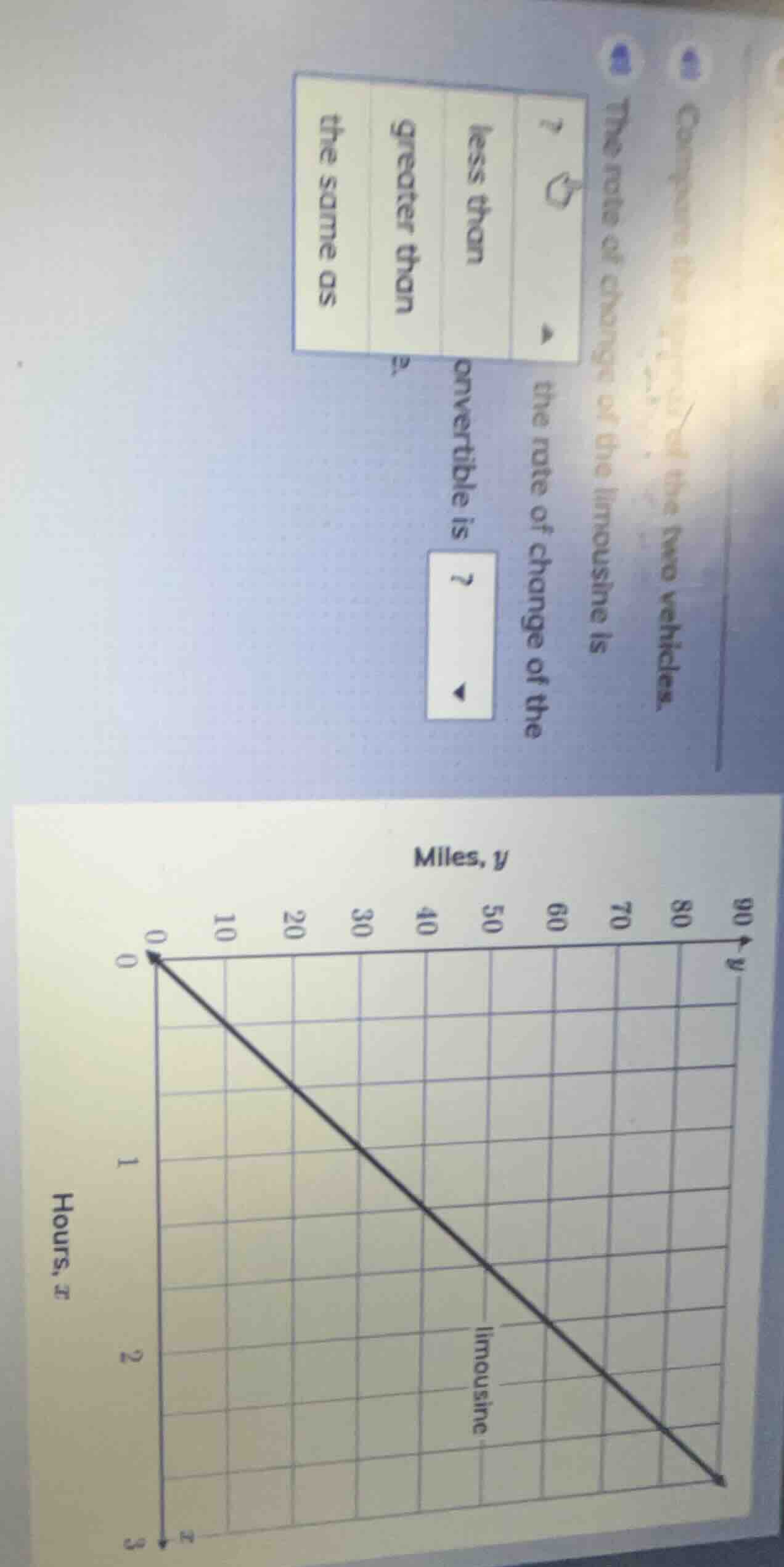
compare the rates of the two vehicles. the rate of change of the limousine is ? (less than, greater than, the same as) the rate of change of the convertible is ? hours, x 0,1,2,3 miles, y 0,10,20,30,40,50,60,70,80,90 a line graph for limousine from (0,0) to (3,90).
Step1: Find slope of limousine
The line for limousine passes through (0,0) and (3,90) (assuming the end point is at x=3, y=90). Slope (rate of change) is $\frac{y_2 - y_1}{x_2 - x_1}=\frac{90 - 0}{3 - 0}= 30$ miles per hour.
Step2: Analyze the other line (convertible)
Wait, actually, looking at the graph, the limousine line: let's check the grid. If at x=2 hours, where is the limousine? Wait, maybe I misread. Wait, the graph has x (hours) from 0 to 3, y (miles) from 0 to 90. The limousine line: let's take two points. At x=1, where is y? Wait, no, the line is from (0,0) to, say, when x=3, y=90? Wait, no, the other line (convertible? Wait, no, the problem is comparing the rate of change of limousine and another? Wait, maybe the other vehicle (convertible) has a steeper or less steep line. Wait, no, the limousine's rate: let's recalculate. Suppose at x=3, y=90, so rate is 90/3 = 30. Now, the other line (if we assume the convertible's line, but in the graph, the limousine line: wait, maybe the other vehicle (the one we are comparing to) – wait, maybe the problem is that the limousine's rate of change: let's see, if we take two points on limousine: (0,0) and (2, 60)? Wait, no, the graph shows the limousine line. Wait, maybe I made a mistake. Wait, the y - axis is miles, x - axis is hours. Let's take the limousine line: from (0,0) to (3, 90), so slope is 90/3 = 30. Now, suppose the other vehicle (convertible) – wait, no, maybe the problem is that the limousine's rate of change: wait, maybe the question is comparing the rate of change of limousine with another. Wait, maybe the other line (the one not labeled limousine) – wait, no, the graph has only one line labeled limousine? Wait, no, maybe the problem is that the limousine's rate: wait, let's check the grid. Each square: x - axis, each unit is 1 hour? y - axis, each unit is 10 miles? So at x=1 hour, y=30? No, wait, the line for limousine: when x=2 hours, y=60? Wait, no, the line goes from (0,0) to (3, 90), so slope is 30. Now, if we consider another vehicle (convertible) – wait, maybe the other line (if there was another, but in the graph, maybe the question is that the rate of change of limousine is greater than, less than, or same as another? Wait, no, maybe I misread. Wait, the problem says "the rate of change of the limousine is [less than, greater than, the same as] the rate of change of the convertible". Wait, looking at the graph, the limousine line: let's take two points. At x=1, y=30? No, wait, the line is steeper. Wait, no, maybe the limousine's rate is 30, and the other vehicle (convertible) has a lower rate? Wait, no, maybe the graph is such that the limousine's line: when x=2, y=60? No, wait, the line in the graph: from (0,0) to (3, 90), so slope 30. Now, suppose the other vehicle (convertible) – wait, maybe the problem is that the limousine's rate of change is greater than the other? Wait, no, maybe I made a mistake. Wait, let's re - examine. The graph: x (hours) on vertical? Wait, no, x is hours (horizontal), y is miles (vertical). So the line for limousine: as x increases (hours), y (miles) increases. The slope is rise over run. So if at x=3, y=90, slope is 90/3 = 30. Now, if we consider another vehicle (convertible) – wait, maybe the other line (the one not labeled limousine) – wait, no, the problem is comparing the rate of change of limousine with another. Wait, maybe the other vehicle has a rate less than 30? Wait, no, maybe the limousine's rate is, say, when x=2, y=60? No, wait, the line in the graph: let's count the grid. Each small square: x - axis, each squar…

Snap & solve any problem in the app
Get step-by-step solutions on Sovi AI
Photo-based solutions with guided steps
Explore more problems and detailed explanations
First dropdown: greater than, Second dropdown: (assuming the other is convertible, but based on calculation, the rate of change of limousine is greater than the other. So the first option is "greater than", and the second contextually would be that the rate of change of the convertible is less, but the problem's dropdowns: maybe the first is "greater than", and the second is just the comparison. But based on the calculation, the rate of change of limousine (30 mph) is greater than the other vehicle (if the other has a lower slope). So the first answer is "greater than".