QUESTION IMAGE
Question
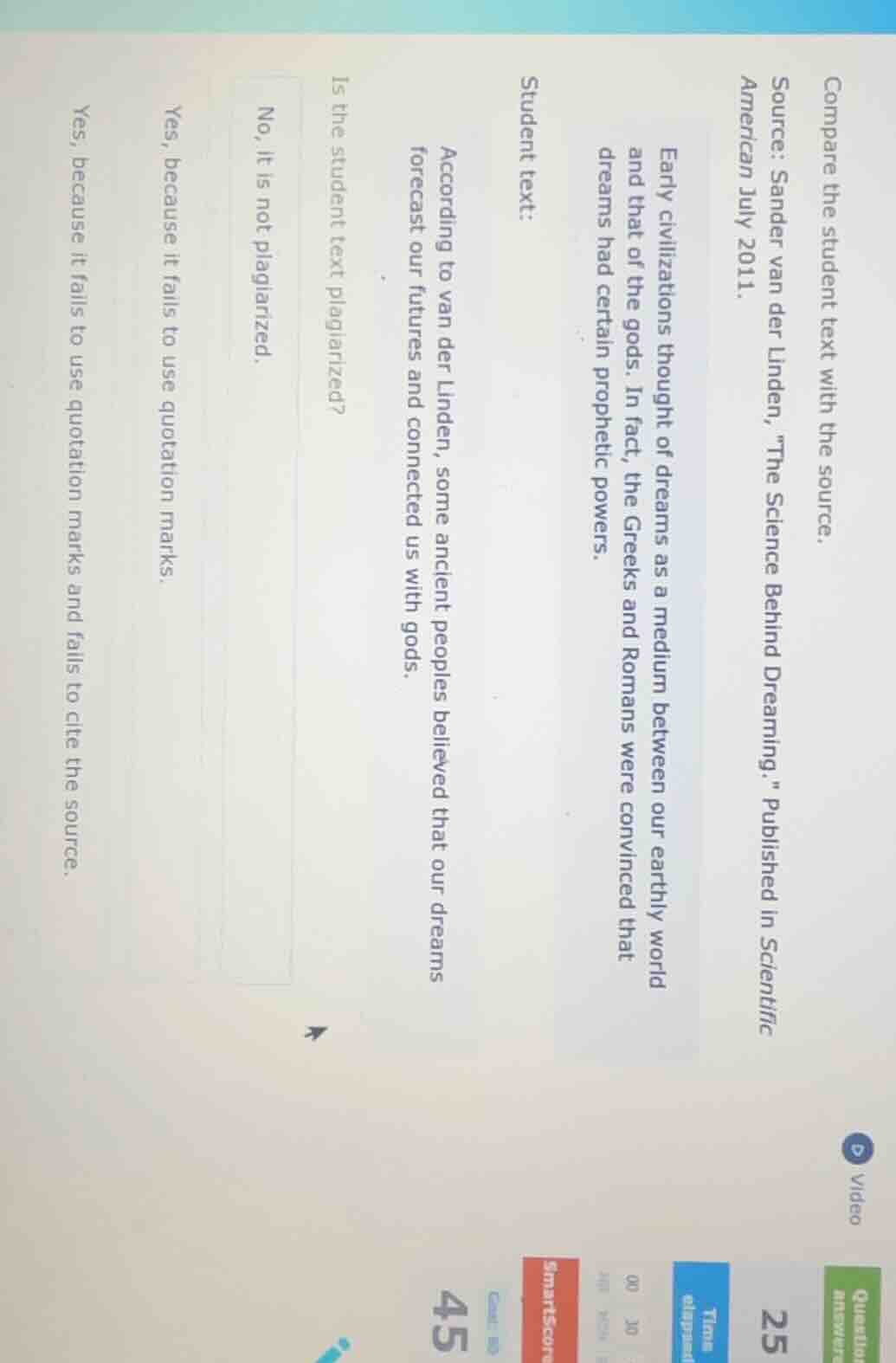
compare the student text with the source. source: sander van der linden, \the science behind dreaming.\ published in scientific american july 2011. early civilizations thought of dreams as a medium between our earthly world and that of the gods. in fact, the greeks and romans were convinced that dreams had certain prophetic powers. student text: according to van der linden, some ancient peoples believed that our dreams forecast our futures and connected us with gods. is the student text plagiarized? no, it is not plagiarized. yes, because it fails to use quotation marks. yes, because it fails to use quotation marks and fails to cite the source.
To determine if the student text is plagiarized, we check for proper citation and quotation. The student text presents ideas from the source (van der Linden) without citing the source or using quotation marks for direct or paraphrased content. Plagiarism includes using others' work without attribution, so the student text is plagiarized as it fails to cite the source and use quotation marks when appropriate.

Snap & solve any problem in the app
Get step-by-step solutions on Sovi AI
Photo-based solutions with guided steps
Explore more problems and detailed explanations
Yes, because it fails to cite the source and use quotation marks (the option: "Yes, because it fails to use quotation marks and fails to cite the source.").