QUESTION IMAGE
Question
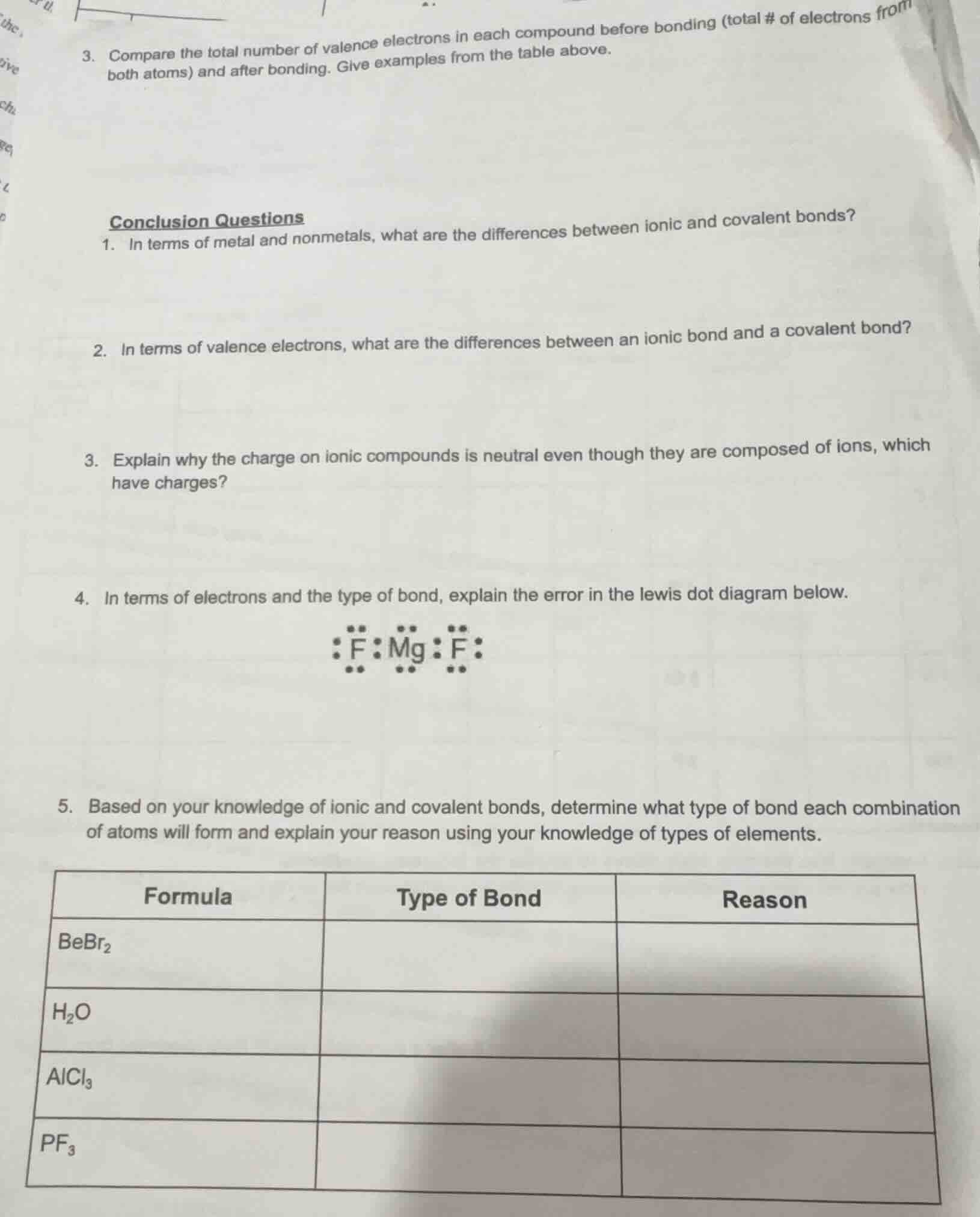
- compare the total number of valence electrons in each compound before bonding (total # of electrons from both atoms) and after bonding. give examples from the table above.
conclusion questions
- in terms of metal and nonmetals, what are the differences between ionic and covalent bonds?
- in terms of valence electrons, what are the differences between an ionic bond and a covalent bond?
- explain why the charge on ionic compounds is neutral even though they are composed of ions, which have charges?
- in terms of electrons and the type of bond, explain the error in the lewis dot diagram below.
:f:mg:f:
- based on your knowledge of ionic and covalent bonds, determine what type of bond each combination of atoms will form and explain your reason using your knowledge of types of elements.
| formula | type of bond | reason |
|---|---|---|
| h₂o | ||
| alcl₃ | ||
| pf₃ |
Brief Explanations
- Question 1: Ionic bonds form between metals and nonmetals, while covalent bonds form between nonmetals (or metalloids and nonmetals).
- Question 2: Ionic bonds involve transfer of valence electrons from metal to nonmetal; covalent bonds involve sharing of valence electrons between atoms.
- Question 3: Ionic compounds contain positively charged cations and negatively charged anions. The total positive charge equals the total negative charge, canceling out to give a neutral overall charge.
- Question 4: Mg is a metal, F is a nonmetal, so they form an ionic bond, not a covalent shared-electron bond as shown. Mg loses 2 valence electrons to form $\text{Mg}^{2+}$, and each F gains 1 electron to form $\text{F}^-$; the diagram incorrectly shows shared electrons instead of ionic charge separation.
- Question 5:
- $\text{BeBr}_2$: Beryllium is a metal, bromine is a nonmetal, so they form an ionic bond.
- $\text{H}_2\text{O}$: Hydrogen and oxygen are both nonmetals, so they form covalent bonds.
- $\text{AlCl}_3$: Aluminum is a metal, chlorine is a nonmetal, so they form an ionic bond.
- $\text{PF}_3$: Phosphorus and fluorine are both nonmetals, so they form covalent bonds.

Snap & solve any problem in the app
Get step-by-step solutions on Sovi AI
Photo-based solutions with guided steps
Explore more problems and detailed explanations
- Ionic bonds form between metals and nonmetals; covalent bonds form between nonmetals (or metalloids and nonmetals).
- Ionic bonds transfer valence electrons; covalent bonds share valence electrons.
- The total positive charge of cations equals the total negative charge of anions, canceling to yield a neutral compound.
- Mg and F form an ionic bond (not covalent as shown). Mg loses 2 electrons to become $\text{Mg}^{2+}$, each F gains 1 electron to become $\text{F}^-$; the diagram incorrectly shows shared electrons instead of ionic charge separation.
5.
| Formula | Type of Bond | Reason |
|---|---|---|
| $\text{H}_2\text{O}$ | Covalent Bond | H (nonmetal) + O (nonmetal) |
| $\text{AlCl}_3$ | Ionic Bond | Al (metal) + Cl (nonmetal) |
| $\text{PF}_3$ | Covalent Bond | P (nonmetal) + F (nonmetal) |