QUESTION IMAGE
Question
comparing quadratic functions
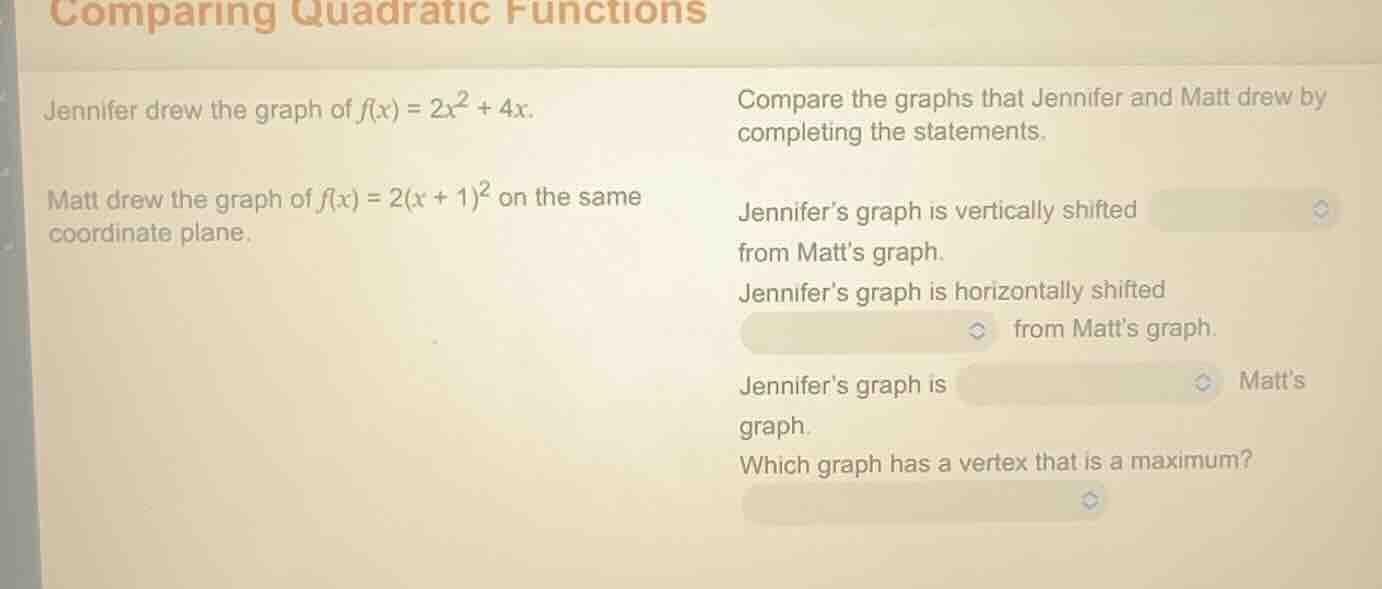
jennifer drew the graph of $f(x) = 2x^2 + 4x$.
matt drew the graph of $f(x) = 2(x + 1)^2$ on the same coordinate plane.
compare the graphs that jennifer and matt drew by completing the statements.
jennifer’s graph is vertically shifted from matt’s graph.
jennifer’s graph is horizontally shifted from matt’s graph.
jennifer’s graph is matt’s graph.
which graph has a vertex that is a maximum?
Step1: Rewrite Jennifer's function in vertex form
First, we complete the square for Jennifer's function \( f(x) = 2x^2 + 4x \). Factor out the coefficient of \( x^2 \) from the first two terms:
\( f(x) = 2(x^2 + 2x) \)
To complete the square inside the parentheses, take half of the coefficient of \( x \) (which is \( 2 \)), square it (\( (2/2)^2 = 1 \)), and add and subtract it inside the parentheses:
\( f(x) = 2[(x^2 + 2x + 1) - 1] \)
Simplify this to vertex form:
\( f(x) = 2(x + 1)^2 - 2 \)
Step2: Compare the vertex forms
Matt's function is \( f(x) = 2(x + 1)^2 \), which has a vertex at \( (-1, 0) \).
Jennifer's function is \( f(x) = 2(x + 1)^2 - 2 \), which has a vertex at \( (-1, -2) \).
Vertical shift:
The vertical shift is determined by the difference in the \( y \)-coordinates of the vertices. Jennifer's vertex \( y \)-coordinate is \( -2 \) and Matt's is \( 0 \). So Jennifer's graph is vertically shifted down by \( 2 \) units from Matt's graph.
Horizontal shift:
The horizontal shift is determined by the \( x \)-coordinates of the vertices. Both vertices have an \( x \)-coordinate of \( -1 \), so there is no horizontal shift (or a horizontal shift of \( 0 \) units).
Shape and direction:
Both functions have a coefficient of \( 2 \) in front of the squared term, which is positive, so both parabolas open upwards. The coefficient is the same, so the graphs have the same shape (they are congruent, or similar with the same vertical stretch). So Jennifer's graph is the same shape as Matt's graph (or we can say it's a vertical shift of Matt's graph, same horizontal position, same opening direction and stretch).
Vertex as maximum or minimum:
Since the coefficient of the squared term is positive (\( 2 > 0 \)) for both functions, both parabolas open upwards, which means their vertices are minimum points (the lowest point on the graph). So neither graph has a vertex that is a maximum; both have a minimum at their vertex. But if we strictly answer the question, since both open upwards, neither vertex is a maximum. But maybe there's a mistake in the question, or maybe we misread. Wait, both functions: \( f(x)=2x^2 + 4x \) and \( f(x)=2(x + 1)^2 \). Let's check the coefficients again. The coefficient of \( x^2 \) is positive for both, so both open upwards, so both vertices are minima. So the answer to "Which graph has a vertex that is a maximum?" is neither, but maybe the question expects that, or maybe there's a typo. But let's proceed with the shift analysis first.

Snap & solve any problem in the app
Get step-by-step solutions on Sovi AI
Photo-based solutions with guided steps
Explore more problems and detailed explanations
s (for the shift parts):
- Jennifer’s graph is vertically shifted \(\boldsymbol{\text{down by 2 units}}\) from Matt’s graph.
- Jennifer’s graph is horizontally shifted \(\boldsymbol{\text{0 units (no horizontal shift)}}\) from Matt’s graph.
- Jennifer’s graph is \(\boldsymbol{\text{the same shape as (or a vertical shift of)}}\) Matt’s graph (since same stretch, same horizontal position, different vertical position).
- Which graph has a vertex that is a maximum? \(\boldsymbol{\text{Neither (both have minima)}}\) (but if we must choose from the two, since both open upwards, their vertices are minima, so no graph has a vertex that is a maximum).