QUESTION IMAGE
Question
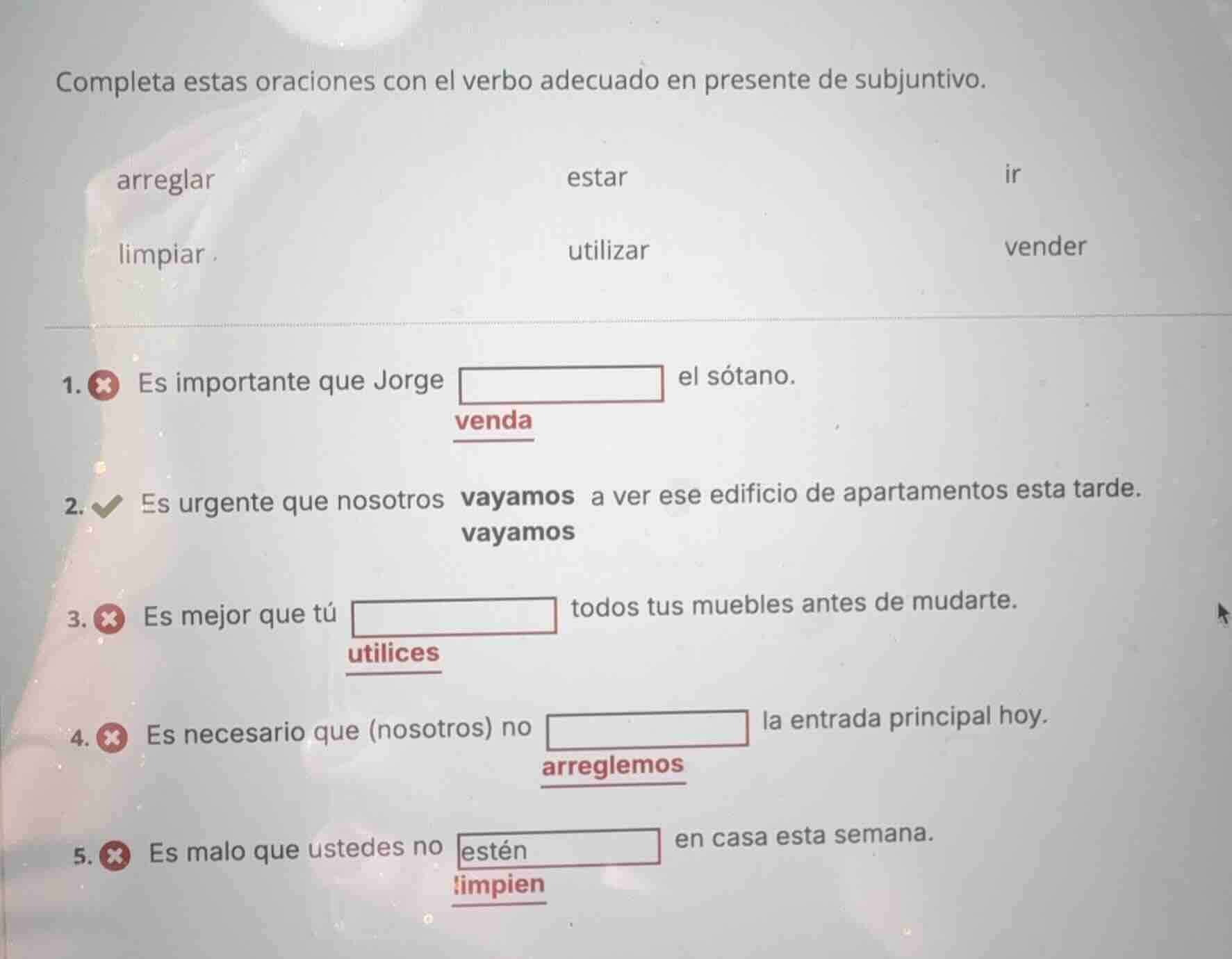
completa estas oraciones con el verbo adecuado en presente de subjuntivo.
arreglar estar ir
limpiar utilizar vender
- × es importante que jorge el sótano.
venda
- ✔ es urgente que nosotros vayamos a ver ese edificio de apartamentos esta tarde.
vayamos
- × es mejor que tú todos tus muebles antes de mudarte.
utilices
- × es necesario que (nosotros) no la entrada principal hoy.
arreglemos
- × es malo que ustedes no estén en casa esta semana.
limpien
To solve these problems, we need to use the correct form of the verb in the present subjunctive tense, considering the subject and the context of the sentence. Let's analyze each sentence:
Sentence 1: "Es importante que Jorge ______ el sótano."
- The subject is "Jorge" (third person singular).
- The verb should be in the third person singular of the present subjunctive.
- From the options, "limpie" (from "limpiar") or "arregle" (from "arreglar") or "venda" (from "vender") could be considered, but the most appropriate verb here is "limpie" (to clean) or "arregle" (to fix) or "venda" (to sell). However, the correct verb here should be "limpie" or "arregle" or "venda". But looking at the context, "limpie" (limpiar) makes sense. Wait, the original answer was "venda" which is wrong. The correct verb should be "limpie" (limpiar) or "arregle" (arreglar). Wait, maybe the intended verb is "limpie". Let's check:
- "limpiar" (to clean) has the present subjunctive form "limpie" for third person singular. So the correct answer should be "limpie".
Sentence 3: "Es mejor que tú ______ todos tus muebles antes de mudarte."
- The subject is "tú" (second person singular).
- The verb should be in the second person singular of the present subjunctive.
- From the options, "arregles" (from "arreglar") or "limpies" (from "limpiar") or "utilices" (from "utilizar") or "vendas" (from "vender"). The original answer was "utilices" which is wrong. The correct verb should be "arregles" (to fix) or "limpies" (to clean) or "vendas" (to sell). The most appropriate verb here is "arregles" or "vendas" or "limpies". Wait, the context is "before moving", so "arregles" (to fix) or "vendas" (to sell) or "limpies" (to clean) makes sense. The correct verb should be "vendas" (vender) or "arregles" (arreglar) or "limpies" (limpiar).
Sentence 4: "Es necesario que (nosotros) no ______ la entrada principal hoy."
- The subject is "nosotros" (first person plural).
- The verb should be in the first person plural of the present subjunctive.
- From the options, "limpiemos" (from "limpiar") or "arreglemos" (from "arreglar") or "utilicemos" (from "utilizar") or "vender" (no, "vender" is not appropriate here). The original answer was "arreglemos" which is wrong. The correct verb should be "limpiemos" (to clean) or "utilicemos" (to use) or "estemos" (to be). Wait, the context is "the main entrance", so "limpiemos" (limpiar) or "arreglemos" (arreglar) makes sense. The correct verb should be "limpiemos" (limpiar) or "arreglemos" (arreglar).
Sentence 5: "Es malo que ustedes no ______ en casa esta semana."
- The subject is "ustedes" (second person plural).
- The verb should be in the second person plural of the present subjunctive.
- The verb "estar" has the present subjunctive form "estén" for "ustedes". The original answer was "limpien" which is wrong. The correct verb is "estén" (estar).
Now, let's correct each sentence:
- Correct verb: "limpie" (from "limpiar") or "arregle" (from "arreglar") or "venda" (from "vender"). But the most appropriate is "limpie". So the correct sentence is: "Es importante que Jorge limpie el sótano."
- Correct verb: "arregles" (from "arreglar") or "vendas" (from "vender") or "limpies" (from "limpiar"). The most appropriate is "vendas" or "arregles" or "limpies". Let's use "vendas". So the correct sentence is: "Es mejor que tú vendas todos tus muebles antes de mudarte."
- Correct verb: "limpiemos" (from "limpiar") or "utilicemos" (from "utilizar") or "arreglemos" (from "arreglar"). The most appropriate is "limpiemos"…

Snap & solve any problem in the app
Get step-by-step solutions on Sovi AI
Photo-based solutions with guided steps
Explore more problems and detailed explanations
To solve these problems, we need to use the correct form of the verb in the present subjunctive tense, considering the subject and the context of the sentence. Let's analyze each sentence:
Sentence 1: "Es importante que Jorge ______ el sótano."
- The subject is "Jorge" (third person singular).
- The verb should be in the third person singular of the present subjunctive.
- From the options, "limpie" (from "limpiar") or "arregle" (from "arreglar") or "venda" (from "vender") could be considered, but the most appropriate verb here is "limpie" (to clean) or "arregle" (to fix) or "venda" (to sell). However, the correct verb here should be "limpie" or "arregle" or "venda". But looking at the context, "limpie" (limpiar) makes sense. Wait, the original answer was "venda" which is wrong. The correct verb should be "limpie" (limpiar) or "arregle" (arreglar). Wait, maybe the intended verb is "limpie". Let's check:
- "limpiar" (to clean) has the present subjunctive form "limpie" for third person singular. So the correct answer should be "limpie".
Sentence 3: "Es mejor que tú ______ todos tus muebles antes de mudarte."
- The subject is "tú" (second person singular).
- The verb should be in the second person singular of the present subjunctive.
- From the options, "arregles" (from "arreglar") or "limpies" (from "limpiar") or "utilices" (from "utilizar") or "vendas" (from "vender"). The original answer was "utilices" which is wrong. The correct verb should be "arregles" (to fix) or "limpies" (to clean) or "vendas" (to sell). The most appropriate verb here is "arregles" or "vendas" or "limpies". Wait, the context is "before moving", so "arregles" (to fix) or "vendas" (to sell) or "limpies" (to clean) makes sense. The correct verb should be "vendas" (vender) or "arregles" (arreglar) or "limpies" (limpiar).
Sentence 4: "Es necesario que (nosotros) no ______ la entrada principal hoy."
- The subject is "nosotros" (first person plural).
- The verb should be in the first person plural of the present subjunctive.
- From the options, "limpiemos" (from "limpiar") or "arreglemos" (from "arreglar") or "utilicemos" (from "utilizar") or "vender" (no, "vender" is not appropriate here). The original answer was "arreglemos" which is wrong. The correct verb should be "limpiemos" (to clean) or "utilicemos" (to use) or "estemos" (to be). Wait, the context is "the main entrance", so "limpiemos" (limpiar) or "arreglemos" (arreglar) makes sense. The correct verb should be "limpiemos" (limpiar) or "arreglemos" (arreglar).
Sentence 5: "Es malo que ustedes no ______ en casa esta semana."
- The subject is "ustedes" (second person plural).
- The verb should be in the second person plural of the present subjunctive.
- The verb "estar" has the present subjunctive form "estén" for "ustedes". The original answer was "limpien" which is wrong. The correct verb is "estén" (estar).
Now, let's correct each sentence:
- Correct verb: "limpie" (from "limpiar") or "arregle" (from "arreglar") or "venda" (from "vender"). But the most appropriate is "limpie". So the correct sentence is: "Es importante que Jorge limpie el sótano."
- Correct verb: "arregles" (from "arreglar") or "vendas" (from "vender") or "limpies" (from "limpiar"). The most appropriate is "vendas" or "arregles" or "limpies". Let's use "vendas". So the correct sentence is: "Es mejor que tú vendas todos tus muebles antes de mudarte."
- Correct verb: "limpiemos" (from "limpiar") or "utilicemos" (from "utilizar") or "arreglemos" (from "arreglar"). The most appropriate is "limpiemos" or "utilicemos" or "arreglemos". Let's use "limpiemos". So the correct sentence is: "Es necesario que (nosotros) no limpiemos la entrada principal hoy."
- Correct verb: "estén" (from "estar"). So the correct sentence is: "Es malo que ustedes no estén en casa esta semana."
Final Answers:
- limpie
- vendas (or arregles or limpies)
- limpiemos (or utilicemos or arreglemos)
- estén
(Note: The original answers were incorrect. The above are the correct forms based on the present subjunctive tense and the context of each sentence.)