QUESTION IMAGE
Question
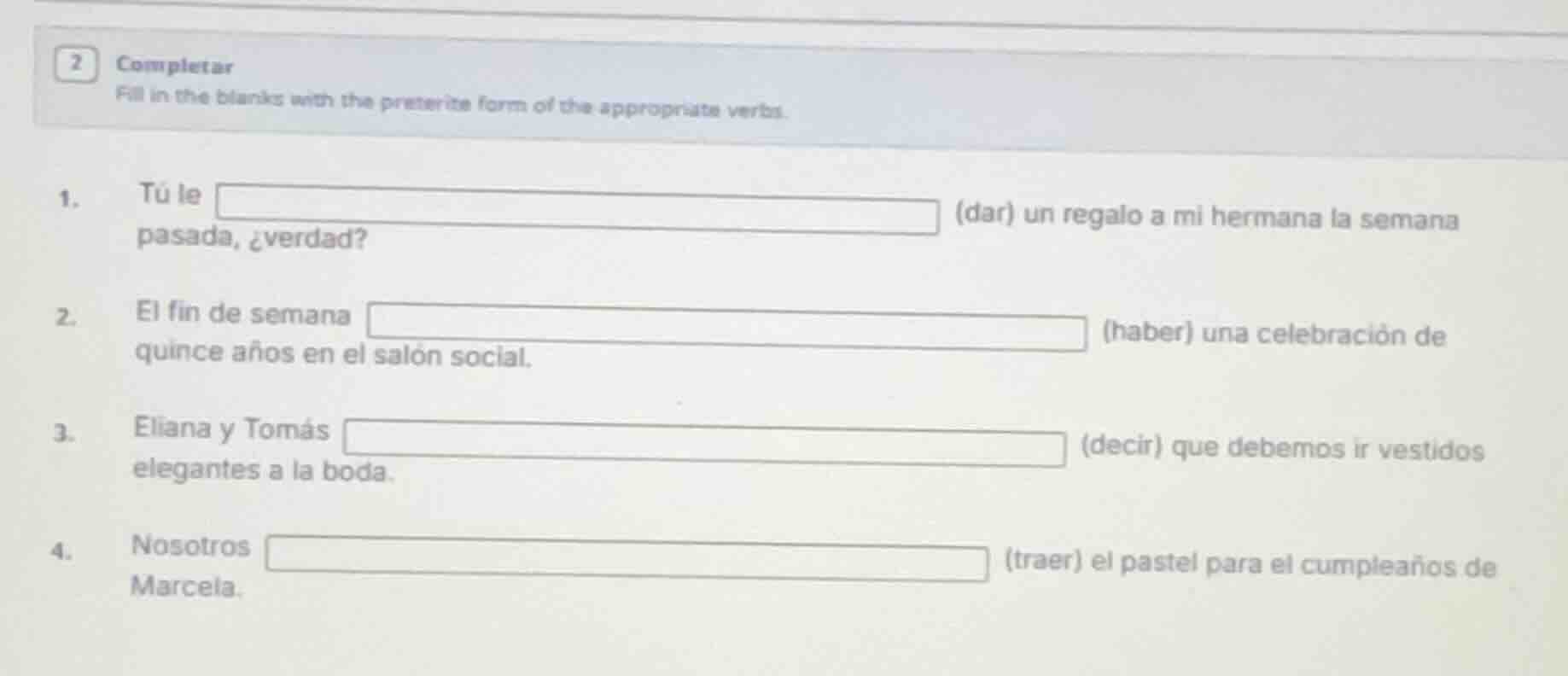
2 completar fill in the blanks with the preterite form of the appropriate verbs. 1. tú le (dar) un regalo a mi hermana la semana pasada, ¿verdad? 2. el fin de semana (haber) una celebración de quince años en el salón social. 3. eliana y tomás (decir) que debemos ir vestidos elegantes a la boda. 4. nosotros (traer) el pastel para el cumpleaños de marcela.
1.
Step1: Identify verb and tense
The verb is "dar", and the tense is preterite (past). For "tú" (second person singular), the preterite form of "dar" is "diste". Wait, no, wait: Wait, "la semana pasada" is past, so preterite. Wait, "dar" preterite: yo di, tú diste, él/ella/Ud. dio, nosotros dimos, vosotros disteis, ellos dieron. Wait, the sentence is "Tú le ____ (dar) un regalo a mi hermana la semana pasada, ¿verdad?". So subject is "tú", verb "dar" preterite. So "diste"? Wait, no, wait: Wait, maybe I made a mistake. Wait, "dar" preterite: tú diste. Wait, but let's check again. Wait, "le" is indirect object, but the verb conjugation is for "tú". So "tú" + "dar" preterite: "diste". Wait, but wait, maybe the correct form is "diste"? Wait, no, wait: Wait, "dar" preterite: yo di, tú diste, él/ella/Ud. dio, nosotros dimos, vosotros disteis, ellos dieron. So yes, "tú" takes "diste". Wait, but maybe I confused with another verb. Wait, no, "dar" preterite for tú is "diste". So the blank should be "diste".
Wait, no, wait: Wait, the sentence is "Tú le ____ (dar) un regalo a mi hermana la semana pasada, ¿verdad?". So the subject is "tú", verb "dar" in preterite. So "diste".
Step2: Confirm conjugation
Preterite of "dar": tú diste. So fill in "diste".
Step1: Identify verb and tense
The verb is "haber" (in the form of "hay" for present, but preterite for "haber" as "haber" is used in "haber + past participle" for perfect tenses, but here it's "haber" as "there was/were". Wait, no, "haber" as the impersonal verb "there is/are" in preterite is "hubo" (for singular) or "hubieron" (for plural). The subject is "El fin de semana" (singular), so "hubo". Wait, the sentence is "El fin de semana ____ (haber) una celebración de quince años en el salón social." So "haber" here is used as "there was", so preterite form is "hubo" (since "el fin de semana" is singular, and "una celebración" is singular). So "hubo".
Step2: Confirm conjugation
Preterite of "haber" (impersonal, "there was"): hubo (singular), hubieron (plural). Since the subject is singular ("el fin de semana") and the noun "una celebración" is singular, we use "hubo".
Step1: Identify verb and tense
The verb is "decir", preterite tense. The subject is "Eliana y Tomás" (third person plural, "ellos"). The preterite form of "decir" for "ellos" is "dijeron". Wait, "decir" preterite: yo dije, tú dijiste, él/ella/Ud. dijo, nosotros dijimos, vosotros dijisteis, ellos dijeron. So "Eliana y Tomás" are "ellos", so "dijeron".
Step2: Confirm conjugation
Preterite of "decir" for "ellos" (third person plural) is "dijeron". So fill in "dijeron".

Snap & solve any problem in the app
Get step-by-step solutions on Sovi AI
Photo-based solutions with guided steps
Explore more problems and detailed explanations
diste