QUESTION IMAGE
Question
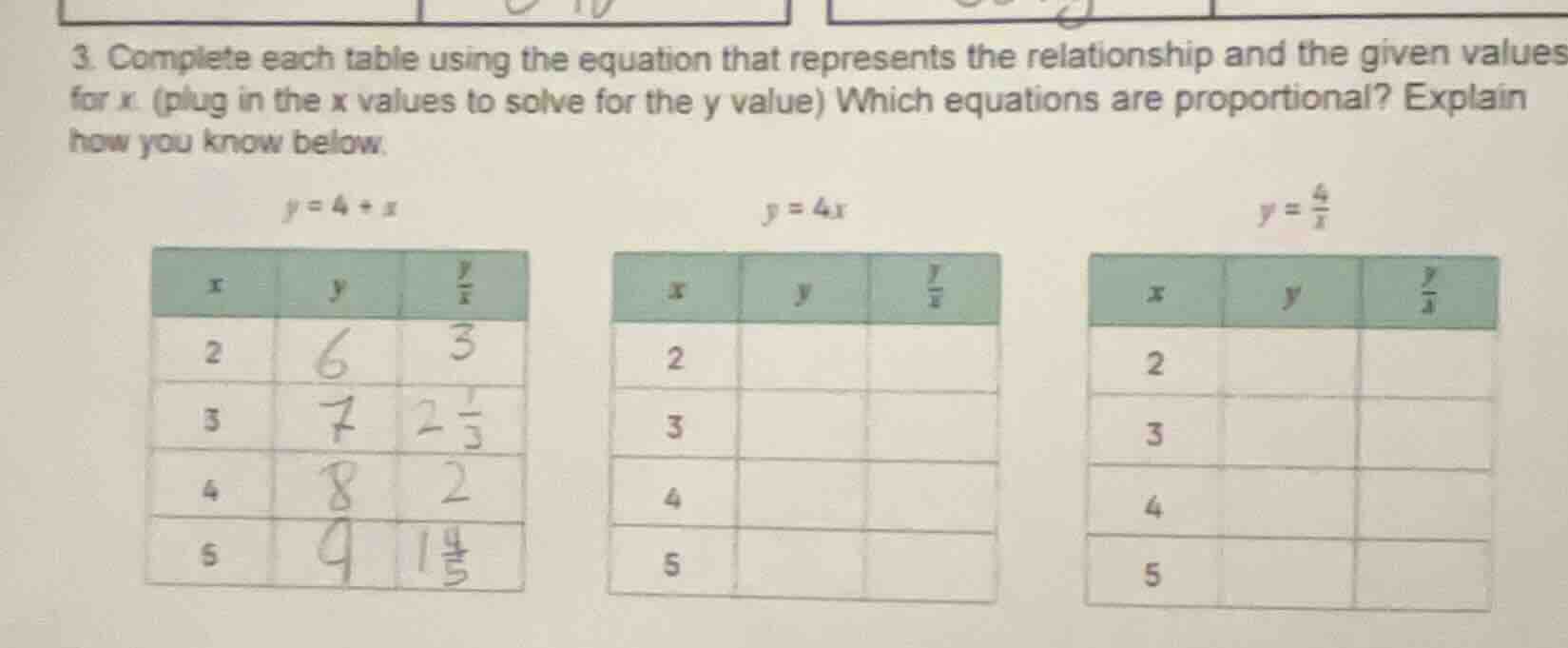
- complete each table using the equation that represents the relationship and the given values for x (plug in the x values to solve for the y value) which equations are proportional? explain how you know below.
$y = 4 + x$
$y = 4x$
$y = \frac{4}{x}$
(three tables with x, y, y/x columns and x values 2,3,4,5, some y values filled in first table)
For the equation \( y = 4x \) table:
Step1: Plug \( x = 2 \) into \( y = 4x \)
\( y = 4\times2 = 8 \), \( \frac{y}{x}=\frac{8}{2}=4 \)
Step2: Plug \( x = 3 \) into \( y = 4x \)
\( y = 4\times3 = 12 \), \( \frac{y}{x}=\frac{12}{3}=4 \)
Step3: Plug \( x = 4 \) into \( y = 4x \)
\( y = 4\times4 = 16 \), \( \frac{y}{x}=\frac{16}{4}=4 \)
Step4: Plug \( x = 5 \) into \( y = 4x \)
\( y = 4\times5 = 20 \), \( \frac{y}{x}=\frac{20}{5}=4 \)
For the equation \( y=\frac{4}{x} \) table:
Step1: Plug \( x = 2 \) into \( y=\frac{4}{x} \)
\( y=\frac{4}{2}=2 \), \( \frac{y}{x}=\frac{2}{2}=1 \) (or check \( xy = 4 \), \( 2\times2 = 4 \))
Step2: Plug \( x = 3 \) into \( y=\frac{4}{x} \)
\( y=\frac{4}{3}\approx1.33 \), \( xy = 3\times\frac{4}{3}=4 \)
Step3: Plug \( x = 4 \) into \( y=\frac{4}{x} \)
\( y=\frac{4}{4}=1 \), \( xy = 4\times1 = 4 \)
Step4: Plug \( x = 5 \) into \( y=\frac{4}{x} \)
\( y=\frac{4}{5}=0.8 \), \( xy = 5\times\frac{4}{5}=4 \)
Proportionality Explanation:
A proportional relationship has the form \( y = kx \) (direct proportion, constant \( \frac{y}{x}=k \)) or \( xy = k \) (inverse proportion, constant product).
- For \( y = 4 + x \): \( \frac{y}{x}=\frac{4 + x}{x}=1+\frac{4}{x} \), not constant (e.g., \( x = 2 \) gives 3, \( x = 3 \) gives \( 2\frac{1}{3} \)), so not proportional.
- For \( y = 4x \): \( \frac{y}{x}=4 \) (constant), so it's a direct proportional relationship.
- For \( y=\frac{4}{x} \): \( xy = 4 \) (constant), so it's an inverse proportional relationship.
Filled Tables:
Table for \( y = 4x \):
| \( x \) | \( y \) | \( \frac{y}{x} \) |
|---|---|---|
| 3 | 12 | 4 |
| 4 | 16 | 4 |
| 5 | 20 | 4 |
Table for \( y=\frac{4}{x} \):
| \( x \) | \( y \) | \( xy \) (or \( \frac{y}{x} \)) |
|---|---|---|
| 3 | \( \frac{4}{3} \) | 4 |
| 4 | 1 | 4 |
| 5 | \( \frac{4}{5} \) | 4 |

Snap & solve any problem in the app
Get step-by-step solutions on Sovi AI
Photo-based solutions with guided steps
Explore more problems and detailed explanations
- The equation \( \boldsymbol{y = 4x} \) is directly proportional (since \( \frac{y}{x}=4 \) constant) and \( \boldsymbol{y=\frac{4}{x}} \) is inversely proportional (since \( xy = 4 \) constant). The equation \( y = 4 + x \) is not proportional as \( \frac{y}{x} \) is not constant.
- Filled tables as shown above.