QUESTION IMAGE
Question
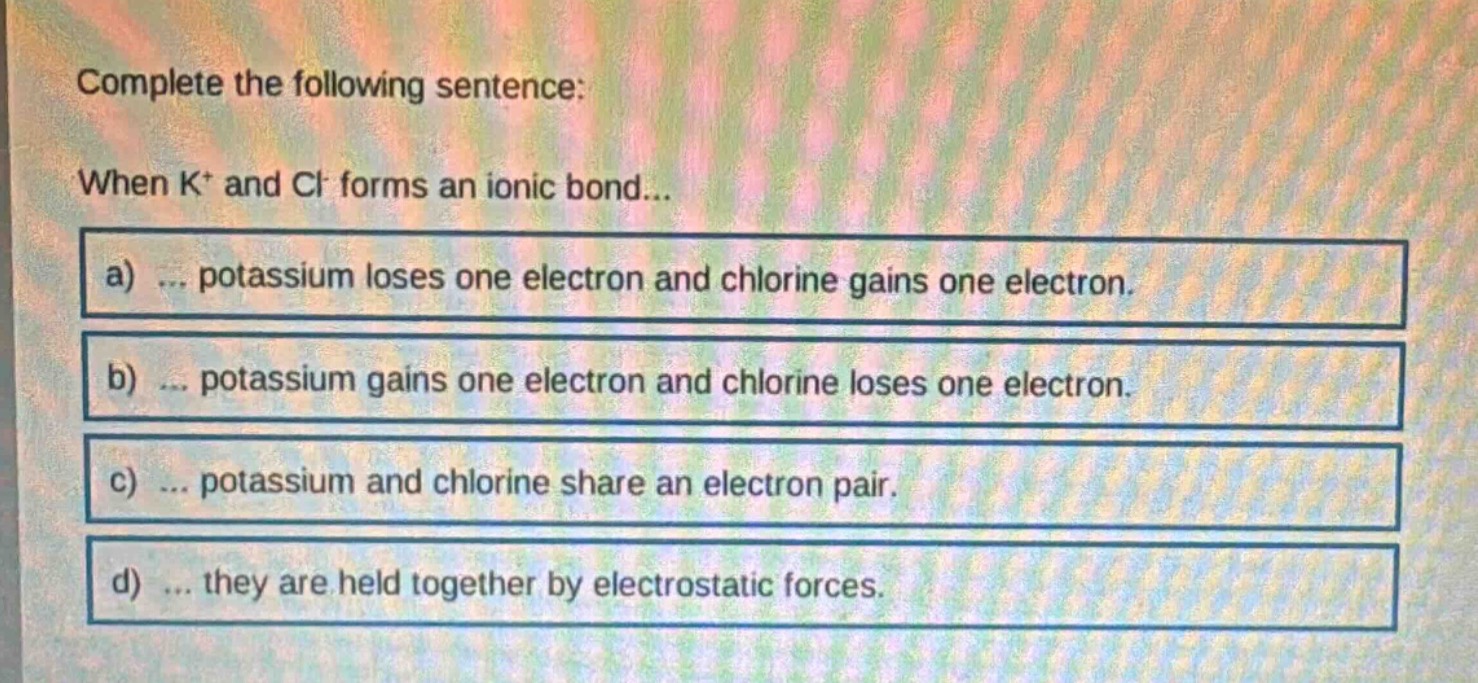
complete the following sentence:
when k⁺ and cl⁻ forms an ionic bond...
a) ... potassium loses one electron and chlorine gains one electron.
b) ... potassium gains one electron and chlorine loses one electron.
c) ... potassium and chlorine share an electron pair.
d) ... they are held together by electrostatic forces.
Brief Explanations
- Option a: The electron transfer (K loses, Cl gains) happens before the ionic bond forms (to create \( K^+ \) and \( Cl^- \)). The question is about when they form the bond, not the electron transfer process leading to ion formation.
- Option b: This is incorrect. Potassium (a metal) loses electrons, and chlorine (a non - metal) gains electrons, not the other way around.
- Option c: Sharing electron pairs is characteristic of covalent bonds, not ionic bonds. Ionic bonds involve the transfer of electrons and the attraction between ions.
- Option d: Ionic bonds are formed due to the electrostatic attraction between positively charged ions (\( K^+ \)) and negatively charged ions (\( Cl^- \)). This accurately describes what holds \( K^+ \) and \( Cl^- \) together in an ionic bond.

Snap & solve any problem in the app
Get step-by-step solutions on Sovi AI
Photo-based solutions with guided steps
Explore more problems and detailed explanations
d) ... they are held together by electrostatic forces.