QUESTION IMAGE
Question
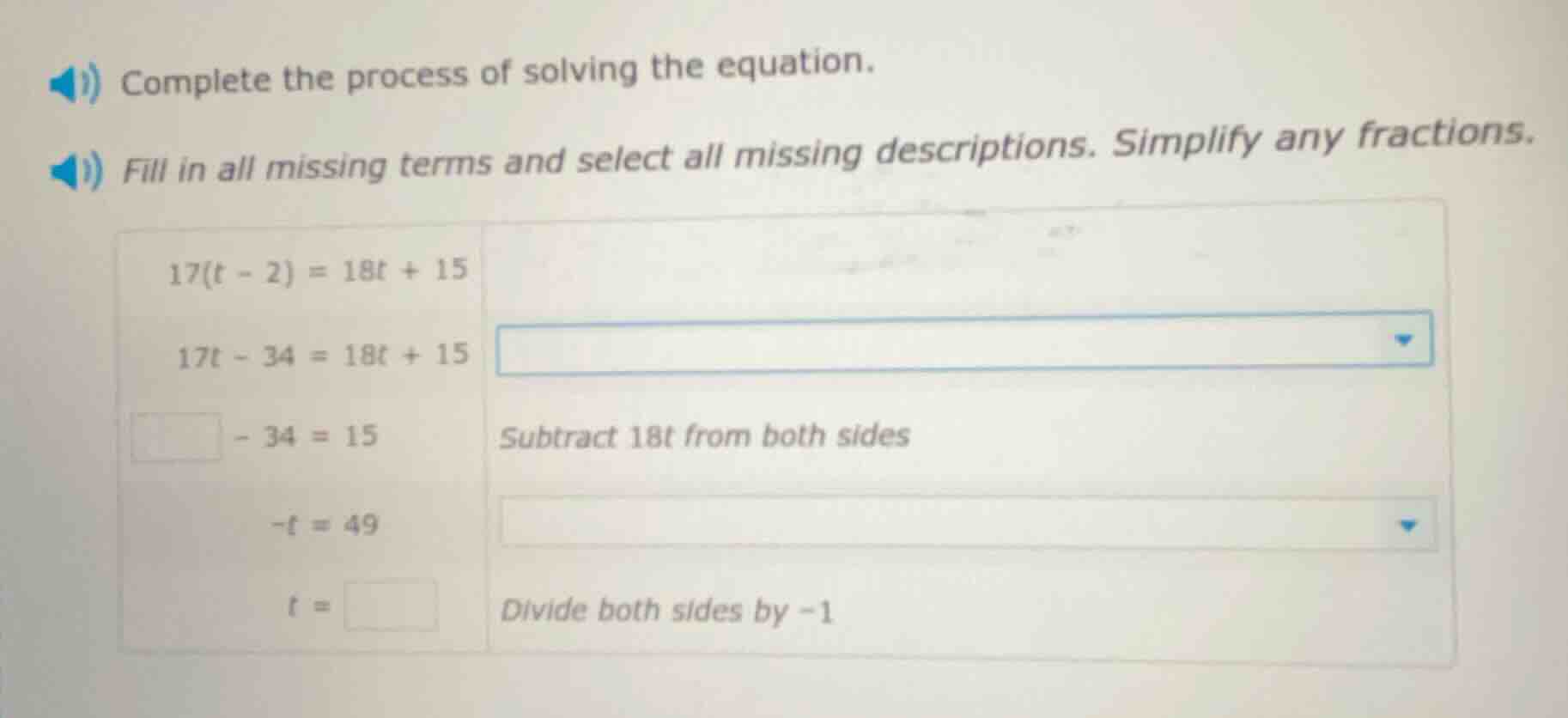
complete the process of solving the equation. fill in all missing terms and select all missing descriptions. simplify any fractions. 17(t - 2) = 18t + 15 17t - 34 = 18t + 15 □ - 34 = 15 subtract 18t from both sides -t = 49 □ t = □ divide both sides by -1
Step1: Identify the first step's description
The first step is expanding \(17(t - 2)\) using the distributive property, so the description for \(17t - 34 = 18t + 15\) is "Distribute 17".
Step2: Subtract 18t from both sides
Starting with \(17t - 34 = 18t + 15\), subtract \(18t\) from both sides: \(17t - 18t - 34 = 18t - 18t + 15\), which simplifies to \(-t - 34 = 15\)? Wait, no, wait the box is for the term before -34. Wait, \(17t - 34 = 18t + 15\), subtract 18t: \(17t - 18t - 34 = 18t - 18t + 15\) → \(-t - 34 = 15\)? Wait no, the given line is \(\square - 34 = 15\). Oh, wait, maybe I made a mistake. Wait \(17t - 34 = 18t + 15\), subtract 18t from both sides: \(17t - 18t - 34 = 18t - 18t + 15\) → \(-t - 34 = 15\)? But the box is for the term before -34. Wait, no, maybe it's \(17t - 18t = -t\), so \(17t - 34 - 18t = 18t + 15 - 18t\) → \((17t - 18t) - 34 = 15\) → \(-t - 34 = 15\)? But the line is \(\square - 34 = 15\), so the square should be \(-t\)? Wait, no, maybe I messed up. Wait, let's do it again. \(17t - 34 = 18t + 15\). Subtract 18t from both sides: \(17t - 18t - 34 = 18t - 18t + 15\) → \(-t - 34 = 15\). Then add 34 to both sides: \(-t - 34 + 34 = 15 + 34\) → \(-t = 49\). Ah, right! So the step between \(17t - 34 = 18t + 15\) and \(\square - 34 = 15\) is subtracting 18t, so \(17t - 18t = -t\)? Wait no, \(17t - 18t = -t\), so \(17t - 34 - 18t = -t - 34\), but the line is \(\square - 34 = 15\). Wait, maybe the square is \(-t\)? No, wait the next line is \(-t = 49\). Wait, let's check the next step. After \(\square - 34 = 15\), then we get \(-t = 49\). So to get from \(\square - 34 = 15\) to \(-t = 49\), we add 34 to both sides: \(\square - 34 + 34 = 15 + 34\) → \(\square = 49\)? No, that can't be. Wait, I think I misread the lines. Let's list the steps:
- \(17(t - 2) = 18t + 15\)
- \(17t - 34 = 18t + 15\) (Distribute 17)
- \(\square - 34 = 15\) (Subtract 18t from both sides: \(17t - 18t - 34 = 18t - 18t + 15\) → \(-t - 34 = 15\)? No, wait the square is for the term before -34. Wait, \(17t - 34 = 18t + 15\), subtract 18t: \(17t - 18t - 34 = 18t - 18t + 15\) → \(-t - 34 = 15\). So the square is \(-t\)? But then the next line is \(-t = 49\), which would be adding 34 to both sides: \(-t - 34 + 34 = 15 + 34\) → \(-t = 49\). So the description for \(-t = 49\) is "Add 34 to both sides". Then, to solve for t, divide both sides by -1: \(t = -49\).
So let's fill in:
First box (description for \(17t - 34 = 18t + 15\)): "Distribute 17"
Second box (term before -34): \(-t\) (Wait, no, the line is \(\square - 34 = 15\). So \(17t - 34 = 18t + 15\), subtract 18t: \(17t - 18t - 34 = 18t - 18t + 15\) → \(-t - 34 = 15\), so the square is \(-t\))
Third box (description for \(-t = 49\)): "Add 34 to both sides"
Fourth box (t's value): \(-49\)
Wait, let's verify:
- \(17(t - 2) = 18t + 15\)
- \(17t - 34 = 18t + 15\) (Distribute 17)
- \(-t - 34 = 15\) (Subtract 18t from both sides: \(17t - 18t = -t\))
- \(-t = 49\) (Add 34 to both sides: \(-t - 34 + 34 = 15 + 34\))
- \(t = -49\) (Divide both sides by -1: \(-t / -1 = 49 / -1\))
Yes, that makes sense.
So:
- First dropdown (description for \(17t - 34 = 18t + 15\)): "Distribute 17"
- Square (term before -34): \(-t\)
- Description for \(-t = 49\): "Add 34 to both sides"
- Square for t: \(-49\)
Let's redo the steps with the correct calculations:
Step1: Distribute 17
The first step is expanding \(17(t - 2)\) using the distributive property: \(17 \times t - 17 \times 2 = 17t - 34\), so the equation becomes \(17t - 34 = 18t + 15\). So the description for this step is "Distribute 17".…

Snap & solve any problem in the app
Get step-by-step solutions on Sovi AI
Photo-based solutions with guided steps
Explore more problems and detailed explanations
- First dropdown: Distribute 17
- Square (before -34): \(-t\)
- Description for \(-t = 49\): Add 34 to both sides
- Square for \(t\): \(-49\)
(If we need to present the final answer for \(t\), it's \(-49\).)