QUESTION IMAGE
Question
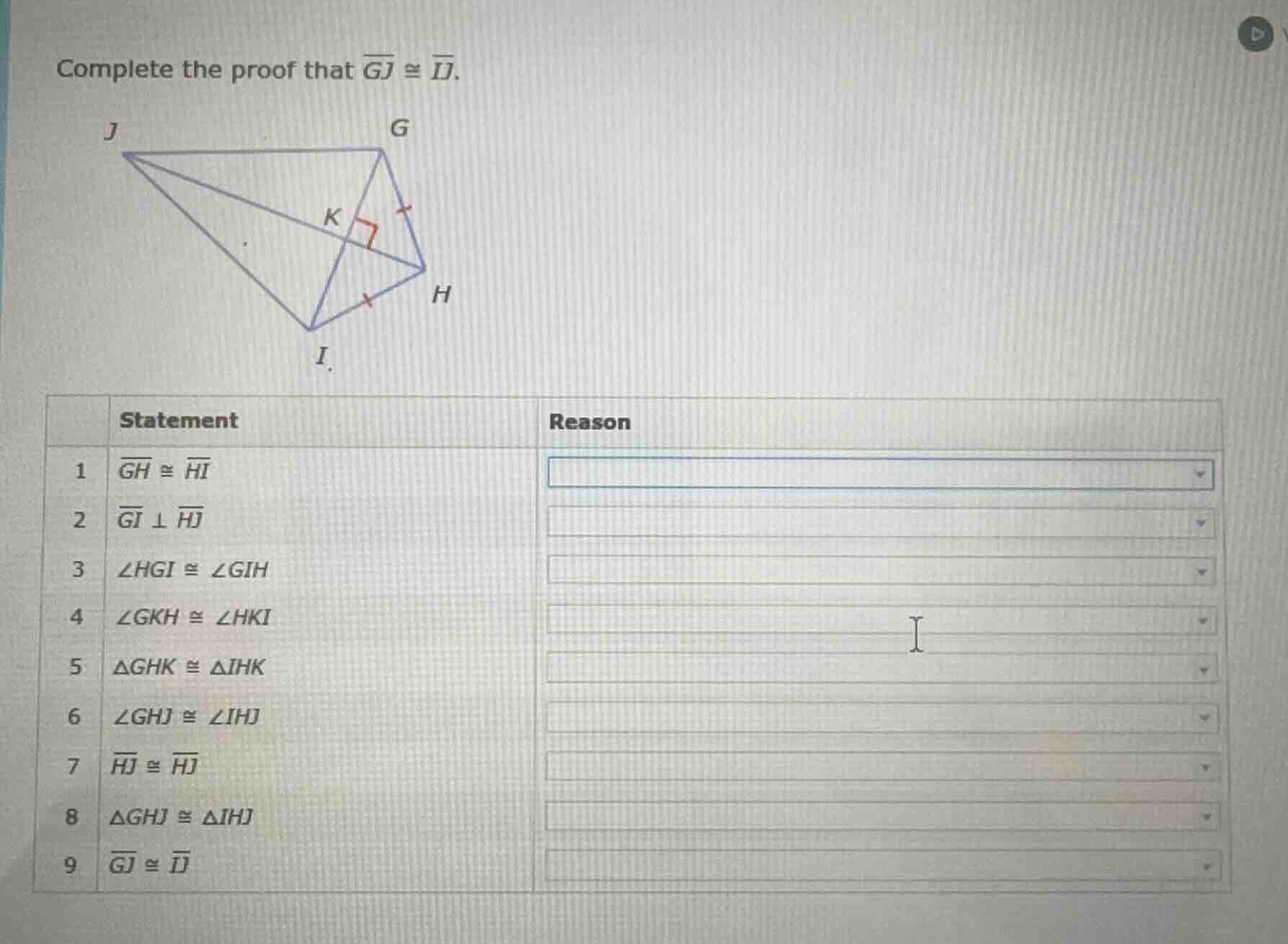
complete the proof that \\(\overline{gj} \cong \overline{ij}\\).
1 \\(\overline{gh} \cong \overline{hi}\\)
2 \\(\overline{gi} \perp \overline{hj}\\)
3 \\(\angle hgi \cong \angle gih\\)
4 \\(\angle gkh \cong \angle hki\\)
5 \\(\triangle ghk \cong \triangle ihk\\)
6 \\(\angle ghj \cong \angle ihj\\)
7 \\(\overline{hj} \cong \overline{hj}\\)
8 \\(\triangle ghj \cong \triangle ihj\\)
9 \\(\overline{gj} \cong \overline{ij}\\)
Step1: Analyze Statement 1
The segments \(\overline{GH}\) and \(\overline{HI}\) are marked as congruent in the diagram (the red tick marks). So the reason for \(\overline{GH} \cong \overline{HI}\) is "Given (marked congruent segments)".
Step2: Analyze Statement 2
\(\overline{GI} \perp \overline{HJ}\) is shown by the right angle symbol at \(K\), so this is "Given (perpendicular lines)".
Step3: Analyze Statement 3
In \(\triangle GHI\), since \(\overline{GH} \cong \overline{HI}\), \(\triangle GHI\) is isosceles with base \(\overline{GI}\). By the Isosceles Triangle Theorem, the base angles are congruent, so \(\angle HGI \cong \angle GIH\) (Isosceles Triangle Theorem: If two sides of a triangle are congruent, then the angles opposite those sides are congruent).
Step4: Analyze Statement 4
\(\angle GKH\) and \(\angle HKI\) are right angles (because \(\overline{GI} \perp \overline{HJ}\)), so all right angles are congruent. Thus, \(\angle GKH \cong \angle HKI\) (All right angles are congruent).
Step5: Analyze Statement 5
We have \(\overline{GH} \cong \overline{HI}\) (Statement 1), \(\angle HGI \cong \angle GIH\) (Statement 3), and \(\overline{HK}\) is common to both \(\triangle GHK\) and \(\triangle IHK\) (or we can use the angles and side). Wait, actually, with \(\overline{GH} \cong \overline{HI}\), \(\angle GKH \cong \angle HKI\) (right angles), and \(\angle HGI \cong \angle GIH\), we can use ASA (Angle - Side - Angle) or AAS (Angle - Angle - Side). Let's check: \(\angle HGI \cong \angle GIH\), \(\overline{GH} \cong \overline{HI}\), \(\angle GKH \cong \angle HKI\) (right angles), so by AAS, \(\triangle GHK \cong \triangle IHK\) (AAS Congruence Criterion).
Step6: Analyze Statement 6
Since \(\triangle GHK \cong \triangle IHK\) (Statement 5), their corresponding angles \(\angle GHJ\) and \(\angle IHJ\) are congruent (Corresponding Parts of Congruent Triangles are Congruent - CPCTC).
Step7: Analyze Statement 7
\(\overline{HJ} \cong \overline{HJ}\) is the Reflexive Property of Congruence (A segment is congruent to itself).
Step8: Analyze Statement 8
We have \(\overline{GH} \cong \overline{HI}\) (Statement 1), \(\angle GHJ \cong \angle IHJ\) (Statement 6), and \(\overline{HJ} \cong \overline{HJ}\) (Statement 7). By SAS (Side - Angle - Side) Congruence Criterion, \(\triangle GHJ \cong \triangle IHJ\) (SAS: If two sides and the included angle of one triangle are congruent to two sides and the included angle of another triangle, then the triangles are congruent).
Step9: Analyze Statement 9
Since \(\triangle GHJ \cong \triangle IHJ\), their corresponding sides \(\overline{GJ}\) and \(\overline{IJ}\) are congruent (CPCTC: Corresponding Parts of Congruent Triangles are Congruent).

Snap & solve any problem in the app
Get step-by-step solutions on Sovi AI
Photo-based solutions with guided steps
Explore more problems and detailed explanations
- Given (marked congruent segments)
- Given (perpendicular lines)
- Isosceles Triangle Theorem
- All right angles are congruent
- AAS Congruence Criterion
- CPCTC (Corresponding Parts of Congruent Triangles are Congruent)
- Reflexive Property of Congruence
- SAS Congruence Criterion
- CPCTC (Corresponding Parts of Congruent Triangles are Congruent)