QUESTION IMAGE
Question
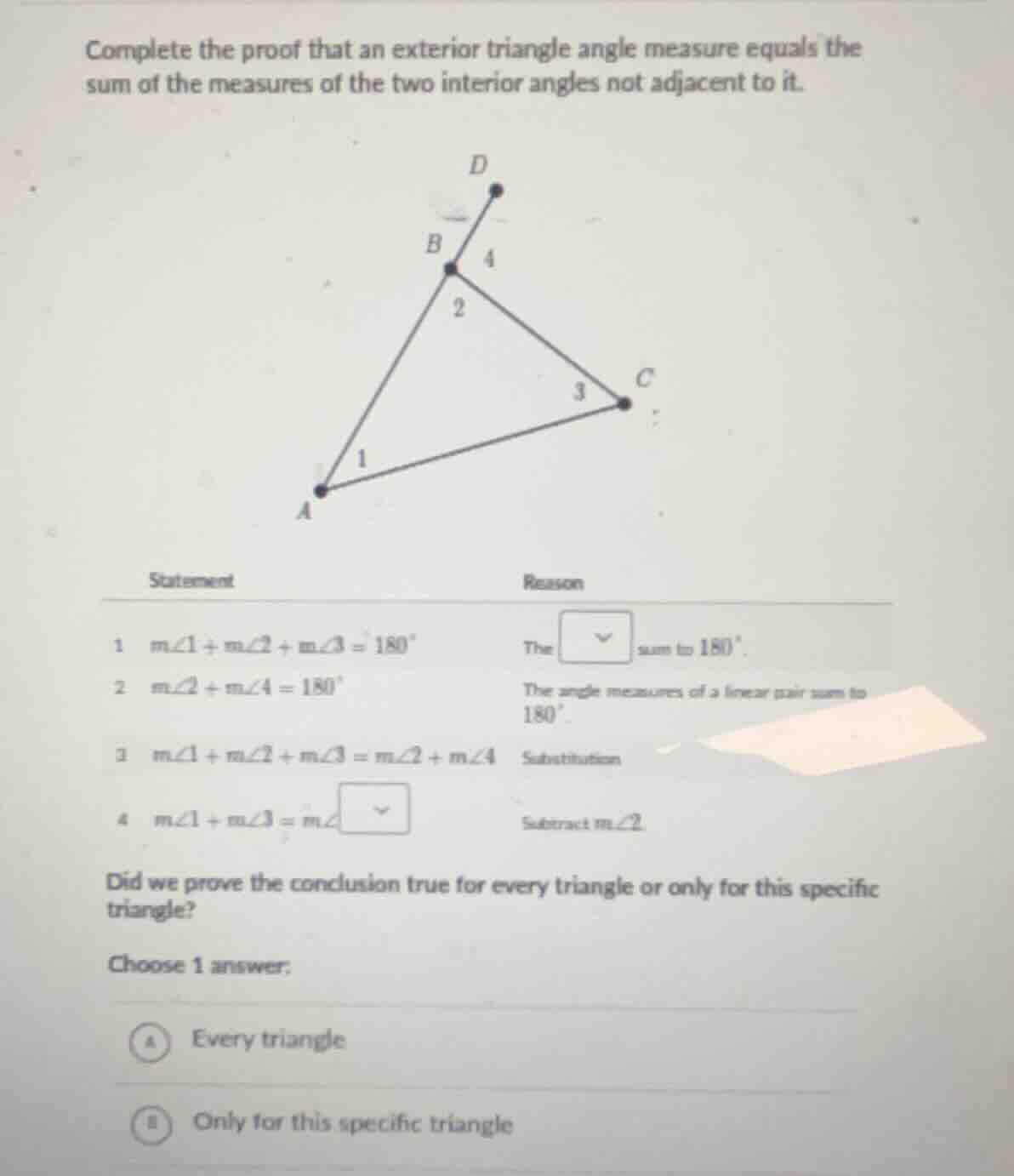
complete the proof that an exterior triangle angle measure equals the sum of the measures of the two interior angles not adjacent to it.
image of triangle abc with exterior angle at b labeled angle 4, and interior angles at a (angle 1), b (angle 2), c (angle 3)
statement | reason
--- | ---
1 ( mangle1 + mangle2 + mangle3 = 180^circ ) | the dropdown sum to ( 180^circ ).
2 ( mangle2 + mangle4 = 180^circ ) | the angle measures of a linear pair sum to ( 180^circ ).
3 ( mangle1 + mangle2 + mangle3 = mangle2 + mangle4 ) | substitution
4 ( mangle1 + mangle3 = mangle ) dropdown | subtract ( mangle2 ).
did we prove the conclusion true for every triangle or only for this specific triangle?
choose 1 answer:
a every triangle
b only for this specific triangle
Step 1: Analyze the first blank (Reason for \( m\angle1 + m\angle2 + m\angle3 = 180^\circ \))
The sum of the interior angles of a triangle is \( 180^\circ \). So the reason here is "interior angles of a triangle".
Step 2: Analyze the second blank (After subtracting \( m\angle2 \))
Starting from \( m\angle1 + m\angle2 + m\angle3 = m\angle2 + m\angle4 \), when we subtract \( m\angle2 \) from both sides, we get \( m\angle1 + m\angle3 = m\angle4 \).
Step 3: Analyze the last question (Every triangle or specific)
The proof uses the general property of the sum of interior angles of a triangle (which holds for all triangles) and the linear pair property (which is a general angle property). So the conclusion holds for every triangle.
Filling the Blanks:
- The first blank (reason) is "interior angles of a triangle".
- The second blank (angle) is \( \angle4 \).
- The answer to the last question is "A. Every triangle".
Final Answers:
- First blank (Reason): interior angles of a triangle
- Second blank (Angle): \( \angle4 \)
- Last question: A. Every triangle

Snap & solve any problem in the app
Get step-by-step solutions on Sovi AI
Photo-based solutions with guided steps
Explore more problems and detailed explanations
Step 1: Analyze the first blank (Reason for \( m\angle1 + m\angle2 + m\angle3 = 180^\circ \))
The sum of the interior angles of a triangle is \( 180^\circ \). So the reason here is "interior angles of a triangle".
Step 2: Analyze the second blank (After subtracting \( m\angle2 \))
Starting from \( m\angle1 + m\angle2 + m\angle3 = m\angle2 + m\angle4 \), when we subtract \( m\angle2 \) from both sides, we get \( m\angle1 + m\angle3 = m\angle4 \).
Step 3: Analyze the last question (Every triangle or specific)
The proof uses the general property of the sum of interior angles of a triangle (which holds for all triangles) and the linear pair property (which is a general angle property). So the conclusion holds for every triangle.
Filling the Blanks:
- The first blank (reason) is "interior angles of a triangle".
- The second blank (angle) is \( \angle4 \).
- The answer to the last question is "A. Every triangle".
Final Answers:
- First blank (Reason): interior angles of a triangle
- Second blank (Angle): \( \angle4 \)
- Last question: A. Every triangle