QUESTION IMAGE
Question
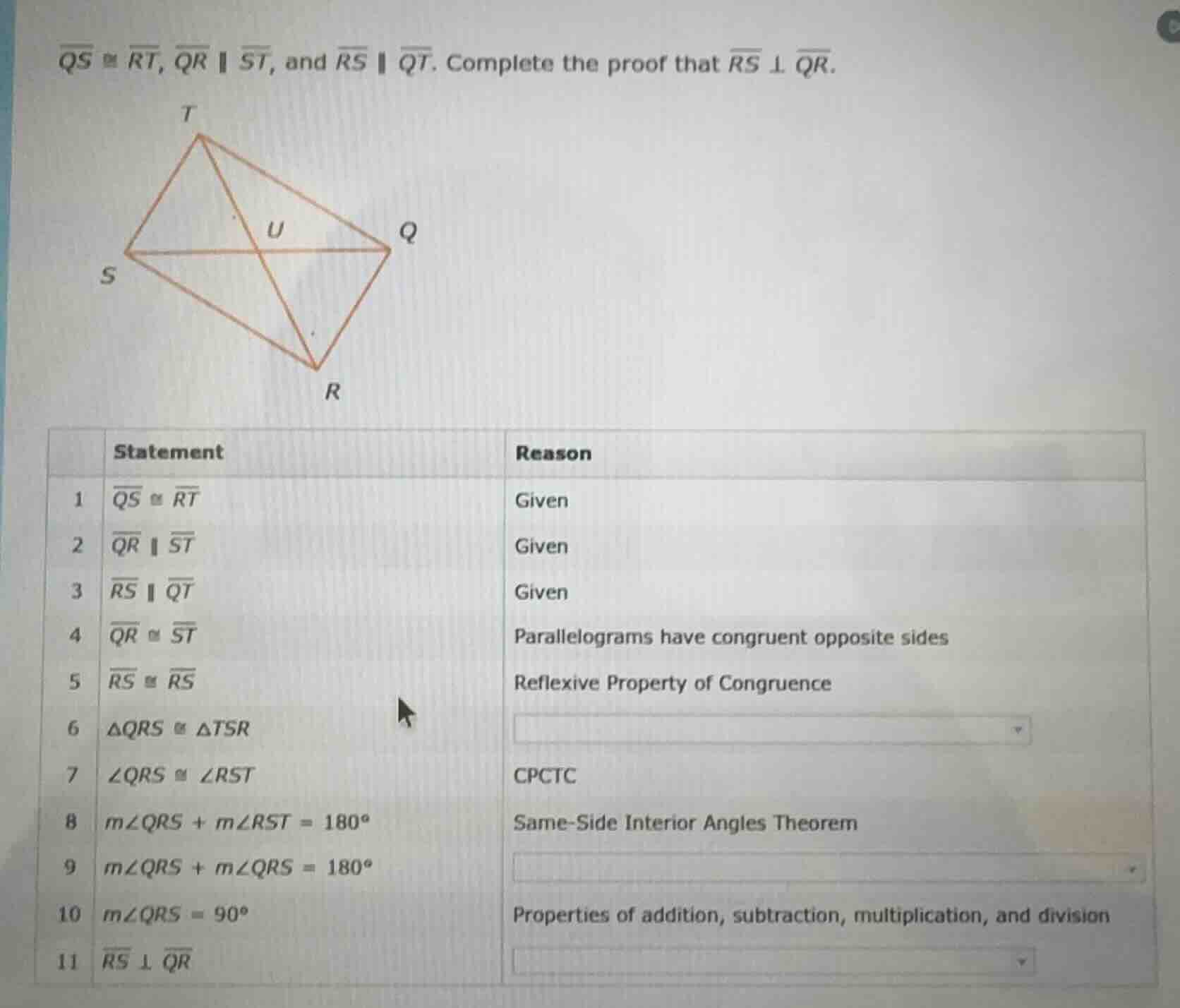
$\overline{qs} \cong \overline{rt}$, $\overline{qr} \parallel \overline{st}$, and $\overline{rs} \parallel \overline{qt}$. complete the proof that $\overline{rs} \perp \overline{qr}$.
| statement | reason | |
|---|---|---|
| 2 | $\overline{qr} \parallel \overline{st}$ | given |
| 3 | $\overline{rs} \parallel \overline{qt}$ | given |
| 4 | $\overline{qr} \cong \overline{st}$ | parallelograms have congruent opposite sides |
| 5 | $\overline{rs} \cong \overline{rs}$ | reflexive property of congruence |
| 6 | $\triangle qrs \cong \triangle tsr$ | |
| 7 | $\angle qrs \cong \angle rst$ | cpctc |
| 8 | $m\angle qrs + m\angle rst = 180^\circ$ | same - side interior angles theorem |
| 9 | $m\angle qrs + m\angle qrs = 180^\circ$ | |
| 10 | $m\angle qrs = 90^\circ$ | properties of addition, subtraction, multiplication, and division |
| 11 | $\overline{rs} \perp \overline{qr}$ |
Step-by-Step Explanation for Each Missing Reason:
Step 1: Reason for Statement 6 ($\triangle QRS \cong \triangle TSR$)
We have:
- $\overline{QS} \cong \overline{RT}$ (Statement 1)
- $\overline{QR} \cong \overline{ST}$ (Statement 4)
- $\overline{RS} \cong \overline{RS}$ (Statement 5, Reflexive Property)
By the SSS (Side - Side - Side) Congruence Criterion, if three sides of one triangle are congruent to three sides of another triangle, then the triangles are congruent. So, $\triangle QRS \cong \triangle TSR$ by SSS.
Step 2: Reason for Statement 9 ($m\angle QRS + m\angle QRS = 180^\circ$)
From Statement 7, we know that $\angle QRS \cong \angle RST$, which means $m\angle QRS=m\angle RST$ (Definition of Congruent Angles). In Statement 8, we have $m\angle QRS + m\angle RST = 180^\circ$. Substituting $m\angle RST$ with $m\angle QRS$ (since they are equal) gives us $m\angle QRS + m\angle QRS = 180^\circ$. This is the Substitution Property (substituting an equal quantity with another equal quantity).
Step 3: Reason for Statement 11 ($\overline{RS} \perp \overline{QR}$)
If $m\angle QRS = 90^\circ$ (Statement 10), and two lines are perpendicular if the angle between them is $90^\circ$, then by the Definition of Perpendicular Lines, $\overline{RS} \perp \overline{QR}$.
Filling in the Reasons:
- For Statement 6: SSS (Side - Side - Side) Congruence Criterion
- For Statement 9: Substitution Property
- For Statement 11: Definition of Perpendicular Lines

Snap & solve any problem in the app
Get step-by-step solutions on Sovi AI
Photo-based solutions with guided steps
Explore more problems and detailed explanations
Step-by-Step Explanation for Each Missing Reason:
Step 1: Reason for Statement 6 ($\triangle QRS \cong \triangle TSR$)
We have:
- $\overline{QS} \cong \overline{RT}$ (Statement 1)
- $\overline{QR} \cong \overline{ST}$ (Statement 4)
- $\overline{RS} \cong \overline{RS}$ (Statement 5, Reflexive Property)
By the SSS (Side - Side - Side) Congruence Criterion, if three sides of one triangle are congruent to three sides of another triangle, then the triangles are congruent. So, $\triangle QRS \cong \triangle TSR$ by SSS.
Step 2: Reason for Statement 9 ($m\angle QRS + m\angle QRS = 180^\circ$)
From Statement 7, we know that $\angle QRS \cong \angle RST$, which means $m\angle QRS=m\angle RST$ (Definition of Congruent Angles). In Statement 8, we have $m\angle QRS + m\angle RST = 180^\circ$. Substituting $m\angle RST$ with $m\angle QRS$ (since they are equal) gives us $m\angle QRS + m\angle QRS = 180^\circ$. This is the Substitution Property (substituting an equal quantity with another equal quantity).
Step 3: Reason for Statement 11 ($\overline{RS} \perp \overline{QR}$)
If $m\angle QRS = 90^\circ$ (Statement 10), and two lines are perpendicular if the angle between them is $90^\circ$, then by the Definition of Perpendicular Lines, $\overline{RS} \perp \overline{QR}$.
Filling in the Reasons:
- For Statement 6: SSS (Side - Side - Side) Congruence Criterion
- For Statement 9: Substitution Property
- For Statement 11: Definition of Perpendicular Lines