QUESTION IMAGE
Question
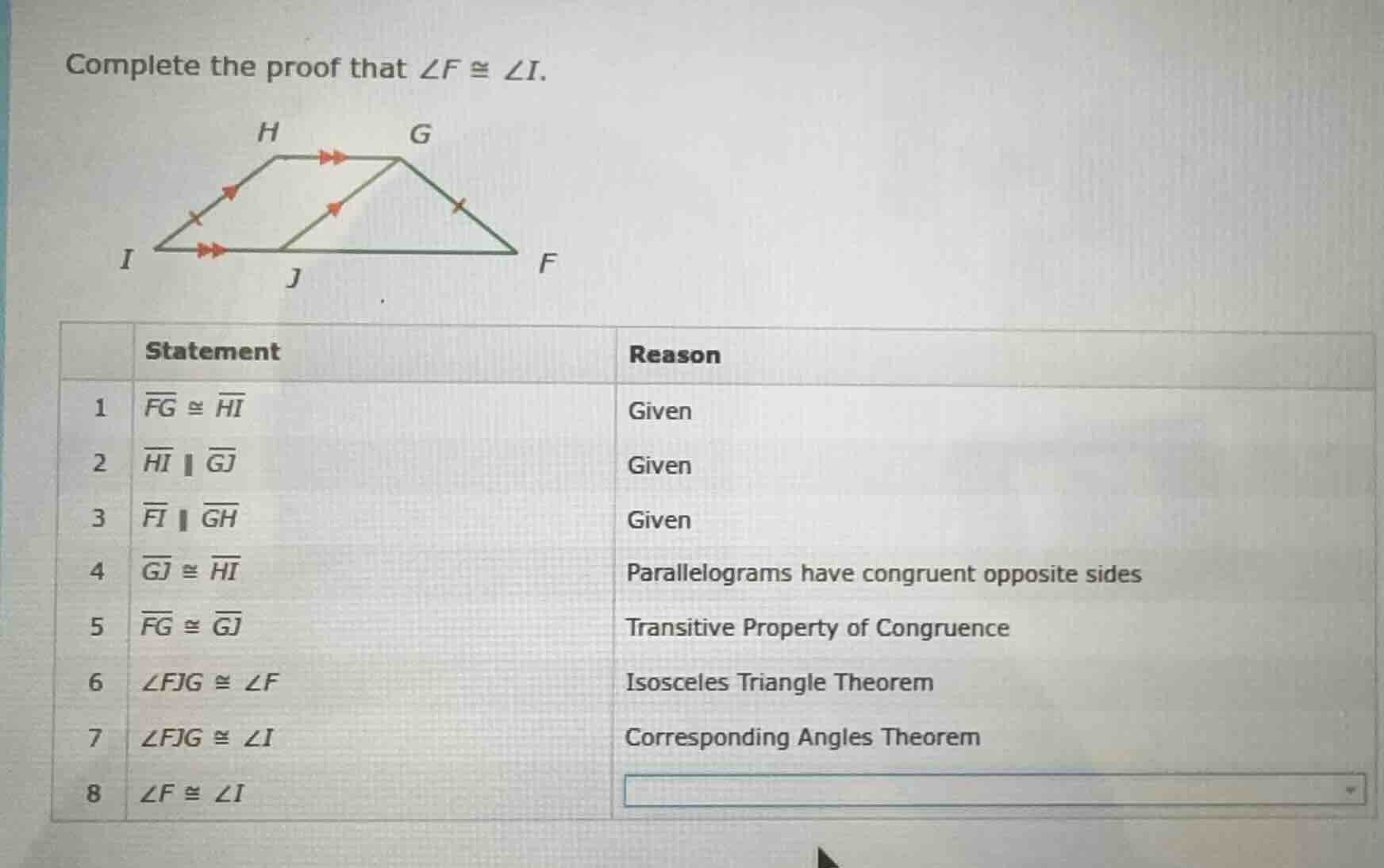
complete the proof that $\angle f \cong \angle i$.
| statement | reason | |
| 1 | $\overline{fg} \cong \overline{hi}$ | given |
| 2 | $\overline{hi} \parallel \overline{gj}$ | given |
| 3 | $\overline{fi} \parallel \overline{gh}$ | given |
| 4 | $\overline{gj} \cong \overline{hi}$ | parallelograms have congruent opposite sides |
| 5 | $\overline{fg} \cong \overline{gj}$ | transitive property of congruence |
| 6 | $\angle fjg \cong \angle f$ | isosceles triangle theorem |
| 7 | $\angle fjg \cong \angle i$ | corresponding angles theorem |
| 8 | $\angle f \cong \angle i$ |
Step1: Identify the relevant property
We know from steps 6 and 7 that $\angle FJG \cong \angle F$ and $\angle FJG \cong \angle I$. To show $\angle F \cong \angle I$, we use the Transitive Property of Congruence, which states that if $a \cong b$ and $b \cong c$, then $a \cong c$. Here, let $a = \angle F$, $b = \angle FJG$, and $c = \angle I$. Since $\angle F \cong \angle FJG$ (step 6) and $\angle FJG \cong \angle I$ (step 7), by the Transitive Property of Congruence, $\angle F \cong \angle I$.

Snap & solve any problem in the app
Get step-by-step solutions on Sovi AI
Photo-based solutions with guided steps
Explore more problems and detailed explanations
Transitive Property of Congruence