QUESTION IMAGE
Question
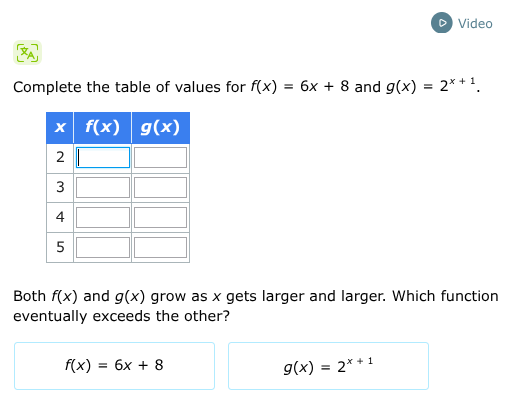
complete the table of values for $f(x) = 6x + 8$ and $g(x) = 2^{x + 1}$.
| $x$ | $f(x)$ | $g(x)$ |
|---|---|---|
| 3 | ||
| 4 | ||
| 5 |
both $f(x)$ and $g(x)$ grow as $x$ gets larger and larger. which function eventually exceeds the other?
$f(x) = 6x + 8$
$g(x) = 2^{x + 1}$
Part 1: Completing the table of values
For \( f(x) = 6x + 8 \)
Step 1: When \( x = 2 \)
Substitute \( x = 2 \) into \( f(x) \):
\( f(2) = 6(2) + 8 = 12 + 8 = 20 \)
Step 2: When \( x = 3 \)
Substitute \( x = 3 \) into \( f(x) \):
\( f(3) = 6(3) + 8 = 18 + 8 = 26 \)
Step 3: When \( x = 4 \)
Substitute \( x = 4 \) into \( f(x) \):
\( f(4) = 6(4) + 8 = 24 + 8 = 32 \)
Step 4: When \( x = 5 \)
Substitute \( x = 5 \) into \( f(x) \):
\( f(5) = 6(5) + 8 = 30 + 8 = 38 \)
For \( g(x) = 2^{x + 1} \)
Step 1: When \( x = 2 \)
Substitute \( x = 2 \) into \( g(x) \):
\( g(2) = 2^{2 + 1} = 2^3 = 8 \)
Step 2: When \( x = 3 \)
Substitute \( x = 3 \) into \( g(x) \):
\( g(3) = 2^{3 + 1} = 2^4 = 16 \)
Step 3: When \( x = 4 \)
Substitute \( x = 4 \) into \( g(x) \):
\( g(4) = 2^{4 + 1} = 2^5 = 32 \)
Step 4: When \( x = 5 \)
Substitute \( x = 5 \) into \( g(x) \):
\( g(5) = 2^{5 + 1} = 2^6 = 64 \)
Completed Table:
| \( x \) | \( f(x) = 6x + 8 \) | \( g(x) = 2^{x + 1} \) |
|---|---|---|
| 3 | 26 | 16 |
| 4 | 32 | 32 |
| 5 | 38 | 64 |
Part 2: Determining which function exceeds the other
- \( f(x) = 6x + 8 \) is a linear function (degree 1), so its growth is constant (slope \( 6 \)).
- \( g(x) = 2^{x + 1} \) is an exponential function (base \( 2 > 1 \)), so its growth accelerates (doubles with each increase in \( x \), since \( 2^{x+1} = 2 \cdot 2^x \)).
From the table:
- At \( x = 4 \), \( f(4) = 32 \) and \( g(4) = 32 \) (equal).
- At \( x = 5 \), \( g(5) = 64 \) exceeds \( f(5) = 38 \).
For large \( x \), exponential functions eventually outpace linear functions because their growth rate becomes infinitely larger. Thus, \( g(x) = 2^{x + 1} \) will eventually exceed \( f(x) = 6x + 8 \).
Final Answers:
Table Completion:
- \( f(2) = 20 \), \( g(2) = 8 \)
- \( f(3) = 26 \), \( g(3) = 16 \)
- \( f(4) = 32 \), \( g(4) = 32 \)
- \( f(5) = 38 \), \( g(5) = 64 \)
Which function exceeds the other?
\( \boldsymbol{g(x) = 2^{x + 1}} \)

Snap & solve any problem in the app
Get step-by-step solutions on Sovi AI
Photo-based solutions with guided steps
Explore more problems and detailed explanations
Part 1: Completing the table of values
For \( f(x) = 6x + 8 \)
Step 1: When \( x = 2 \)
Substitute \( x = 2 \) into \( f(x) \):
\( f(2) = 6(2) + 8 = 12 + 8 = 20 \)
Step 2: When \( x = 3 \)
Substitute \( x = 3 \) into \( f(x) \):
\( f(3) = 6(3) + 8 = 18 + 8 = 26 \)
Step 3: When \( x = 4 \)
Substitute \( x = 4 \) into \( f(x) \):
\( f(4) = 6(4) + 8 = 24 + 8 = 32 \)
Step 4: When \( x = 5 \)
Substitute \( x = 5 \) into \( f(x) \):
\( f(5) = 6(5) + 8 = 30 + 8 = 38 \)
For \( g(x) = 2^{x + 1} \)
Step 1: When \( x = 2 \)
Substitute \( x = 2 \) into \( g(x) \):
\( g(2) = 2^{2 + 1} = 2^3 = 8 \)
Step 2: When \( x = 3 \)
Substitute \( x = 3 \) into \( g(x) \):
\( g(3) = 2^{3 + 1} = 2^4 = 16 \)
Step 3: When \( x = 4 \)
Substitute \( x = 4 \) into \( g(x) \):
\( g(4) = 2^{4 + 1} = 2^5 = 32 \)
Step 4: When \( x = 5 \)
Substitute \( x = 5 \) into \( g(x) \):
\( g(5) = 2^{5 + 1} = 2^6 = 64 \)
Completed Table:
| \( x \) | \( f(x) = 6x + 8 \) | \( g(x) = 2^{x + 1} \) |
|---|---|---|
| 3 | 26 | 16 |
| 4 | 32 | 32 |
| 5 | 38 | 64 |
Part 2: Determining which function exceeds the other
- \( f(x) = 6x + 8 \) is a linear function (degree 1), so its growth is constant (slope \( 6 \)).
- \( g(x) = 2^{x + 1} \) is an exponential function (base \( 2 > 1 \)), so its growth accelerates (doubles with each increase in \( x \), since \( 2^{x+1} = 2 \cdot 2^x \)).
From the table:
- At \( x = 4 \), \( f(4) = 32 \) and \( g(4) = 32 \) (equal).
- At \( x = 5 \), \( g(5) = 64 \) exceeds \( f(5) = 38 \).
For large \( x \), exponential functions eventually outpace linear functions because their growth rate becomes infinitely larger. Thus, \( g(x) = 2^{x + 1} \) will eventually exceed \( f(x) = 6x + 8 \).
Final Answers:
Table Completion:
- \( f(2) = 20 \), \( g(2) = 8 \)
- \( f(3) = 26 \), \( g(3) = 16 \)
- \( f(4) = 32 \), \( g(4) = 32 \)
- \( f(5) = 38 \), \( g(5) = 64 \)
Which function exceeds the other?
\( \boldsymbol{g(x) = 2^{x + 1}} \)