QUESTION IMAGE
Question
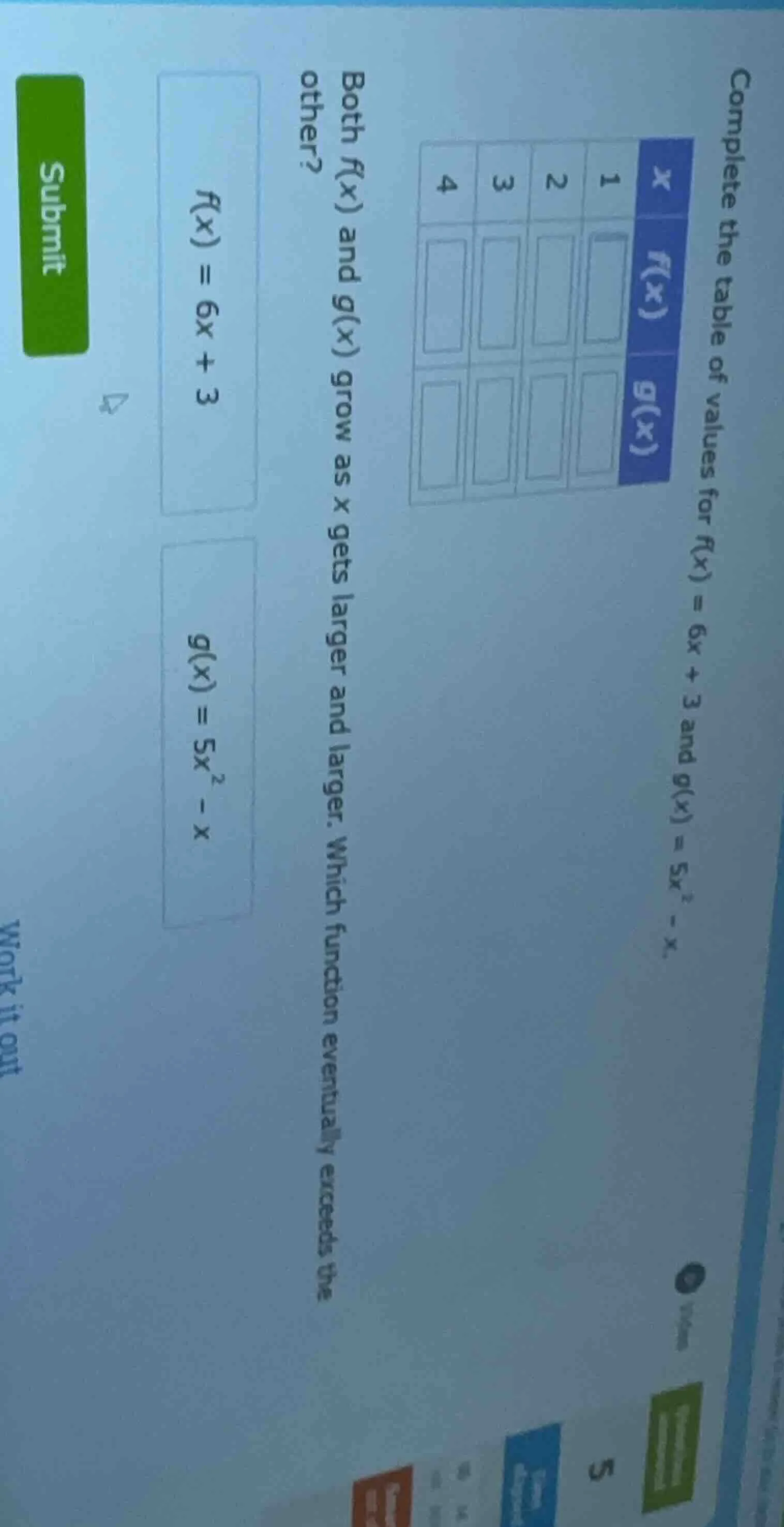
complete the table of values for ( f(x) = 6x + 3 ) and ( g(x) = 5x^2 - x ). both ( f(x) ) and ( g(x) ) grow as ( x ) gets larger and larger. which function eventually exceeds the other? ( f(x) = 6x + 3 ) ( g(x) = 5x^2 - x )
Step1: Calculate f(x) for x=1
Substitute x=1 into $f(x)=6x+3$:
$6(1)+3=9$
Step2: Calculate f(x) for x=2
Substitute x=2 into $f(x)=6x+3$:
$6(2)+3=15$
Step3: Calculate f(x) for x=3
Substitute x=3 into $f(x)=6x+3$:
$6(3)+3=21$
Step4: Calculate f(x) for x=4
Substitute x=4 into $f(x)=6x+3$:
$6(4)+3=27$
Step5: Calculate g(x) for x=1
Substitute x=1 into $g(x)=5x^2-x$:
$5(1)^2-1=4$
Step6: Calculate g(x) for x=2
Substitute x=2 into $g(x)=5x^2-x$:
$5(2)^2-2=18$
Step7: Calculate g(x) for x=3
Substitute x=3 into $g(x)=5x^2-x$:
$5(3)^2-3=42$
Step8: Compare long-term growth
Quadratic functions grow faster than linear functions.

Snap & solve any problem in the app
Get step-by-step solutions on Sovi AI
Photo-based solutions with guided steps
Explore more problems and detailed explanations
Completed Table:
| $x$ | $f(x)$ | $g(x)$ |
|---|---|---|
| 2 | 15 | 18 |
| 3 | 21 | 42 |
| 4 | 27 | 76 |
Growth Conclusion:
$g(x) = 5x^2 - x$ eventually exceeds $f(x) = 6x + 3$ as $x$ increases.