QUESTION IMAGE
Question
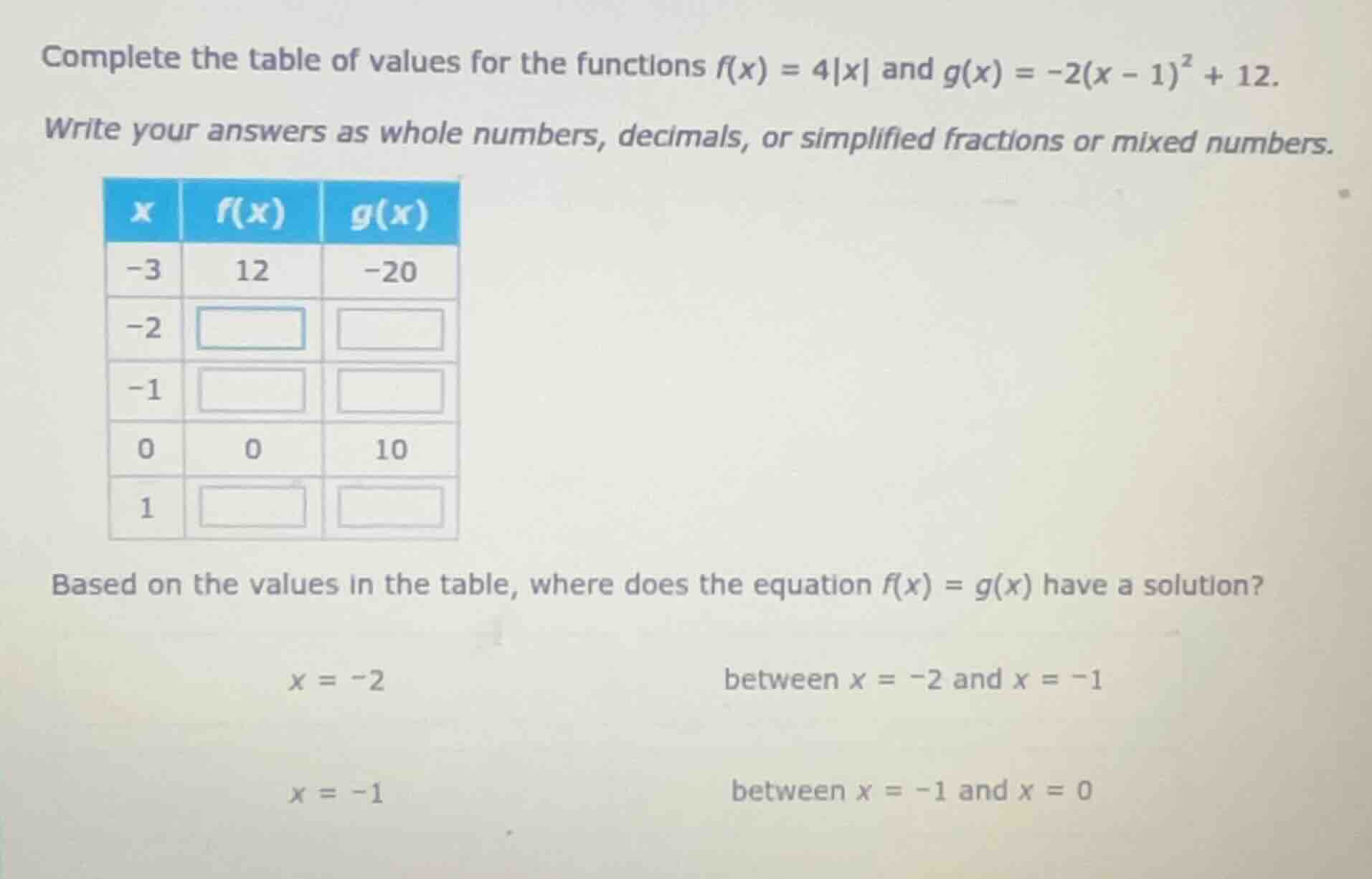
complete the table of values for the functions $f(x) = 4|x|$ and $g(x) = -2(x - 1)^2 + 12$. write your answers as whole numbers, decimals, or simplified fractions or mixed numbers. \
based on the values in the table, where does the equation $f(x) = g(x)$ have a solution? $x = -2$ \quad\quad\quad\quad between $x = -2$ and $x = -1$ $x = -1$ \quad\quad\quad\quad between $x = -1$ and $x = 0$
Part 1: Completing the table for \( f(x) = 4|x| \) and \( g(x) = -2(x - 1)^2 + 12 \)
For \( f(x) = 4|x| \):
- When \( x = -2 \):
\( f(-2) = 4|-2| = 4 \times 2 = 8 \)
- When \( x = -1 \):
\( f(-1) = 4|-1| = 4 \times 1 = 4 \)
- When \( x = 1 \):
\( f(1) = 4|1| = 4 \times 1 = 4 \)
For \( g(x) = -2(x - 1)^2 + 12 \):
- When \( x = -2 \):
\( g(-2) = -2(-2 - 1)^2 + 12 = -2(-3)^2 + 12 = -2(9) + 12 = -18 + 12 = -6 \)
- When \( x = -1 \):
\( g(-1) = -2(-1 - 1)^2 + 12 = -2(-2)^2 + 12 = -2(4) + 12 = -8 + 12 = 4 \)
- When \( x = 1 \):
\( g(1) = -2(1 - 1)^2 + 12 = -2(0)^2 + 12 = 0 + 12 = 12 \)
Filled Table:
| \( x \) | \( f(x) \) | \( g(x) \) |
|---|---|---|
| \( -2 \) | \( 8 \) | \( -6 \) |
| \( -1 \) | \( 4 \) | \( 4 \) |
| \( 0 \) | \( 0 \) | \( 10 \) |
| \( 1 \) | \( 4 \) | \( 12 \) |
Part 2: Solving \( f(x) = g(x) \)
To find where \( f(x) = g(x) \), we analyze the table:
- At \( x = -2 \): \( f(-2) = 8 \), \( g(-2) = -6 \) ( \( f(x) > g(x) \) )
- At \( x = -1 \): \( f(-1) = 4 \), \( g(-1) = 4 \) ( \( f(x) = g(x) \) ) Wait, no—wait, the table shows \( f(-1) = 4 \) and \( g(-1) = 4 \), so \( x = -1 \) is a solution? Wait, no, let’s recheck:
Wait, the original table for \( x = -1 \):
\( f(-1) = 4 \), \( g(-1) = 4 \). So \( f(-1) = g(-1) \), meaning \( x = -1 \) is a solution? But the options include "between \( x = -2 \) and \( x = -1 \)" or "between \( x = -1 \) and \( x = 0 \)". Wait, maybe a miscalculation?
Wait, let’s re-express \( g(x) \):
\( g(x) = -2(x - 1)^2 + 12 \). At \( x = -1 \):
\( (x - 1) = -2 \), squared is \( 4 \), times \( -2 \) is \( -8 \), plus \( 12 \) is \( 4 \). Correct. \( f(-1) = 4 \). So \( f(-1) = g(-1) \), so \( x = -1 \) is a solution. But the options are:
- \( x = -2 \)
- between \( x = -2 \) and \( x = -1 \)
- \( x = -1 \)
- between \( x = -1 \) and \( x = 0 \)
From the table, at \( x = -1 \), \( f(x) = g(x) = 4 \). So the solution is \( x = -1 \).
Final Answers:
Table Completion:
- \( x = -2 \): \( f(x) = 8 \), \( g(x) = -6 \)
- \( x = -1 \): \( f(x) = 4 \), \( g(x) = 4 \)
- \( x = 1 \): \( f(x) = 4 \), \( g(x) = 12 \)
Solution to \( f(x) = g(x) \):
\( x = -1 \) (since \( f(-1) = g(-1) = 4 \))
Final Answer for the Equation:
\( \boldsymbol{x = -1} \)

Snap & solve any problem in the app
Get step-by-step solutions on Sovi AI
Photo-based solutions with guided steps
Explore more problems and detailed explanations
Part 1: Completing the table for \( f(x) = 4|x| \) and \( g(x) = -2(x - 1)^2 + 12 \)
For \( f(x) = 4|x| \):
- When \( x = -2 \):
\( f(-2) = 4|-2| = 4 \times 2 = 8 \)
- When \( x = -1 \):
\( f(-1) = 4|-1| = 4 \times 1 = 4 \)
- When \( x = 1 \):
\( f(1) = 4|1| = 4 \times 1 = 4 \)
For \( g(x) = -2(x - 1)^2 + 12 \):
- When \( x = -2 \):
\( g(-2) = -2(-2 - 1)^2 + 12 = -2(-3)^2 + 12 = -2(9) + 12 = -18 + 12 = -6 \)
- When \( x = -1 \):
\( g(-1) = -2(-1 - 1)^2 + 12 = -2(-2)^2 + 12 = -2(4) + 12 = -8 + 12 = 4 \)
- When \( x = 1 \):
\( g(1) = -2(1 - 1)^2 + 12 = -2(0)^2 + 12 = 0 + 12 = 12 \)
Filled Table:
| \( x \) | \( f(x) \) | \( g(x) \) |
|---|---|---|
| \( -2 \) | \( 8 \) | \( -6 \) |
| \( -1 \) | \( 4 \) | \( 4 \) |
| \( 0 \) | \( 0 \) | \( 10 \) |
| \( 1 \) | \( 4 \) | \( 12 \) |
Part 2: Solving \( f(x) = g(x) \)
To find where \( f(x) = g(x) \), we analyze the table:
- At \( x = -2 \): \( f(-2) = 8 \), \( g(-2) = -6 \) ( \( f(x) > g(x) \) )
- At \( x = -1 \): \( f(-1) = 4 \), \( g(-1) = 4 \) ( \( f(x) = g(x) \) ) Wait, no—wait, the table shows \( f(-1) = 4 \) and \( g(-1) = 4 \), so \( x = -1 \) is a solution? Wait, no, let’s recheck:
Wait, the original table for \( x = -1 \):
\( f(-1) = 4 \), \( g(-1) = 4 \). So \( f(-1) = g(-1) \), meaning \( x = -1 \) is a solution? But the options include "between \( x = -2 \) and \( x = -1 \)" or "between \( x = -1 \) and \( x = 0 \)". Wait, maybe a miscalculation?
Wait, let’s re-express \( g(x) \):
\( g(x) = -2(x - 1)^2 + 12 \). At \( x = -1 \):
\( (x - 1) = -2 \), squared is \( 4 \), times \( -2 \) is \( -8 \), plus \( 12 \) is \( 4 \). Correct. \( f(-1) = 4 \). So \( f(-1) = g(-1) \), so \( x = -1 \) is a solution. But the options are:
- \( x = -2 \)
- between \( x = -2 \) and \( x = -1 \)
- \( x = -1 \)
- between \( x = -1 \) and \( x = 0 \)
From the table, at \( x = -1 \), \( f(x) = g(x) = 4 \). So the solution is \( x = -1 \).
Final Answers:
Table Completion:
- \( x = -2 \): \( f(x) = 8 \), \( g(x) = -6 \)
- \( x = -1 \): \( f(x) = 4 \), \( g(x) = 4 \)
- \( x = 1 \): \( f(x) = 4 \), \( g(x) = 12 \)
Solution to \( f(x) = g(x) \):
\( x = -1 \) (since \( f(-1) = g(-1) = 4 \))
Final Answer for the Equation:
\( \boldsymbol{x = -1} \)