QUESTION IMAGE
Question
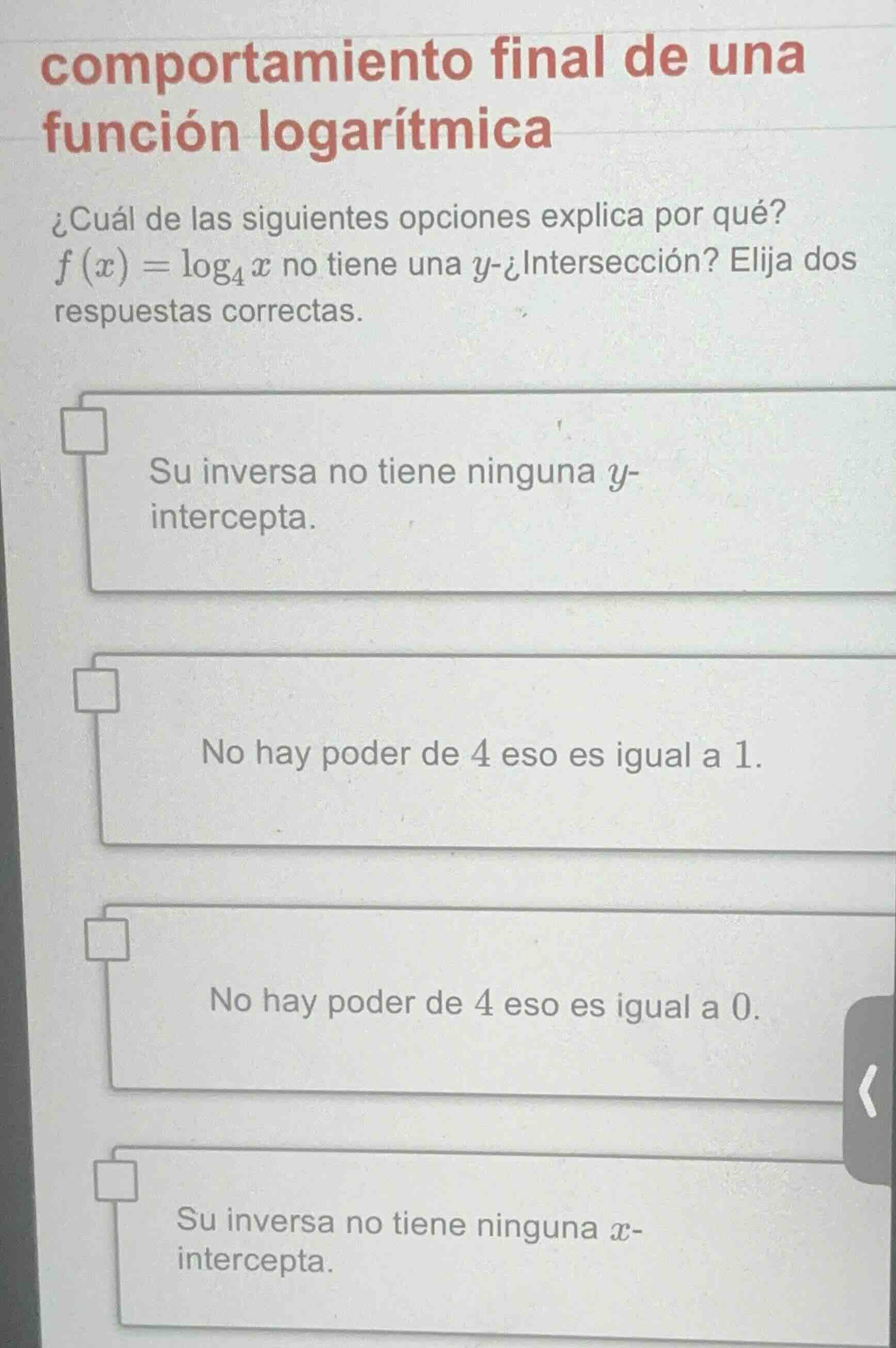
comportamiento final de una función logarítmica
¿cuál de las siguientes opciones explica por qué?
$f(x) = \log_{4} x$ no tiene una $y$-¿intersección? elija dos respuestas correctas.
- su inversa no tiene ninguna $y$-intercepta.
- no hay poder de 4 eso es igual a 1.
- no hay poder de 4 eso es igual a 0.
- su inversa no tiene ninguna $x$-intercepta.
To solve the problem of why \( f(x)=\log_{4}x \) has no \( y \)-intercept, we analyze the options:
Step 1: Recall the definition of \( y \)-intercept
A \( y \)-intercept occurs where \( x = 0 \). For \( f(x)=\log_{4}x \), we check if \( x = 0 \) is in the domain. The domain of \( \log_{b}x \) is \( x>0 \), so \( x = 0 \) is not in the domain. Thus, \( f(x) \) has no \( y \)-intercept.
Step 2: Analyze the inverse function
The inverse of \( f(x)=\log_{4}x \) is \( f^{-1}(x)=4^{x} \) (since logarithmic and exponential functions are inverses).
- Option 1: "Su inversa no tiene ninguna \( y \)-intercepta."
The \( y \)-intercept of \( f^{-1}(x)=4^{x} \) occurs at \( x = 0 \): \( 4^{0}=1 \). So \( f^{-1}(x) \) does have a \( y \)-intercept (\( (0,1) \)). This option is incorrect.
- Option 2: "No hay poder de 4 eso es igual a 1."
A \( y \)-intercept requires \( x = 0 \). For \( f(x)=\log_{4}x \), setting \( x = 0 \) is undefined (since \( \log_{4}0 \) is not a real number). The statement "No hay poder de 4 eso es igual a 1" is unclear, but it does not relate to \( x = 0 \) for \( \log_{4}x \). This option is incorrect.
- Option 3: "No hay poder de 4 eso es igual a 0."
For \( \log_{4}x \) to have a \( y \)-intercept, \( x = 0 \) would be required. But \( \log_{4}0 \) is undefined. The statement "No hay poder de 4 eso es igual a 0" refers to the fact that there is no exponent \( k \) such that \( 4^{k}=0 \) (since exponential functions \( 4^{x} \) are always positive). This is related to the domain of \( \log_{4}x \) (which excludes \( x = 0 \)), so this option is correct.
- Option 4: "Su inversa no tiene ninguna \( x \)-intercepta."
The \( x \)-intercept of \( f^{-1}(x)=4^{x} \) occurs where \( y = 0 \), i.e., \( 4^{x}=0 \). But \( 4^{x}>0 \) for all \( x \), so \( f^{-1}(x) \) has no \( x \)-intercept. Since \( f(x) \) and \( f^{-1}(x) \) are inverses, the \( y \)-intercept of \( f(x) \) corresponds to the \( x \)-intercept of \( f^{-1}(x) \). If \( f^{-1}(x) \) has no \( x \)-intercept, then \( f(x) \) has no \( y \)-intercept. This option is correct.
Correct Options
The two correct options are:
- "No hay poder de 4 eso es igual a 0."
- "Su inversa no tiene ninguna \( x \)-intercepta."

Snap & solve any problem in the app
Get step-by-step solutions on Sovi AI
Photo-based solutions with guided steps
Explore more problems and detailed explanations
- No hay poder de 4 eso es igual a 0.
- Su inversa no tiene ninguna \( x \)-intercepta.