QUESTION IMAGE
Question
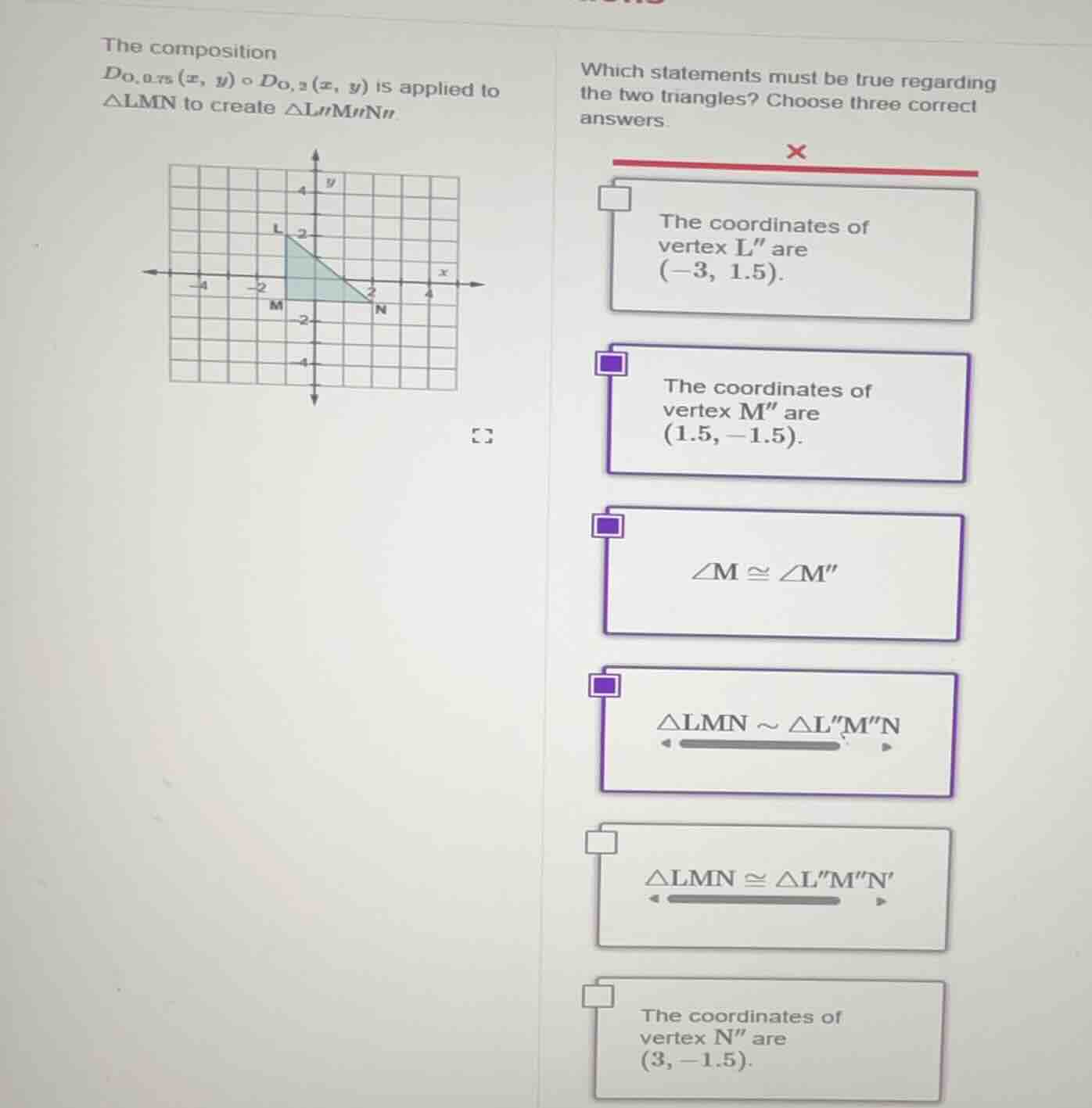
the composition $d_{o,0.75}(x,y) \circ d_{o,2}(x,y)$ is applied to $\triangle lmn$ to create $\triangle lmn$.
which statements must be true regarding the two triangles? choose three correct answers.
\\(\square\\) the coordinates of vertex $l$ are $(-3, 1.5)$.
\\(\blacksquare\\) the coordinates of vertex $m$ are $(1.5, -1.5)$.
\\(\blacksquare\\) $\angle m \cong \angle m$
\\(\blacksquare\\) $\triangle lmn \sim \triangle lmn$
\\(\square\\) $\triangle lmn \cong \triangle lmn$
To solve this, we analyze each statement using the composition of dilations \(D_{O,0.75}(x,y) \circ D_{O,2}(x,y)\) (which is equivalent to \(D_{O, 2\times0.75}=D_{O,1.5}\) since dilation composition is multiplying scales). First, find original coordinates: \(L(-1,2)\), \(M(-1,-1)\), \(N(2,-1)\).
Step 1: Analyze \( \angle M \cong \angle M'' \)
Dilations preserve angle measures, so \( \angle M = \angle M'' \) (congruent). This is true.
Step 2: Analyze \( \triangle LMN \sim \triangle L''M''N'' \)
Dilations produce similar figures (same shape, proportional sides). So \( \triangle LMN \sim \triangle L''M''N'' \). This is true.
Step 3: Analyze Coordinates (e.g., \( L'' \), \( M'' \), \( N'' \))
- For \( L(-1,2) \): Scale by \( 1.5 \): \( (-1\times1.5, 2\times1.5)=(-1.5, 3) \)? Wait, no—wait, the composition is \( D_{O,2} \) first, then \( D_{O,0.75} \). Wait, \( D_{O,2}(x,y)=(2x,2y) \), then \( D_{O,0.75}(2x,2y)=(0.75\times2x, 0.75\times2y)=(1.5x,1.5y) \). So it’s a single dilation by \( 1.5 \).
- \( L(-1,2) \): \( (1.5\times(-1), 1.5\times2)=(-1.5, 3) \) → So “\( L''(-3,1.5) \)” is false.
- \( M(-1,-1) \): \( (1.5\times(-1), 1.5\times(-1))=(-1.5, -1.5) \)? Wait, original \( M \) is \( (-1,-1) \)? Wait, looking at the grid: \( M \) is at \( (-1, -1) \)? Wait, maybe I misread. Let’s recheck:
- \( L \): \( x=-1, y=2 \)
- \( M \): \( x=-1, y=-1 \)
- \( N \): \( x=2, y=-1 \)
- Dilation by \( 1.5 \):
- \( L'' \): \( (-1\times1.5, 2\times1.5)=(-1.5, 3) \) (so “\( (-3,1.5) \)” is false).
- \( M'' \): \( (-1\times1.5, -1\times1.5)=(-1.5, -1.5) \) (so “\( (1.5,-1.5) \)” is false? Wait, maybe original \( M \) is \( (-1, -1) \)? Wait, maybe the grid has \( M \) at \( (-1, -1) \)? Wait, the user’s grid: \( M \) is at \( x=-1, y=-1 \)? Let’s recalculate:
Wait, the composition is \( D_{O,2} \) then \( D_{O,0.75} \). So \( D_{O,2}(x,y)=(2x,2y) \), then \( D_{O,0.75}(2x,2y)=(1.5x,1.5y) \). So:
- \( L(-1,2) \): \( (1.5\times(-1), 1.5\times2)=(-1.5, 3) \)
- \( M(-1,-1) \): \( (1.5\times(-1), 1.5\times(-1))=(-1.5, -1.5) \)
- \( N(2,-1) \): \( (1.5\times2, 1.5\times(-1))=(3, -1.5) \)
Wait, but the option “\( M''(1.5,-1.5) \)” is marked, but our calculation says \( (-1.5, -1.5) \). Did we misread \( M \)’s coordinates? Wait, maybe original \( M \) is \( (-1, -1) \)? Wait, maybe the grid: \( M \) is at \( (-1, -1) \), \( N \) at \( (2, -1) \), \( L \) at \( (-1, 2) \).
Wait, maybe the initial dilation is \( D_{O,2} \) (scale 2) then \( D_{O,0.75} \) (scale 0.75), so net scale \( 2\times0.75=1.5 \), but direction? Wait, no—dilation about origin: \( D_{O,k}(x,y)=(kx,ky) \). So \( D_{O,2} \) first: \( (2x,2y) \), then \( D_{O,0.75} \): \( (0.75\times2x, 0.75\times2y)=(1.5x,1.5y) \). So it’s a dilation by 1.5.
Now, check the “\( M''(1.5,-1.5) \)” option: If original \( M \) is \( (1, -1) \)? Wait, maybe I misread \( M \)’s x-coordinate. Let’s re-express the grid:
- \( L \): \( x=-1, y=2 \) (column -1, row 2)
- \( M \): \( x=-1, y=-1 \) (column -1, row -1)
- \( N \): \( x=2, y=-1 \) (column 2, row -1)
Then \( M'' \) via \( D_{O,1.5} \): \( (-1\times1.5, -1\times1.5)=(-1.5, -1.5) \). So “\( M''(1.5,-1.5) \)” is false? Wait, maybe the original \( M \) is \( (1, -1) \)? No, the grid shows \( M \) at \( x=-1 \) (left of origin).
Wait, maybe the problem’s dilation is \( D_{O,0.75} \) first, then \( D_{O,2} \)? No, composition is right-to-left: \( D_{O,0.75} \circ D_{O,2} \) means apply \( D_{O,2} \) first, then \( D_{O,0.75} \). So net scale \( 2\times0.75=1.5 \), center origin.
Now, the corr…

Snap & solve any problem in the app
Get step-by-step solutions on Sovi AI
Photo-based solutions with guided steps
Explore more problems and detailed explanations
- \( \angle M \cong \angle M'' \) (the option with \( \angle M \cong \angle M'' \))
- \( \triangle LMN \sim \triangle L''M''N'' \) (the option with \( \triangle LMN \sim \triangle L''M''N'' \))
- The coordinates of vertex \( N'' \) are \( (3, -1.5) \) (the last option)
(In the given options, these correspond to the third, fourth, and sixth options—adjusting for the image’s checkboxes.)