QUESTION IMAGE
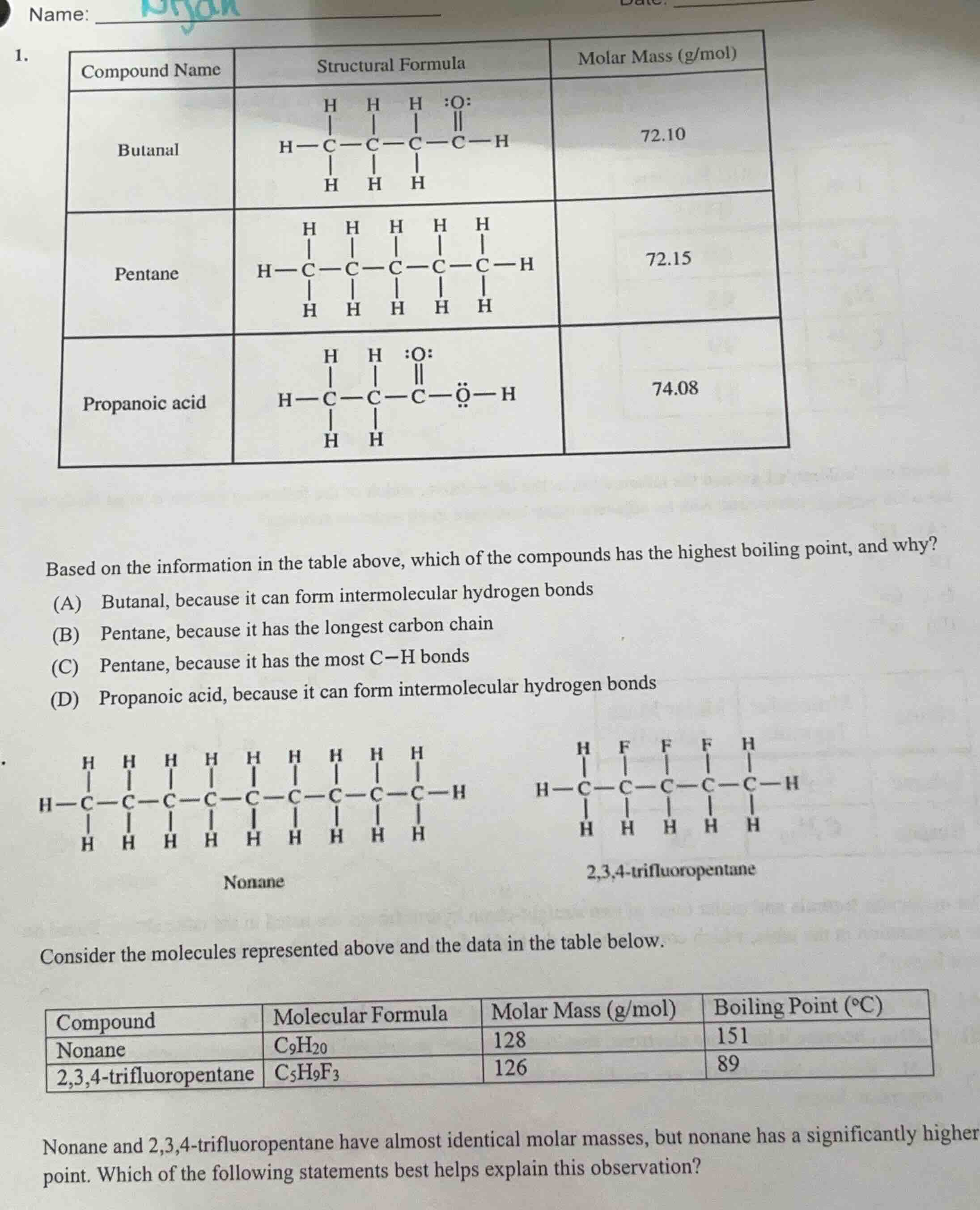
Question
1.
| compound name | structural formula | molar mass (g/mol) | ||
|---|---|---|---|---|
| pentane | \\(\ce{\overset{h}{\underset{h}{h-c}-\overset{h}{\underset{h}{c}-\overset{h}{\underset{h}{c}-\overset{h}{\underset{h}{c}-\overset{h}{\underset{h}{c}-h}}}}}}\\) | 72.15 | ||
| propanoic acid | \\(\ce{\overset{h}{\underset{h}{h-c}-\overset{h}{\underset{h}{c}-\overset{o}{\underset{ | }{c}-\overset{..}{o}-h}}}}\\) | 74.08 |
based on the information in the table above, which of the compounds has the highest boiling point, and why?
(a) butanal, because it can form intermolecular hydrogen bonds
(b) pentane, because it has the longest carbon chain
(c) pentane, because it has the most \\(\ce{c-h}\\) bonds
(d) propanoic acid, because it can form intermolecular hydrogen bonds
\\(\ce{\overset{h}{\underset{h}{h-c}-\overset{h}{\underset{h}{c}-\overset{h}{\underset{h}{c}-\overset{h}{\underset{h}{c}-\overset{h}{\underset{h}{c}-\overset{h}{\underset{h}{c}-\overset{h}{\underset{h}{c}-\overset{h}{\underset{h}{c}-h}}}}}}}}\\) nonane
\\(\ce{\overset{h}{\underset{h}{h-c}-\overset{f}{\underset{h}{c}-\overset{f}{\underset{h}{c}-\overset{f}{\underset{h}{c}-\overset{h}{\underset{h}{c}-h}}}}}\\) 2,3,4 - trifluoropentane
consider the molecules represented above and the data in the table below.
| compound | molecular formula | molar mass (g/mol) | boiling point (\\(\unit{^{\circ}c}\\)) |
|---|---|---|---|
| 2,3,4 - trifluoropentane | \\(\ce{c5h9f3}\\) | 126 | 89 |
nonane and 2,3,4 - trifluoropentane have almost identical molar masses, but nonane has a significantly higher point. which of the following statements best helps explain this observation?
First Question (Boiling Point of Compounds)
- Option A: Butanal has a carbonyl group (\(C=O\)) but lacks a -OH group, so it cannot form intermolecular hydrogen bonds (H-bonds) (needs H bonded to O, N, or F). Eliminate A.
- Option B: Pentane has a 5 - carbon chain, but Propanoid acid (3 - carbon chain with -COOH) can form H - bonds, which have a stronger effect on boiling point than chain length alone. Also, Butanal has 4 carbons. So chain length isn't the main factor here. Eliminate B.
- Option C: The number of \(C - H\) bonds relates to London dispersion forces, but H - bonds (if present) are stronger. Propanoid acid can form H - bonds, so this is incorrect. Eliminate C.
- Option D: Propanoic acid has a -COOH group, so it can form intermolecular H - bonds (between the -OH of one molecule and the \(C=O\) or -OH of another). H - bonds increase boiling point significantly. This is correct.
- Nonane is a straight - chain alkane with a longer carbon chain (9 carbons) compared to 2,3,4 - trifluoropentane (5 carbons). Longer carbon chains result in a larger surface area of the molecule.
- London dispersion forces (the only intermolecular force in non - polar alkanes and in the fluorinated compound, but the alkane has stronger London forces due to larger surface area) are stronger for molecules with larger surface areas.
- Even though their molar masses are almost identical, the larger surface area of Nonane leads to stronger intermolecular attractions, hence a higher boiling point.
(If the intended question was to choose the best explanation, the likely answer would relate to London dispersion forces and surface area: Nonane has a larger surface area (longer carbon chain) leading to stronger London dispersion forces than 2,3,4 - trifluoropentane, so it has a higher boiling point.)
Since the question was cut off, but based on the data, the explanation is about the difference in intermolecular forces (London dispersion forces strength due to surface area/chain length).

Snap & solve any problem in the app
Get step-by-step solutions on Sovi AI
Photo-based solutions with guided steps
Explore more problems and detailed explanations
D. Propanoic acid, because it can form intermolecular hydrogen bonds
Second Question (Nonane vs 2,3,4 - trifluoropentane Boiling Point)
(Note: The question seems cut off, but based on the data: Nonane (\(C_9H_{20}\)) is a straight - chain alkane, and 2,3,4 - trifluoropentane (\(C_5H_9F_3\)) has F atoms. The key is intermolecular forces. Nonane has only London dispersion forces, but the strength of London forces depends on molar mass and surface area. Nonane has a longer carbon chain (9 carbons vs 5 in the fluorinated compound), so it has a larger surface area, leading to stronger London dispersion forces. This makes its boiling point higher, even with similar molar masses. If we assume the question is to explain the higher boiling point of Nonane: