QUESTION IMAGE
Question
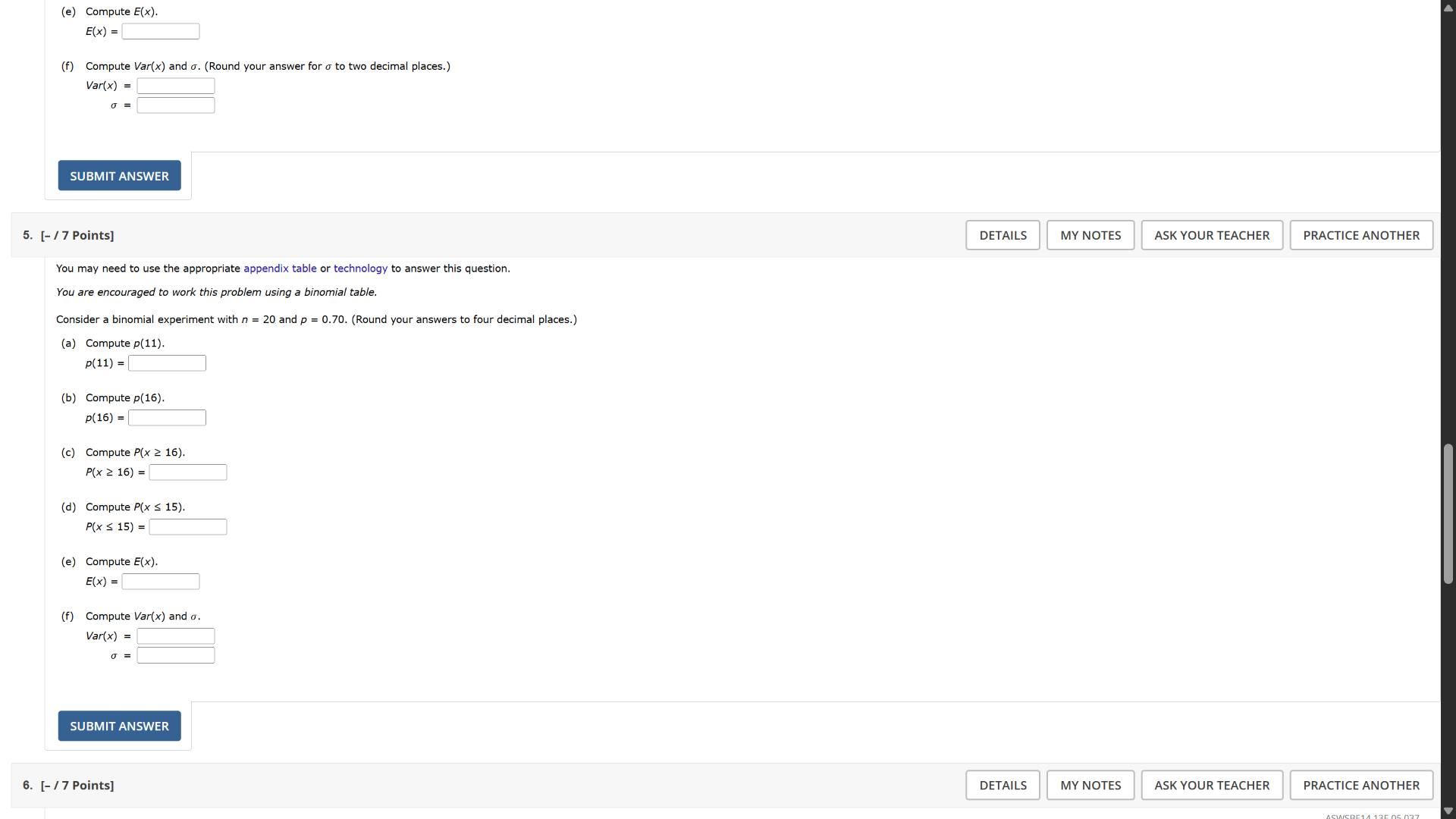
(e) compute ( e(x) ).
( e(x) = )
(f) compute ( \text{var}(x) ) and ( sigma ). (round your answer for ( sigma ) to two decimal places.)
( \text{var}(x) = )
( sigma = )
submit answer
- - / 7 points
details my notes ask your teacher practice another
you may need to use the appropriate appendix table or technology to answer this question.
you are encouraged to work this problem using a binomial table.
consider a binomial experiment with ( n = 20 ) and ( p = 0.70 ). (round your answers to four decimal places.)
(a) compute ( p(11) ).
( p(11) = )
(b) compute ( p(16) ).
( p(16) = )
(c) compute ( p(x geq 16) ).
( p(x geq 16) = )
(d) compute ( p(x leq 15) ).
( p(x leq 15) = )
(e) compute ( e(x) ).
( e(x) = )
(f) compute ( \text{var}(x) ) and ( sigma ).
( \text{var}(x) = )
( sigma = )
submit answer
- - / 7 points
details my notes ask your teacher practice another
Part (a): Compute \( p(11) \)
Step 1: Recall binomial probability formula
The binomial probability formula is \( p(x) = \binom{n}{x} p^x (1 - p)^{n - x} \), where \( \binom{n}{x} = \frac{n!}{x!(n - x)!} \), \( n = 20 \), \( p = 0.70 \), and \( x = 11 \).
Step 2: Calculate combination \( \binom{20}{11} \)
\( \binom{20}{11} = \frac{20!}{11!(20 - 11)!} = \frac{20!}{11!9!} = 167960 \)
Step 3: Substitute into probability formula
\( p(11) = 167960 \times (0.70)^{11} \times (0.30)^{9} \)
First, calculate \( (0.70)^{11} \approx 0.0197732674 \) and \( (0.30)^{9} \approx 0.000019683 \)
Then, \( p(11) \approx 167960 \times 0.0197732674 \times 0.000019683 \approx 0.0654 \)
Step 1: Use binomial probability formula
\( p(x) = \binom{n}{x} p^x (1 - p)^{n - x} \), \( n = 20 \), \( p = 0.70 \), \( x = 16 \)
Step 2: Calculate combination \( \binom{20}{16} \)
\( \binom{20}{16} = \binom{20}{4} = \frac{20!}{4!16!} = 4845 \)
Step 3: Substitute into formula
\( p(16) = 4845 \times (0.70)^{16} \times (0.30)^{4} \)
Calculate \( (0.70)^{16} \approx 0.003323293 \) and \( (0.30)^{4} = 0.0081 \)
Then, \( p(16) \approx 4845 \times 0.003323293 \times 0.0081 \approx 0.1304 \)
Step 1: Recall \( P(x \geq 16) = p(16) + p(17) + p(18) + p(19) + p(20) \)
Step 2: Calculate each probability
- \( p(17) = \binom{20}{17} (0.70)^{17} (0.30)^{3} \)
\( \binom{20}{17} = \binom{20}{3} = 1140 \)
\( (0.70)^{17} \approx 0.002326305 \), \( (0.30)^{3} = 0.027 \)
\( p(17) \approx 1140 \times 0.002326305 \times 0.027 \approx 0.0716 \)
- \( p(18) = \binom{20}{18} (0.70)^{18} (0.30)^{2} \)
\( \binom{20}{18} = \binom{20}{2} = 190 \)
\( (0.70)^{18} \approx 0.001628414 \), \( (0.30)^{2} = 0.09 \)
\( p(18) \approx 190 \times 0.001628414 \times 0.09 \approx 0.0277 \)
- \( p(19) = \binom{20}{19} (0.70)^{19} (0.30)^{1} \)
\( \binom{20}{19} = 20 \)
\( (0.70)^{19} \approx 0.00113989 \), \( (0.30)^{1} = 0.3 \)
\( p(19) \approx 20 \times 0.00113989 \times 0.3 \approx 0.0068 \)
- \( p(20) = \binom{20}{20} (0.70)^{20} (0.30)^{0} \)
\( \binom{20}{20} = 1 \), \( (0.70)^{20} \approx 0.000797923 \), \( (0.30)^{0} = 1 \)
\( p(20) \approx 1 \times 0.000797923 \times 1 \approx 0.0008 \)
Step 3: Sum the probabilities
\( P(x \geq 16) = 0.1304 + 0.0716 + 0.0277 + 0.0068 + 0.0008 \approx 0.2373 \)

Snap & solve any problem in the app
Get step-by-step solutions on Sovi AI
Photo-based solutions with guided steps
Explore more problems and detailed explanations
\( p(11) \approx 0.0654 \)