QUESTION IMAGE
Question
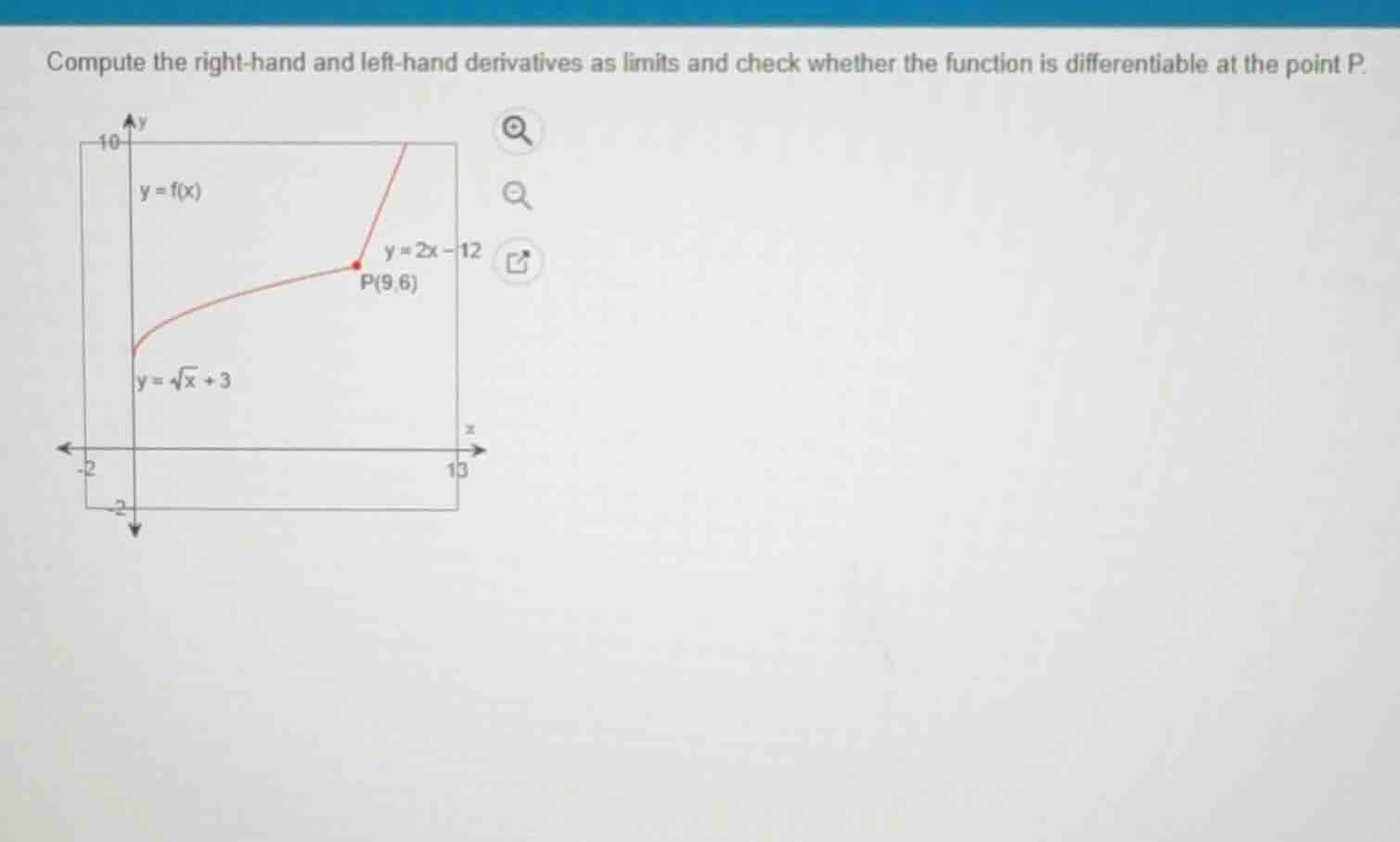
compute the right-hand and left-hand derivatives as limits and check whether the function is differentiable at the point p.
$y = f(x)$
$y = 2x - 12$
$p(9,6)$
$y = \sqrt{x} + 3$
Step1: Define left-hand derivative formula
The left-hand derivative at $x=9$ uses $f(x)=\sqrt{x}+3$:
$$\lim_{h \to 0^-} \frac{f(9+h)-f(9)}{h}$$
Step2: Substitute $f(9+h)$ and $f(9)$
$f(9)=\sqrt{9}+3=6$, so:
$$\lim_{h \to 0^-} \frac{\sqrt{9+h}+3 - 6}{h} = \lim_{h \to 0^-} \frac{\sqrt{9+h}-3}{h}$$
Step3: Rationalize the numerator
Multiply by $\frac{\sqrt{9+h}+3}{\sqrt{9+h}+3}$:
$$\lim_{h \to 0^-} \frac{(9+h)-9}{h(\sqrt{9+h}+3)} = \lim_{h \to 0^-} \frac{h}{h(\sqrt{9+h}+3)}$$
Step4: Simplify and evaluate the limit
Cancel $h$, then substitute $h=0$:
$$\lim_{h \to 0^-} \frac{1}{\sqrt{9+h}+3} = \frac{1}{3+3} = \frac{1}{6}$$
Step5: Define right-hand derivative formula
The right-hand derivative at $x=9$ uses $f(x)=2x-12$:
$$\lim_{h \to 0^+} \frac{f(9+h)-f(9)}{h}$$
Step6: Substitute $f(9+h)$ and $f(9)$
$f(9)=2(9)-12=6$, so:
$$\lim_{h \to 0^+} \frac{2(9+h)-12 - 6}{h} = \lim_{h \to 0^+} \frac{18+2h-18}{h}$$
Step7: Simplify and evaluate the limit
Simplify numerator, cancel $h$:
$$\lim_{h \to 0^+} \frac{2h}{h} = \lim_{h \to 0^+} 2 = 2$$
Step8: Check differentiability
A function is differentiable at a point if left-hand derivative = right-hand derivative. Here $\frac{1}{6}
eq 2$.

Snap & solve any problem in the app
Get step-by-step solutions on Sovi AI
Photo-based solutions with guided steps
Explore more problems and detailed explanations
Left-hand derivative at $P(9,6)$: $\frac{1}{6}$
Right-hand derivative at $P(9,6)$: $2$
The function is not differentiable at point $P$.