QUESTION IMAGE
Question
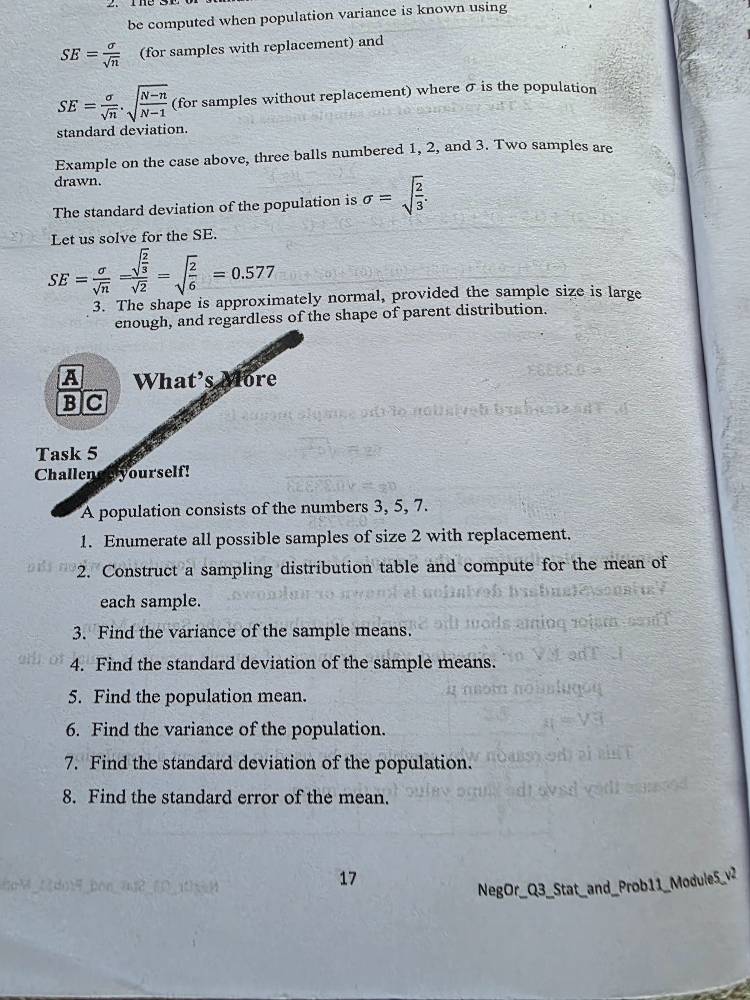
be computed when population variance is known using
$se = \frac{\sigma}{\sqrt{n}}$ (for samples with replacement) and
$se = \frac{\sigma}{\sqrt{n}} \cdot \sqrt{\frac{n - n}{n - 1}}$ (for samples without replacement) where $\sigma$ is the population standard deviation.
example on the case above, three balls numbered 1, 2, and 3. two samples are drawn.
the standard deviation of the population is $\sigma = \sqrt{\frac{2}{3}}$.
let us solve for the se.
$se = \frac{\sigma}{\sqrt{n}} = \frac{\sqrt{\frac{2}{3}}}{\sqrt{2}} = \sqrt{\frac{2}{6}} = 0.577$
- the shape is approximately normal, provided the sample size is large enough, and regardless of the shape of parent distribution.
whats more
task 5
challen yourself!
a population consists of the numbers 3, 5, 7.
- enumerate all possible samples of size 2 with replacement.
- construct a sampling distribution table and compute for the mean of each sample.
- find the variance of the sample means.
- find the standard deviation of the sample means.
- find the population mean.
- find the variance of the population.
- find the standard deviation of the population.
- find the standard error of the mean.
1. Enumerate all possible samples of size 2 with replacement.
Step1: Identify population elements
Population: {3, 5, 7}. Sample size \( n = 2 \), with replacement (so we can repeat elements).
Step2: List all combinations
- (3, 3)
- (3, 5)
- (3, 7)
- (5, 3)
- (5, 5)
- (5, 7)
- (7, 3)
- (7, 5)
- (7, 7)
Step1: Calculate mean for each sample
Mean formula: \( \bar{x} = \frac{x_1 + x_2}{2} \)
- (3, 3): \( \frac{3 + 3}{2} = 3 \)
- (3, 5): \( \frac{3 + 5}{2} = 4 \)
- (3, 7): \( \frac{3 + 7}{2} = 5 \)
- (5, 3): \( \frac{5 + 3}{2} = 4 \)
- (5, 5): \( \frac{5 + 5}{2} = 5 \)
- (5, 7): \( \frac{5 + 7}{2} = 6 \)
- (7, 3): \( \frac{7 + 3}{2} = 5 \)
- (7, 5): \( \frac{7 + 5}{2} = 6 \)
- (7, 7): \( \frac{7 + 7}{2} = 7 \)
Step2: Create sampling distribution table (frequency of each mean)
| Sample Mean (\( \bar{x} \)) | Frequency (\( f \)) |
|---|---|
| 4 | 2 |
| 5 | 3 |
| 6 | 2 |
| 7 | 1 |
Step1: Recall variance formula for sampling distribution
\( \sigma_{\bar{x}}^2 = \frac{\sum f(\bar{x} - \mu_{\bar{x}})^2}{N} \) (where \( N \) is total number of samples, \( \mu_{\bar{x}} \) is mean of sample means)
First, find \( \mu_{\bar{x}} \):
\( \mu_{\bar{x}} = \frac{\sum f\bar{x}}{\sum f} = \frac{1(3) + 2(4) + 3(5) + 2(6) + 1(7)}{9} = \frac{3 + 8 + 15 + 12 + 7}{9} = \frac{45}{9} = 5 \)
Step2: Calculate \( (\bar{x} - \mu_{\bar{x}})^2 \) for each \( \bar{x} \)
- For \( \bar{x} = 3 \): \( (3 - 5)^2 = 4 \), \( f = 1 \), \( f(\bar{x} - \mu_{\bar{x}})^2 = 1 \times 4 = 4 \)
- For \( \bar{x} = 4 \): \( (4 - 5)^2 = 1 \), \( f = 2 \), \( f(\bar{x} - \mu_{\bar{x}})^2 = 2 \times 1 = 2 \)
- For \( \bar{x} = 5 \): \( (5 - 5)^2 = 0 \), \( f = 3 \), \( f(\bar{x} - \mu_{\bar{x}})^2 = 3 \times 0 = 0 \)
- For \( \bar{x} = 6 \): \( (6 - 5)^2 = 1 \), \( f = 2 \), \( f(\bar{x} - \mu_{\bar{x}})^2 = 2 \times 1 = 2 \)
- For \( \bar{x} = 7 \): \( (7 - 5)^2 = 4 \), \( f = 1 \), \( f(\bar{x} - \mu_{\bar{x}})^2 = 1 \times 4 = 4 \)
Step3: Sum the squared terms
\( \sum f(\bar{x} - \mu_{\bar{x}})^2 = 4 + 2 + 0 + 2 + 4 = 12 \)
Step4: Compute variance
\( \sigma_{\bar{x}}^2 = \frac{12}{9} = \frac{4}{3} \approx 1.333 \)

Snap & solve any problem in the app
Get step-by-step solutions on Sovi AI
Photo-based solutions with guided steps
Explore more problems and detailed explanations
(3, 3), (3, 5), (3, 7), (5, 3), (5, 5), (5, 7), (7, 3), (7, 5), (7, 7)