QUESTION IMAGE
Question
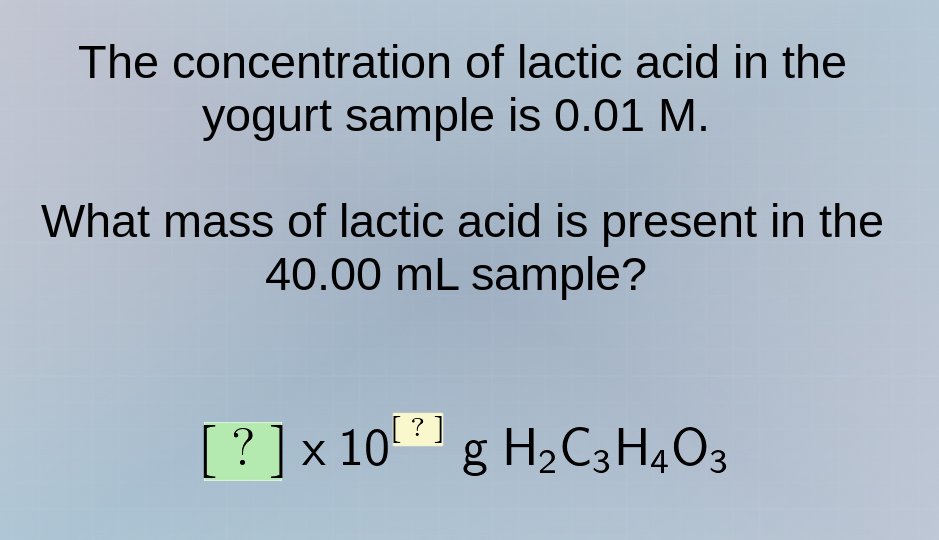
the concentration of lactic acid in the yogurt sample is 0.01 m. what mass of lactic acid is present in the 40.00 ml sample? ? × 10^? g h₂c₃h₄o₃
Step1: Recall the formula for moles from molarity
Molarity ($M$) is defined as moles of solute ($n$) per liter of solution ($V$ in liters). The formula is $M=\frac{n}{V}$. We need to find moles first. Given $M = 0.01\ M$, $V = 40.00\ mL=0.04000\ L$. Rearranging the formula, $n = M\times V$.
$n=0.01\ mol/L\times0.04000\ L = 0.0004\ mol$
Step2: Calculate molar mass of lactic acid ($\ce{H2C3H4O3}$)
Molar mass is calculated by summing the atomic masses of each atom. Atomic masses: $H = 1\ g/mol$, $C = 12\ g/mol$, $O = 16\ g/mol$.
For $\ce{H2C3H4O3}$, number of $H$ atoms: $2 + 4=6$, $C$ atoms: $3$, $O$ atoms: $3$.
Molar mass ($M_m$) = $(6\times1)+(3\times12)+(3\times16)=6 + 36+48 = 90\ g/mol$
Step3: Calculate mass from moles
Mass ($m$) = moles ($n$) $\times$ molar mass ($M_m$). So $m = 0.0004\ mol\times90\ g/mol = 0.036\ g$. In scientific notation, $0.036\ g = 3.6\times10^{-2}\ g$.

Snap & solve any problem in the app
Get step-by-step solutions on Sovi AI
Photo-based solutions with guided steps
Explore more problems and detailed explanations
$3.6\times 10^{-2}$ (so the first box is 3.6 and the second box is -2)