QUESTION IMAGE
Question
concepts:
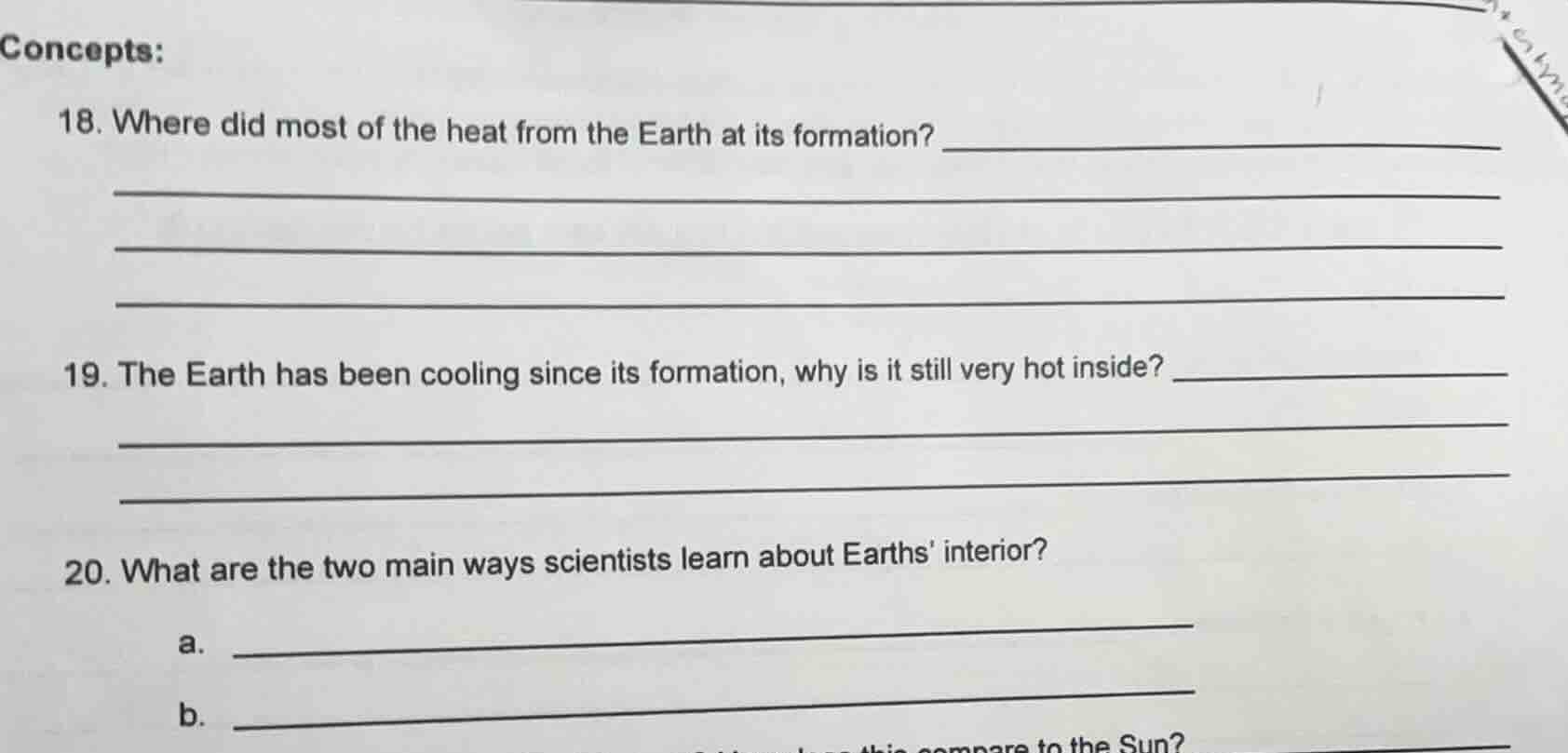
- where did most of the heat from the earth at its formation?
- the earth has been cooling since its formation, why is it still very hot inside?
- what are the two main ways scientists learn about earths interior?
a.
b.
Question 18
Most of the heat at Earth's formation came from accretion (collision of planetesimals, releasing gravitational potential energy as heat) and radioactive decay (of elements like uranium, thorium, potassium, releasing heat as they decay). Also, the differentiation process (heavy elements sinking to core, releasing gravitational energy as heat) contributed.
Earth remains hot inside because of ongoing radioactive decay (producing new heat), its large size (slow heat loss due to low surface - to - volume ratio, so heat takes long to escape), and the insulating effect of the mantle (reducing heat transfer to the surface, slowing cooling).
Scientists learn about Earth’s interior mainly through: (a) Seismic waves (earthquakes generate P - waves and S - waves; by studying how these waves travel through/reflect off different layers, we infer density, composition, and state of matter in the interior). (b) Laboratory experiments and modeling (replicating high - pressure/temperature conditions of Earth’s interior in labs to study mineral behavior, and using computer models to simulate interior processes like convection or core dynamics).

Snap & solve any problem in the app
Get step-by-step solutions on Sovi AI
Photo-based solutions with guided steps
Explore more problems and detailed explanations
Most of the heat at Earth’s formation came from three main sources: (1) accretion (collisions of planetesimals during Earth’s assembly released gravitational potential energy as heat), (2) radioactive decay (of unstable isotopes like uranium, thorium, and potassium, which emit heat as they decay), and (3) differentiation (heavy elements sinking to the core, releasing gravitational energy as heat).