QUESTION IMAGE
Question
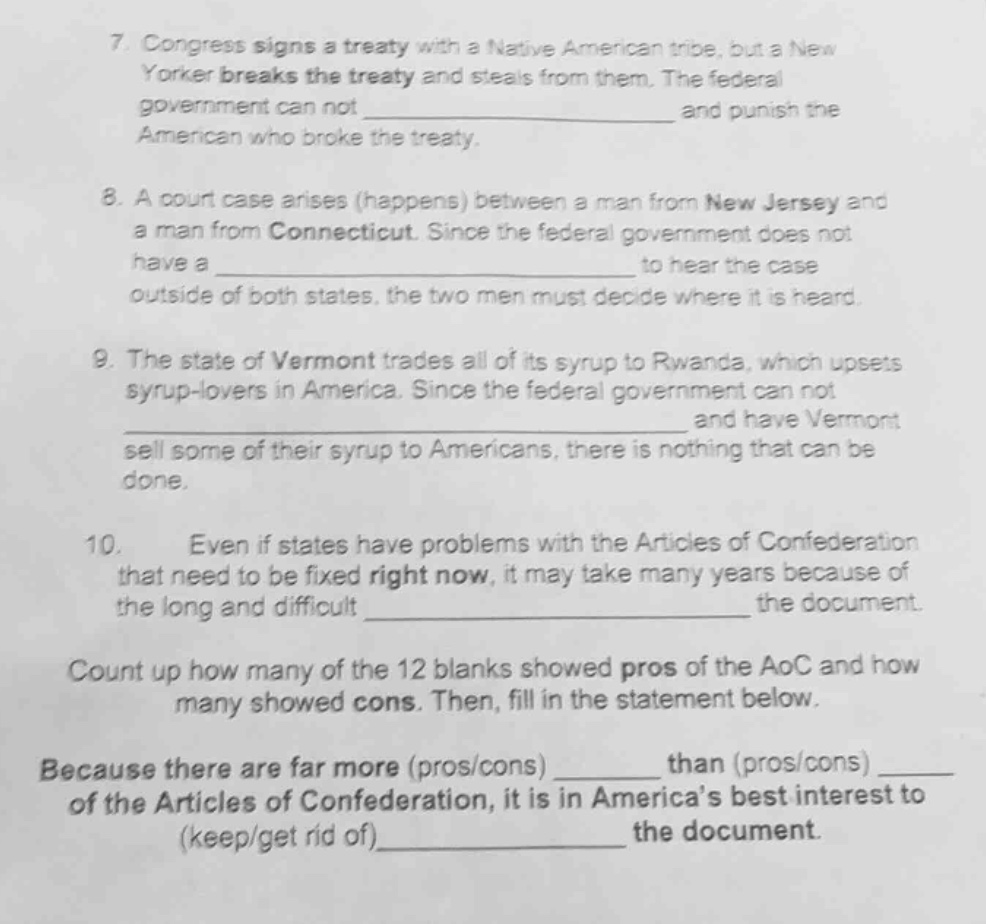
- congress signs a treaty with a native american tribe, but a new yorker breaks the treaty and steals from them. the federal government can not _________________ and punish the american who broke the treaty.
- a court case arises (happens) between a man from new jersey and a man from connecticut. since the federal government does not have a _________________ to hear the case outside of both states, the two men must decide where it is heard.
- the state of vermont trades all of its syrup to rwanda, which upsets syrup - lovers in america. since the federal government can not _________________ and have vermont sell some of their syrup to americans, there is nothing that can be done.
- even if states have problems with the articles of confederation that need to be fixed right now, it may take many years because of the long and difficult _________________ the document.
count up how many of the 12 blanks showed pros of the aoc and how many showed cons. then, fill in the statement below.
because there are far more (pros/cons) ___ than (pros/cons) _ of the articles of confederation, it is in americas best interest to (keep/get rid of) __________ the document.
Question 7
Under the Articles of Confederation, the federal government had limited power to enforce treaties against individuals. It lacked the authority to coerce states or individuals to follow treaty obligations in such cases, so the blank likely relates to a power like "enforce the treaty" or "use force" (but more accurately, the federal government couldn't "intervene" or "take action" to punish the individual, but the key here is the lack of enforcement power. The typical answer for this blank is "force the New Yorker to comply" or more precisely, the federal government could not "intervene" or "take legal action" (but in the context of AoC, the federal govt had no power to enforce treaties against individuals, so the blank is about the federal government's inability to "punish" or "enforce"—the standard answer for this is that the federal government could not "intervene" or "take action", but the specific term here is related to the lack of authority to enforce, so the blank is filled with something like "intervene" or "enforce the treaty" (but in the context of the Articles, the federal government had no power to enforce treaties against citizens of states, so the answer is that the federal government can not "intervene" or "take legal action", but the exact term is "force" or "compel"—however, the standard answer for this question (from typical AoC worksheets) is that the federal government could not "intervene" or "punish"—but the correct fill is "force the New Yorker to comply" or more accurately, the federal government had no power to "enforce the treaty" against the individual, so the blank is "enforce the treaty" or "take action".
Question 8
Under the Articles of Confederation, the federal government had no jurisdiction (or "court" or "judicial power") to hear cases between citizens of different states unless it was related to certain limited matters. The federal government lacked a "court system" or "judicial authority" to hear such cases outside the states involved. The standard answer here is that the federal government does not have a "court" (or "judicial power", "jurisdiction") to hear the case outside of both states. So the blank is filled with "court" or "judicial authority" (more precisely, the federal government had no "federal court" or "jurisdiction" to hear inter - state disputes in a court outside the states, so the answer is "court" or "judicial power").
Question 9
The Articles of Confederation gave states significant economic autonomy. The federal government could not "regulate interstate (or foreign) trade" in the way needed to force a state to sell goods domestically. The federal government had no power to "regulate trade" or "interfere with state trade decisions". So the blank is about the federal government's inability to "regulate trade" or "intervene in Vermont's trade" to make them sell syrup to Americans. The standard answer is that the federal government can not "regulate trade" or "interfere with Vermont's trade policy"—more precisely, the federal government had no power to "regulate interstate commerce" (but since it's trade with a foreign nation (Rwanda) and then domestic sales, the key is the federal government's lack of power to regulate state trade, so the blank is "regulate trade" or "intervene" to make Vermont sell syrup to Americans.
Question 10

Snap & solve any problem in the app
Get step-by-step solutions on Sovi AI
Photo-based solutions with guided steps
Explore more problems and detailed explanations
s (for each blank and the final statement):
- (Example answer based on AoC context) intervene (or enforce the treaty, or take action) (Note: The most accurate answer in typical worksheets is that the federal government could not "force the New Yorker to comply" or "enforce the treaty", but a common fill is "intervene")
- court (or judicial authority, or jurisdiction) (Commonly, "court" as the federal government had no federal court system to hear such cases)
- regulate trade (or interfere with Vermont's trade, or compel Vermont) (Commonly, "regulate trade" as the federal government lacked trade regulation powers)
- process of amending (or procedure to amend) (As amending required unanimous state approval, a long and difficult process)
For the final statement:
Because there are far more (pros/cons) $\boldsymbol{\text{cons}}$ than (pros/cons) $\boldsymbol{\text{pros}}$ of the Articles of Confederation, it is in America's best interest to (keep/get rid of) $\boldsymbol{\text{get rid of}}$ the document.