QUESTION IMAGE
Question
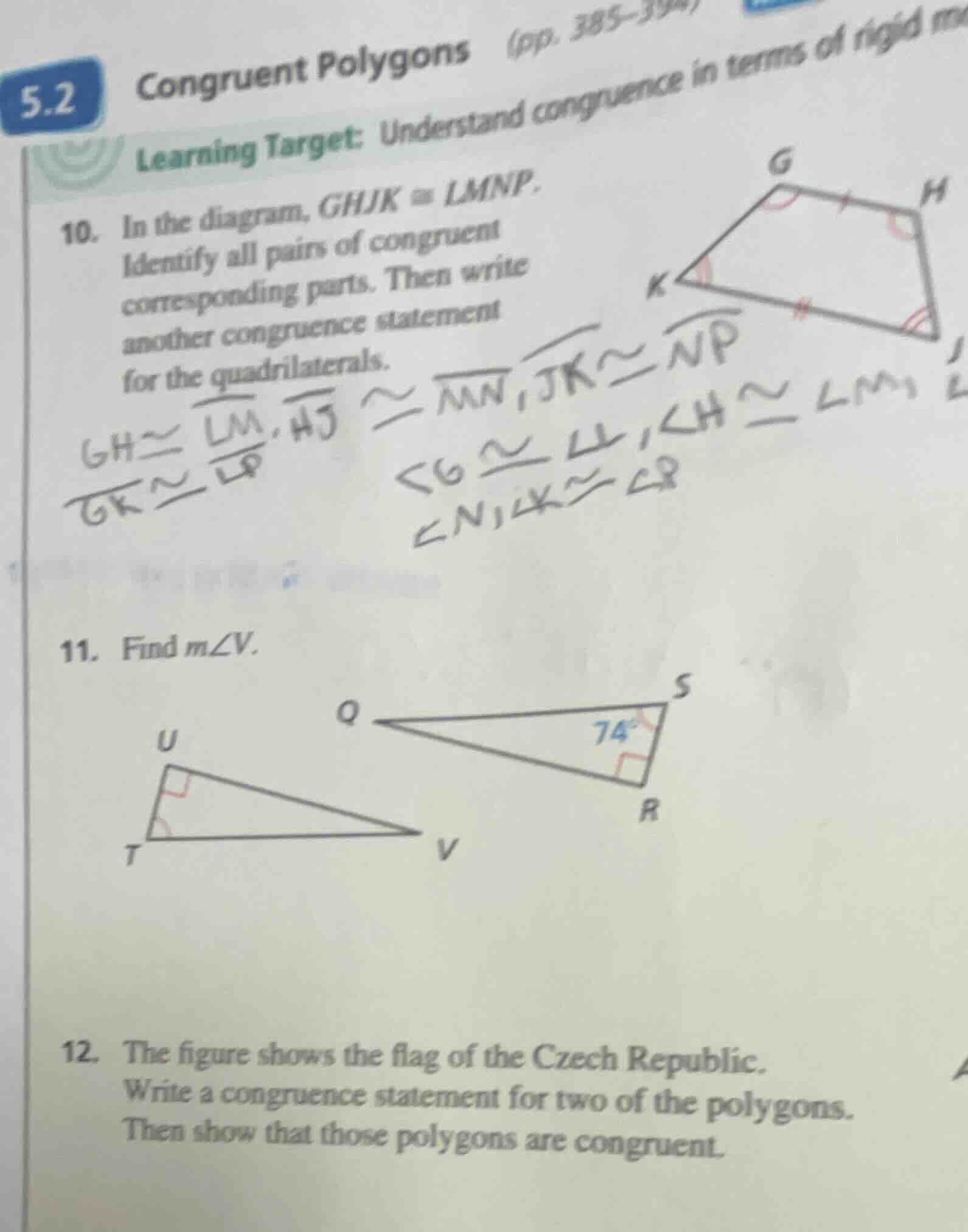
5.2 congruent polygons (pp. 385-394) learning target: understand congruence in terms of rigid m 10. in the diagram, ghjk ≅ lmnp. identify all pairs of congruent corresponding parts. then write another congruence statement for the quadrilaterals. 11. find m∠v. 12. the figure shows the flag of the czech republic. write a congruence statement for two of the polygons. then show that those polygons are congruent.
Problem 11: Find \( m\angle V \)
Step 1: Identify Congruent Triangles
The triangles \( \triangle TUV \) and \( \triangle QRS \) are right triangles (since \( \angle U \) and \( \angle R \) are right angles, \( 90^\circ \)) and appear to be congruent (marked with congruent angles and right angles). So, corresponding angles are equal. In \( \triangle QRS \), we know \( \angle S = 74^\circ \), \( \angle R = 90^\circ \). The sum of angles in a triangle is \( 180^\circ \), so \( \angle Q = 180^\circ - 90^\circ - 74^\circ = 16^\circ \). But since \( \triangle TUV \cong \triangle QRS \), \( \angle V \) corresponds to \( \angle S \)? Wait, no, let's check the markings. The marked angle in \( \triangle TUV \) is at \( T \), and in \( \triangle QRS \) at \( S \). Wait, actually, the right angle is \( \angle U \) and \( \angle R \), and the other marked angle (acute) is at \( T \) and \( S \)? Wait, no, the triangle \( \triangle QRS \) has \( \angle R = 90^\circ \), \( \angle S = 74^\circ \), so \( \angle Q = 180 - 90 - 74 = 16^\circ \)? Wait, no, maybe the triangles are congruent, so \( \angle V \) corresponds to \( \angle Q \)? Wait, no, let's re-examine. The right angle is \( \angle U \) (in \( \triangle TUV \)) and \( \angle R \) (in \( \triangle QRS \)). The angle at \( T \) (in \( \triangle TUV \)) is marked congruent to the angle at \( S \) (in \( \triangle QRS \))? Wait, the diagram shows \( \triangle TUV \) with right angle at \( U \), angle at \( T \) marked, and \( \triangle QRS \) with right angle at \( R \), angle at \( S \) marked \( 74^\circ \). So if the triangles are congruent, then \( \angle T \cong \angle S \), so \( \angle T = 74^\circ \). Then in \( \triangle TUV \), \( \angle U = 90^\circ \), \( \angle T = 74^\circ \), so \( \angle V = 180^\circ - 90^\circ - 74^\circ = 16^\circ \)? Wait, no, that can't be. Wait, maybe the correspondence is \( \triangle TUV \cong \triangle SRQ \)? Wait, maybe I mixed up the correspondence. Let's assume the triangles are congruent, so corresponding angles are equal. The right angles are \( \angle U \) and \( \angle R \), so \( \angle U \cong \angle R \). The angle at \( T \) (in \( \triangle TUV \)) and angle at \( S \) (in \( \triangle QRS \)) are congruent, so \( \angle T \cong \angle S \). Therefore, the third angles \( \angle V \) and \( \angle Q \) must be congruent. Wait, but in \( \triangle QRS \), \( \angle S = 74^\circ \), \( \angle R = 90^\circ \), so \( \angle Q = 180 - 90 - 74 = 16^\circ \). But that seems small. Wait, maybe the angle at \( S \) is \( 74^\circ \), so the angle at \( T \) is also \( 74^\circ \), so in \( \triangle TUV \), angles are \( 90^\circ \) (at \( U \)), \( 74^\circ \) (at \( T \)), so \( \angle V = 180 - 90 - 74 = 16^\circ \)? Wait, that must be it. So \( m\angle V = 16^\circ \)? Wait, no, wait, maybe I got the correspondence wrong. Let's do it properly.
In a right triangle, the two acute angles are complementary (sum to \( 90^\circ \)). So in \( \triangle QRS \), right-angled at \( R \), \( \angle S = 74^\circ \), so the other acute angle \( \angle Q = 90^\circ - 74^\circ = 16^\circ \). Since \( \triangle TUV \cong \triangle QRS \) (by congruent right angles and congruent acute angles), \( \angle V \) corresponds to \( \angle Q \), so \( m\angle V = 16^\circ \)? Wait, no, wait, maybe \( \angle V \) corresponds to \( \angle S \)? No, that would be \( 74^\circ \), but that would make the sum exceed \( 180^\circ \). Wait, no, let's check the triangle angle sum. For \( \triangle TUV \), angles are \( \angle U = 90^\circ \), \( \angle T \), and \( \angle V \). If \( \triangle TUV \cong \t…

Snap & solve any problem in the app
Get step-by-step solutions on Sovi AI
Photo-based solutions with guided steps
Explore more problems and detailed explanations
\( m\angle V = 16^\circ \)