QUESTION IMAGE
Question
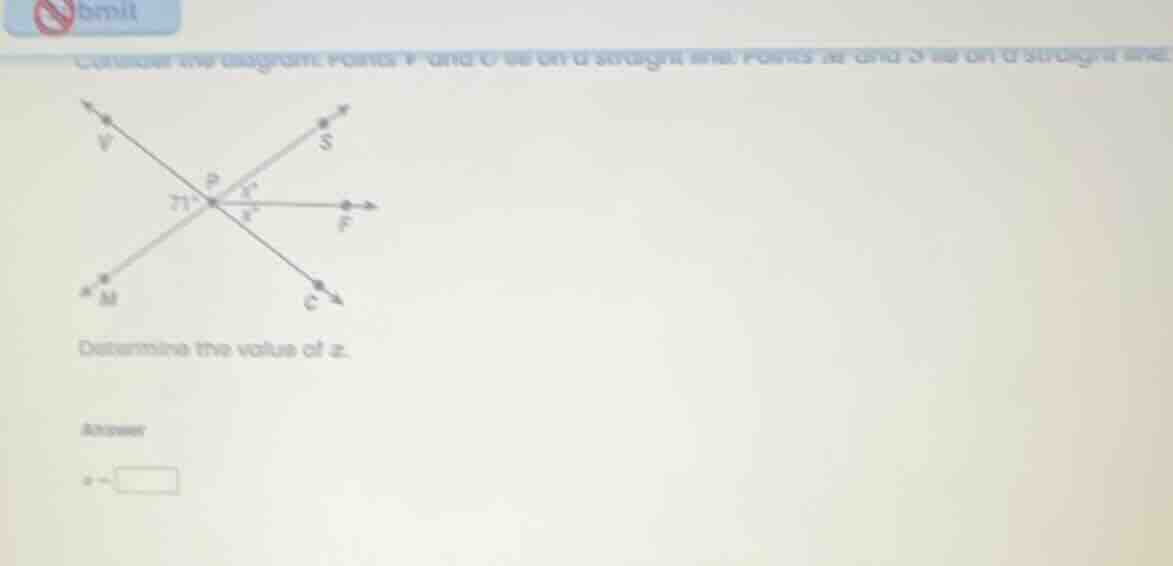
consider the diagram. points v and c lie on a straight line. points m and s lie on a straight line. determine the value of x. answer x = \boxed{}
Step1: Identify angle relationship
The angle of \(71^\circ\) and the angle \(x^\circ\) are adjacent and form a linear pair (they are on a straight line), so their sum is \(180^\circ\)? Wait, no, actually, looking at the diagram, the angle \(71^\circ\) and the angle \(x\) (along with the right angle? Wait, no, maybe vertical angles or supplementary. Wait, the line \(VF\) is a straight line? Wait, no, the lines \(VC\) and \(MF\)? Wait, no, the key is that the angle of \(71^\circ\) and the angle \(x\) are complementary? Wait, no, maybe the angle \(71^\circ\) and \(x\) are such that they are vertical or supplementary. Wait, actually, looking at the diagram, the angle \(71^\circ\) and \(x\) are adjacent and form a right angle? No, wait, the line \(PF\) is horizontal, and the angle between \(MP\) and \(VP\) is \(71^\circ\), and the angle between \(SP\) and \(PF\) is \(x\). Wait, maybe the angle \(71^\circ\) and \(x\) are complementary? No, wait, actually, the angle \(71^\circ\) and \(x\) are such that they add up to \(90^\circ\)? No, wait, maybe the angle \(71^\circ\) and \(x\) are vertical angles? No, wait, the correct approach: since the lines intersect, and we have a straight line, the sum of \(71^\circ\), \(x\), and the right angle? Wait, no, the diagram shows that \(PF\) is a horizontal ray, and \(SP\) is a ray, and \(MP\) and \(VP\) are lines. Wait, actually, the angle of \(71^\circ\) and \(x\) are complementary? No, wait, the correct way: the angle \(71^\circ\) and \(x\) are adjacent and form a right angle? No, wait, maybe the angle \(71^\circ\) and \(x\) are such that \(71 + x = 90\)? No, that would be if there's a right angle. Wait, no, looking at the diagram, the angle between \(MP\) and \(VP\) is \(71^\circ\), and the angle between \(SP\) and \(PF\) is \(x\), and \(PF\) is perpendicular to... Wait, no, maybe the lines \(VC\) and \(MF\) intersect at \(P\), and \(PF\) is a horizontal line, and \(SP\) is a vertical line? No, the key is that the angle \(71^\circ\) and \(x\) are complementary, so \(x = 90 - 71 = 19\)? Wait, no, that's not right. Wait, maybe the angle \(71^\circ\) and \(x\) are supplementary? No, \(71 + x = 180\) would be too big. Wait, no, the correct relationship: the angle of \(71^\circ\) and \(x\) are adjacent and form a right angle, so \(71 + x = 90\), so \(x = 19\). Wait, let's re-examine. If the diagram has a right angle (since \(PF\) is horizontal and \(SP\) is vertical, forming a right angle), then the angle between \(MP\) and \(VP\) is \(71^\circ\), so the angle between \(SP\) and \(PF\) (which is \(x\)) would be \(90 - 71 = 19\). So:
Step1: Recognize right angle
The angle between \(SP\) and \(PF\) (x) and the angle of \(71^\circ\) are complementary (sum to \(90^\circ\)) because they form a right angle.
\[
71 + x = 90
\]
Step2: Solve for x
Subtract \(71\) from both sides:
\[
x = 90 - 71
\]
\[
x = 19
\]

Snap & solve any problem in the app
Get step-by-step solutions on Sovi AI
Photo-based solutions with guided steps
Explore more problems and detailed explanations
\(x = 19\)