QUESTION IMAGE
Question
consider the figure below.
a) what is the exact perimeter of the figure?
b) what is the approximate perimeter of the figure, rounded to two decimal places?
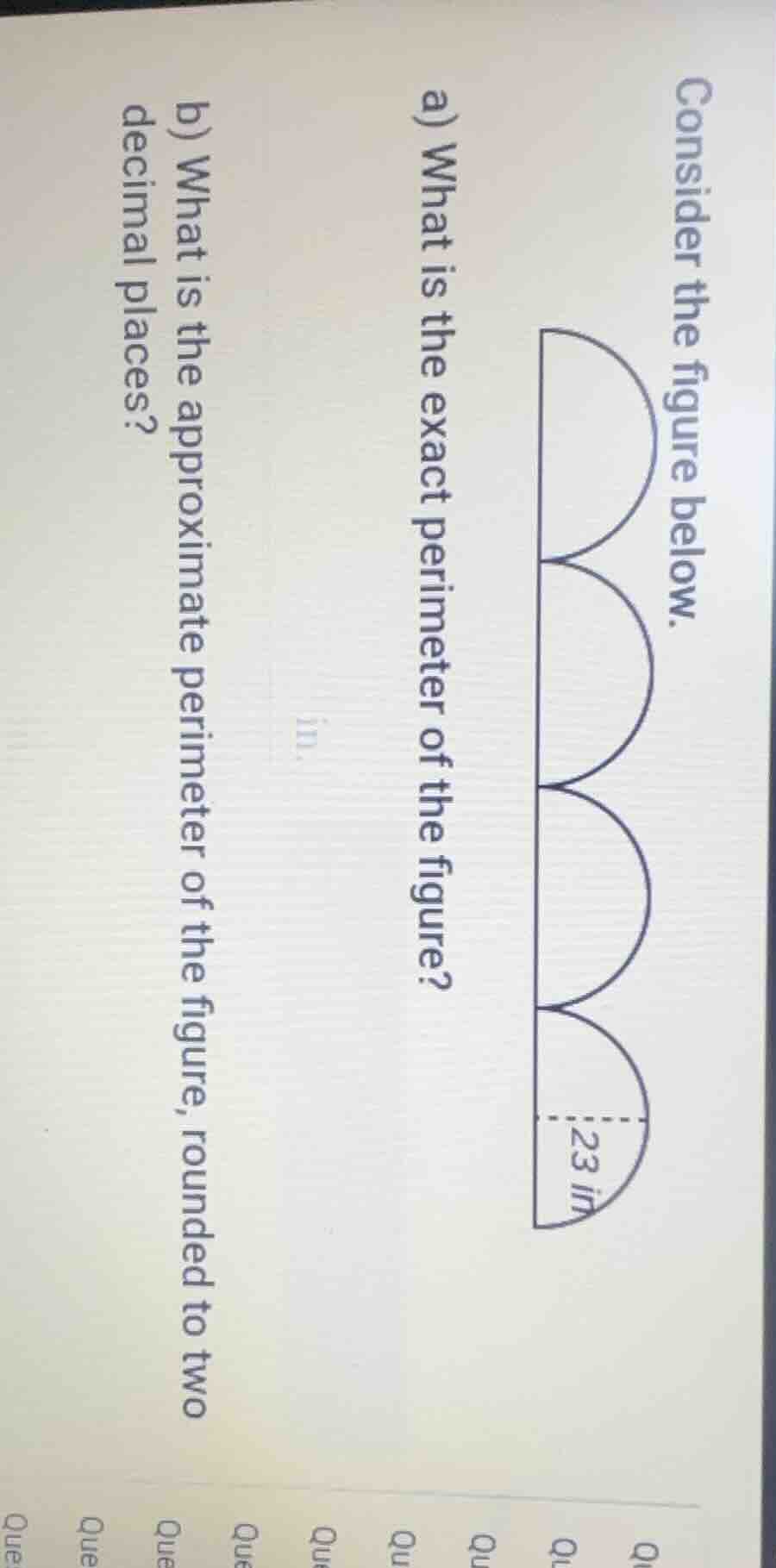
(the figure shows four semicircles with a dashed line labeled 23 in for the radius of the bottom - most semicircle)
Part (a)
Step 1: Analyze the figure's components
The figure consists of 4 semicircles on the top and a straight line at the bottom. The radius of each semicircle is \( r = 23 \) in. The length of the straight line is \( 4\times(2r)=4\times46 = 184 \) in (since each semicircle has a diameter of \( 2r \), and there are 4 diameters along the straight line). The curved part: the circumference of a full circle is \( C = 2\pi r \), so a semicircle's length is \( \pi r \). There are 4 semicircles, so total curved length is \( 4\times\pi r \). But notice that 4 semicircles (each with radius \( r \)) is equivalent to 2 full circles (since \( 4\times\frac{1}{2}=2 \)). So curved length is \( 2\times2\pi r\)? Wait, no. Wait, radius is 23, so diameter is 46. Wait, maybe I misread. Wait, the dashed line is 23, so radius is 23, diameter is 46. Wait, the figure: looking at the diagram, there are 4 semicircles, each with radius 23? Wait, no, maybe the diameter is 23? Wait, the dashed line is labeled 23 in, which is the radius? Wait, no, the dashed line is from the center to the arc, so that's radius \( r = 23 \) in. So each semicircle has radius 23, so diameter \( d = 46 \) in.
Wait, let's re-express: the curved part: each semicircle has length \( \pi r \). There are 4 semicircles, so total curved length is \( 4\times\pi r \). The straight part: the length is the sum of the diameters of the semicircles. Since each semicircle has diameter \( 2r \), and there are 4 semicircles, the straight length is \( 4\times2r=8r \)? Wait, no, looking at the diagram, the bottom line is a straight line with 4 semicircles above it, each attached to the line. So the straight line's length is equal to the sum of the diameters of the 4 semicircles. Each semicircle has diameter \( 2r \), so 4 diameters: \( 4\times2r = 8r \). Wait, but the dashed line is 23, so \( r = 23 \), so diameter is 46. Wait, maybe the dashed line is the diameter? Wait, the problem says "dashed line 23 in" – maybe that's the diameter. Let's check both cases. Wait, the diagram: the bottom semicircle has a dashed line from the center to the arc, so that's radius 23. So radius \( r = 23 \) in.
So curved part: 4 semicircles. Each semicircle's length is \( \pi r \). So 4 semicircles: \( 4\times\frac{1}{2}\times2\pi r= 4\pi r \)? Wait, no: circumference of a semicircle is \( \pi r + 2r \), but in this figure, the straight part of the semicircle is attached to the bottom line, so we only consider the curved part. So each semicircle's curved length is \( \pi r \). So 4 semicircles: \( 4\times\pi r \). The straight part: the length is the sum of the diameters of the 4 semicircles. Since each semicircle has diameter \( 2r \), 4 diameters: \( 4\times2r = 8r \). Wait, but let's check with \( r = 23 \):
Wait, maybe the figure is such that the total curved length is equal to the circumference of a circle with diameter equal to the total length of the straight line? Wait, no. Wait, another approach: the 4 semicircles (each with radius \( r \)) have a total curved length equal to \( 4\times\frac{1}{2}\times2\pi r= 4\pi r \) (since \( \frac{1}{2}\times2\pi r=\pi r \) per semicircle, times 4). The straight line: the length is \( 4\times2r = 8r \) (since each semicircle has a diameter of \( 2r \), and there are 4 diameters along the straight line). Wait, but let's plug \( r = 23 \):
Curved length: \( 4\times\pi\times23 = 92\pi \)
Straight length: \( 8\times23 = 184 \)
Wait, but wait, maybe the 4 semicircles are equivalent to 2 full circles. Because 4 semicircles (each is half a circle) make 2 full circles. So curved l…
Step 1: Use the exact perimeter from part (a)
We have the exact perimeter \( P = 92\pi + 184 \). We know that \( \pi \approx 3.1415926535 \).
Step 2: Calculate the numerical value
First, calculate \( 92\pi \):
\( 92\times\pi \approx 92\times3.1415926535 \approx 289.026524122 \)
Then add 184:
\( 289.026524122 + 184 = 473.026524122 \)
Step 3: Round to two decimal places
Rounding 473.026524122 to two decimal places: look at the third decimal place, which is 6, so we round up the second decimal place. So 473.03? Wait, no: 473.0265... the first decimal is 0, second is 2, third is 6. So 0.0265... rounds to 0.03? Wait, 473.0265 is 473.03 when rounded to two decimal places? Wait, 473.0265: the number is 473.02 (first two decimals) and the next digit is 6, which is ≥5, so we add 1 to the second decimal place: 2 + 1 = 3. So 473.03? Wait, no: 473.0265 is 473.02 (tenths and hundredths) and thousandths is 6. So 473.0265 ≈ 473.03 when rounded to two decimal places? Wait, no, 473.0265:
Wait, 473.0265:
- Tenths place: 0
- Hundredths place: 2
- Thousandths place: 6
Since 6 ≥ 5, we round up the hundredths place: 2 + 1 = 3. So the number becomes 473.03.
Wait, but let's recalculate \( 92\pi \):
\( 92\times3.1415926535 = 92\times3 + 92\times0.1415926535 = 276 + 13.026524122 = 289.026524122 \)
Then \( 289.026524122 + 184 = 473.026524122 \)
Rounding to two decimal places: look at the third decimal digit, which is 6. So we round the second decimal digit (2) up by 1, making it 3. So 473.03.
Wait, but wait, 473.026524122: the first decimal is 0, second is 2, third is 6. So yes, 473.03.

Snap & solve any problem in the app
Get step-by-step solutions on Sovi AI
Photo-based solutions with guided steps
Explore more problems and detailed explanations
The exact perimeter is \( \boldsymbol{92\pi + 184} \) inches (or \( \boldsymbol{92(\pi + 2)} \) inches, or simplified further as needed).