QUESTION IMAGE
Question
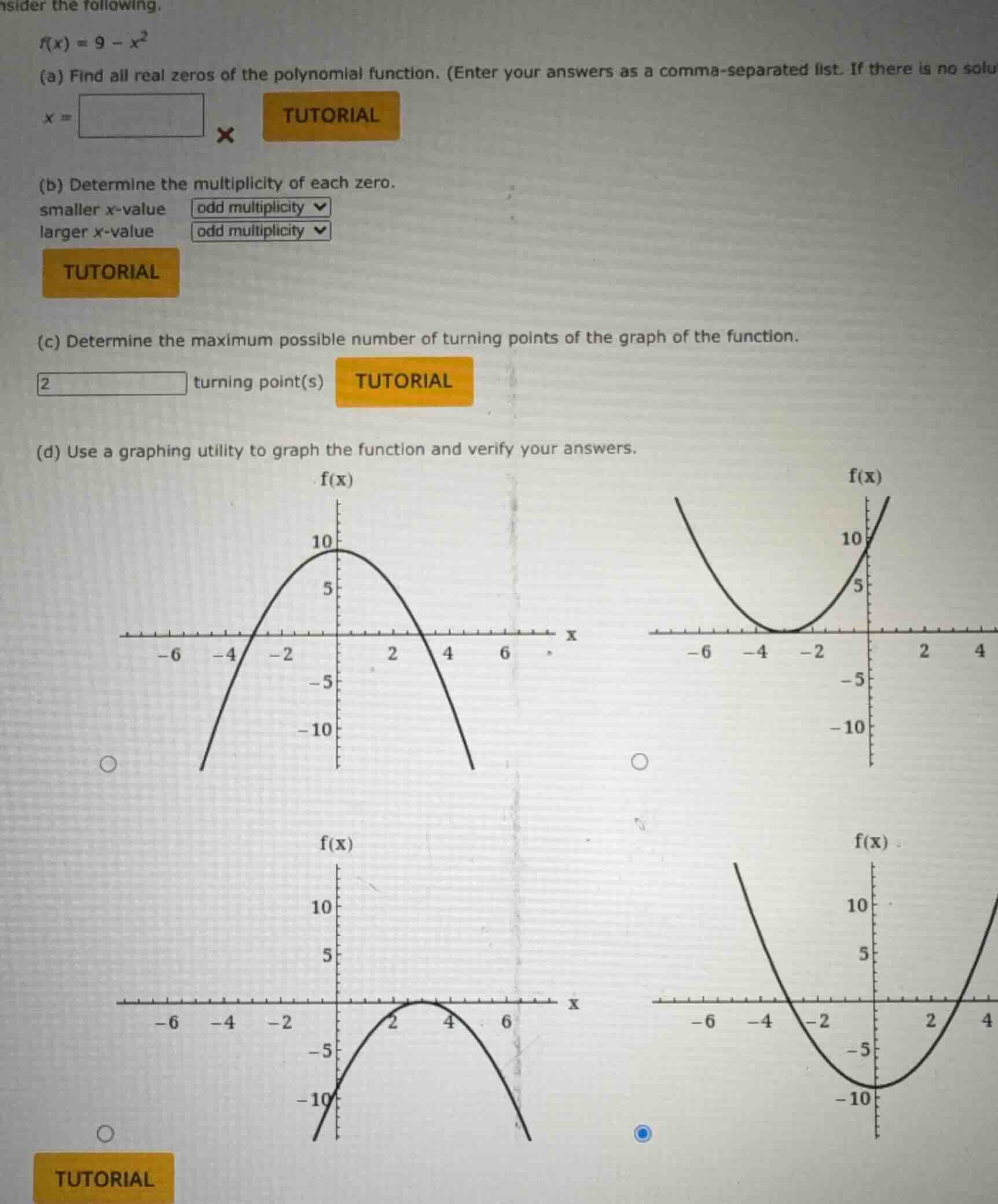
consider the following.\\
$f(x) = 9 - x^2$\\
(a) find all real zeros of the polynomial function. (enter your answers as a comma - separated list. if there is no solu\\
$x = $\\
(b) determine the multiplicity of each zero.\\
smaller $x$-value \boxed{odd multiplicity} larger $x$-value \boxed{odd multiplicity}\\
(c) determine the maximum possible number of turning points of the graph of the function.\\
\boxed{2} turning point(s) \\
(d) use a graphing utility to graph the function and verify your answers.
Part (a)
Step 1: Set \( f(x) = 0 \)
To find the real zeros of the polynomial function \( f(x)=9 - x^{2} \), we set \( f(x) = 0 \). So we have the equation:
\[
9 - x^{2}=0
\]
Step 2: Solve for \( x \)
We can rewrite the equation \( 9 - x^{2}=0 \) as a difference of squares. Recall that \( a^{2}-b^{2}=(a - b)(a + b) \), here \( a = 3 \) and \( b=x \), so \( 9 - x^{2}=3^{2}-x^{2}=(3 - x)(3 + x) \).
Setting each factor equal to zero:
- For \( 3 - x=0 \), we get \( x = 3 \).
- For \( 3 + x=0 \), we get \( x=- 3 \).
The polynomial \( f(x)=9 - x^{2}=-(x - 3)(x + 3)=(-1)(x - 3)^{1}(x + 3)^{1} \). The multiplicity of a zero is the exponent of the corresponding factor in the factored form of the polynomial. For the zero \( x=-3 \) (from the factor \( (x + 3)=(x-(-3)) \)) the exponent is 1, and for the zero \( x = 3 \) (from the factor \( (x - 3) \)) the exponent is also 1. Since 1 is an odd number, both zeros have odd multiplicity.
Step 1: Recall the formula for turning points
The maximum number of turning points of a polynomial function of degree \( n \) is given by \( n - 1 \).
Step 2: Determine the degree of the polynomial
The polynomial \( f(x)=9 - x^{2}=-x^{2}+9 \) is a quadratic polynomial, and its degree \( n = 2 \).
Step 3: Calculate the number of turning points
Using the formula \( n-1 \), with \( n = 2 \), we get \( 2-1 = 1 \)? Wait, no, wait. Wait, the function \( y=9 - x^{2}\) is a parabola. Wait, maybe I made a mistake. Wait, the general form of a polynomial of degree \( n \) has at most \( n - 1 \) turning points. For \( f(x)=9 - x^{2}\), the degree \( n = 2 \), so the maximum number of turning points is \( 2-1=1 \)? But the graph of \( y = 9 - x^{2}\) is a parabola which has 1 turning point (the vertex). Wait, maybe the initial thought of 2 was wrong. Wait, let's re - check.
Wait, the function \( f(x)=9 - x^{2}\) is a quadratic function (degree 2). The derivative of \( f(x) \) is \( f^\prime(x)=-2x \). Setting \( f^\prime(x) = 0 \), we have \( -2x=0\Rightarrow x = 0 \). So the function has only 1 turning point. But maybe the original problem's function was misread? Wait, no, the function is \( f(x)=9 - x^{2}\), degree 2. So the maximum number of turning points is \( 2 - 1=1 \). But the user's initial input had 2, which is incorrect. Wait, maybe there is a mistake in the problem or in my understanding. Wait, no, for a quadratic function (degree 2), the graph is a parabola, which has exactly 1 turning point (the vertex). So the correct number of turning points is 1.
Wait, let's re - derive:
The number of turning points of a polynomial \( y = a_{n}x^{n}+a_{n - 1}x^{n - 1}+\cdots+a_{1}x + a_{0}\) is at most \( n-1 \). For \( f(x)=9 - x^{2}\), \( n = 2 \), so the maximum number of turning points is \( 2-1 = 1 \).

Snap & solve any problem in the app
Get step-by-step solutions on Sovi AI
Photo-based solutions with guided steps
Explore more problems and detailed explanations
\( x=-3,3 \)