QUESTION IMAGE
Question
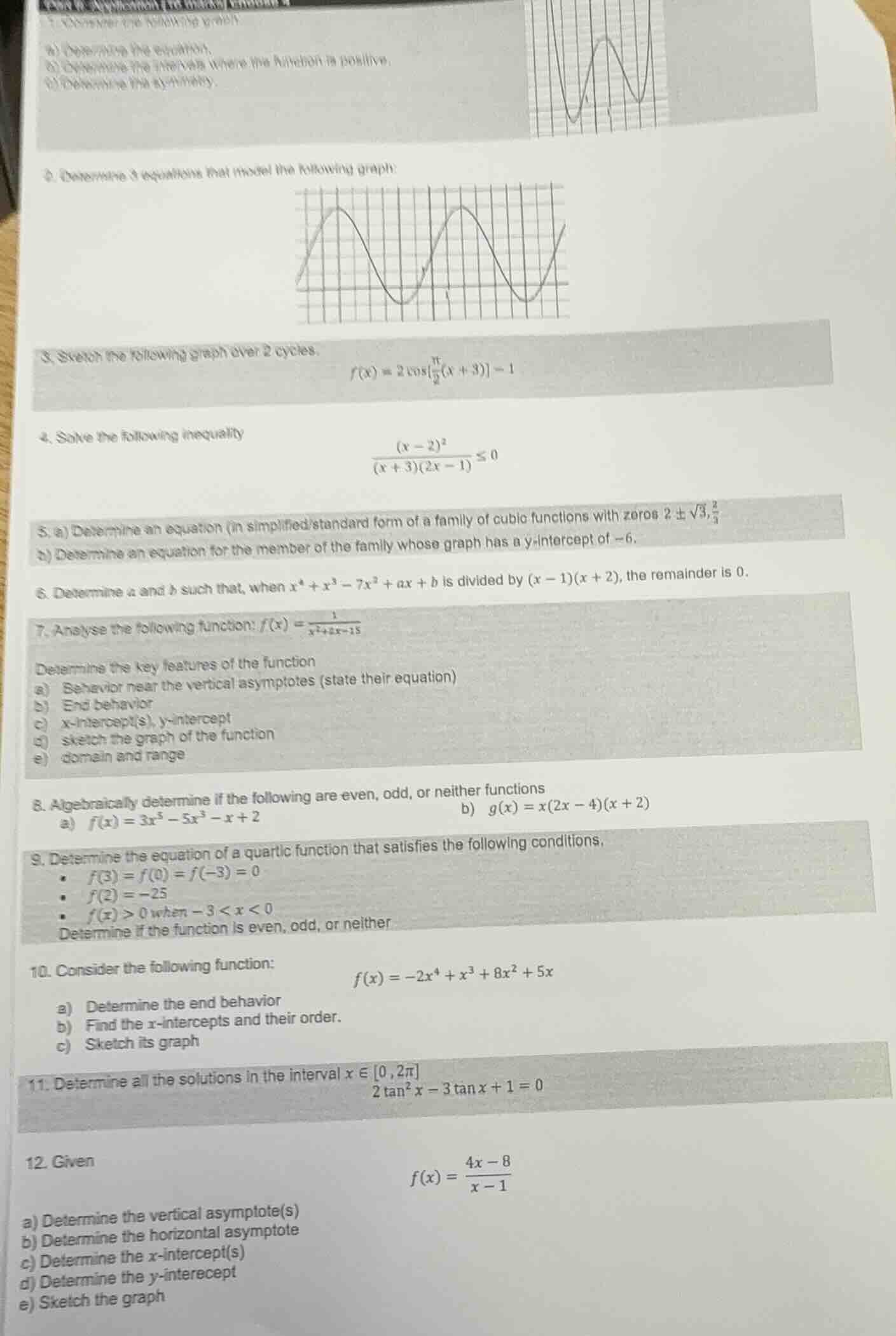
- consider the following graph
a) determine the equation.
b) determine the interval where the function is positive.
c) determine the symmetry.
- determine a equation that model the following graph:
- sketch the following graph over 2 cycles.
$f(x) = 2\cos\left(\frac{\pi}{2}(x + 3)\
ight) - 1$
- solve the following inequality
$\frac{(x - 2)^2}{(x + 3)(2x - 1)} \leq 0$
- a) determine an equation (in simplified standard form of a family of cubic functions with zeros $2 \pm \sqrt{3}, \frac{2}{3}$
b) determine an equation for the member of the family whose graph has a y-intercept of $-6$.
- determine $a$ and $b$ such that, when $x^4 + x^3 - 7x^2 + ax + b$ is divided by $(x - 1)(x + 2)$, the remainder is 0.
- analyse the following function: $f(x) = \frac{1}{x^2 + 2x - 15}$
determine the key features of the function
a) behavior near the vertical asymptotes (state their equation)
b) end behavior
c) x-intercept(s), y-intercept
d) sketch the graph of the function
e) domain and range
- algebraically determine if the following are even, odd, or neither functions
a) $f(x) = 3x^5 - 5x^3 - x + 2$
b) $g(x) = x(2x - 4)(x + 2)$
- determine the equation of a quartic function that satisfies the following conditions,
- $f(3) = f(0) = f(-3) = 0$
- $f(2) = -25$
- $f(x) > 0$ when $-3 < x < 0$
determine if the function is even, odd, or neither
- consider the following function:
$f(x) = -2x^4 + x^3 + 8x^2 + 5x$
a) determine the end behavior
b) find the x-intercepts and their order.
c) sketch its graph
- determine all the solutions in the interval $x \in 0, 2\pi$
$2\tan^2 x - 3\tan x + 1 = 0$
- given
$f(x) = \frac{4x - 8}{x - 1}$
a) determine the vertical asymptote(s)
b) determine the horizontal asymptote
c) determine the x-intercept(s)
d) determine the y-intercept
e) sketch the graph
To solve the inequality \(\frac{(x - 2)^2}{(x + 3)(2x - 1)} \leq 0\), we follow these steps:
Step 1: Find the critical points
The critical points are where the numerator is zero or the denominator is zero (since these are the points where the sign of the expression can change).
- Numerator zero: \((x - 2)^2 = 0 \implies x = 2\)
- Denominator zero: \(x + 3 = 0 \implies x = -3\) and \(2x - 1 = 0 \implies x = \frac{1}{2}\)
So the critical points are \(x = -3\), \(x = \frac{1}{2}\), and \(x = 2\). These divide the real number line into the intervals: \((-\infty, -3)\), \((-3, \frac{1}{2})\), \((\frac{1}{2}, 2)\), and \((2, \infty)\).
Step 2: Test the sign of the expression in each interval
We can use test points in each interval to determine the sign of \(\frac{(x - 2)^2}{(x + 3)(2x - 1)}\):
- Interval \((-\infty, -3)\): Let's choose \(x = -4\)
- Numerator: \((-4 - 2)^2 = 36 > 0\)
- Denominator: \((-4 + 3)(2(-4) - 1) = (-1)(-9) = 9 > 0\)
- So the expression is \(\frac{36}{9} = 4 > 0\)
- Interval \((-3, \frac{1}{2})\): Let's choose \(x = 0\)
- Numerator: \((0 - 2)^2 = 4 > 0\)
- Denominator: \((0 + 3)(2(0) - 1) = (3)(-1) = -3 < 0\)
- So the expression is \(\frac{4}{-3} = -\frac{4}{3} < 0\)
- Interval \((\frac{1}{2}, 2)\): Let's choose \(x = 1\)
- Numerator: \((1 - 2)^2 = 1 > 0\)
- Denominator: \((1 + 3)(2(1) - 1) = (4)(1) = 4 > 0\)
- So the expression is \(\frac{1}{4} > 0\)
- Interval \((2, \infty)\): Let's choose \(x = 3\)
- Numerator: \((3 - 2)^2 = 1 > 0\)
- Denominator: \((3 + 3)(2(3) - 1) = (6)(5) = 30 > 0\)
- So the expression is \(\frac{1}{30} > 0\)
Step 3: Consider the critical points
- At \(x = -3\) and \(x = \frac{1}{2}\), the denominator is zero, so the expression is undefined. We cannot include these points in the solution.
- At \(x = 2\), the numerator is zero, so the expression is zero. We include \(x = 2\) in the solution because the inequality is \(\leq 0\).
Step 4: Write the solution
From the sign analysis, the expression is negative in the interval \((-3, \frac{1}{2})\) and zero at \(x = 2\). So the solution to the inequality \(\frac{(x - 2)^2}{(x + 3)(2x - 1)} \leq 0\) is:
\[
-3 < x < \frac{1}{2} \quad \text{or} \quad x = 2
\]
In interval notation, this is:
\[
(-3, \frac{1}{2}) \cup \{2\}
\]
\(\boxed{(-3, \frac{1}{2}) \cup \{2\}}\)

Snap & solve any problem in the app
Get step-by-step solutions on Sovi AI
Photo-based solutions with guided steps
Explore more problems and detailed explanations
To solve the inequality \(\frac{(x - 2)^2}{(x + 3)(2x - 1)} \leq 0\), we follow these steps:
Step 1: Find the critical points
The critical points are where the numerator is zero or the denominator is zero (since these are the points where the sign of the expression can change).
- Numerator zero: \((x - 2)^2 = 0 \implies x = 2\)
- Denominator zero: \(x + 3 = 0 \implies x = -3\) and \(2x - 1 = 0 \implies x = \frac{1}{2}\)
So the critical points are \(x = -3\), \(x = \frac{1}{2}\), and \(x = 2\). These divide the real number line into the intervals: \((-\infty, -3)\), \((-3, \frac{1}{2})\), \((\frac{1}{2}, 2)\), and \((2, \infty)\).
Step 2: Test the sign of the expression in each interval
We can use test points in each interval to determine the sign of \(\frac{(x - 2)^2}{(x + 3)(2x - 1)}\):
- Interval \((-\infty, -3)\): Let's choose \(x = -4\)
- Numerator: \((-4 - 2)^2 = 36 > 0\)
- Denominator: \((-4 + 3)(2(-4) - 1) = (-1)(-9) = 9 > 0\)
- So the expression is \(\frac{36}{9} = 4 > 0\)
- Interval \((-3, \frac{1}{2})\): Let's choose \(x = 0\)
- Numerator: \((0 - 2)^2 = 4 > 0\)
- Denominator: \((0 + 3)(2(0) - 1) = (3)(-1) = -3 < 0\)
- So the expression is \(\frac{4}{-3} = -\frac{4}{3} < 0\)
- Interval \((\frac{1}{2}, 2)\): Let's choose \(x = 1\)
- Numerator: \((1 - 2)^2 = 1 > 0\)
- Denominator: \((1 + 3)(2(1) - 1) = (4)(1) = 4 > 0\)
- So the expression is \(\frac{1}{4} > 0\)
- Interval \((2, \infty)\): Let's choose \(x = 3\)
- Numerator: \((3 - 2)^2 = 1 > 0\)
- Denominator: \((3 + 3)(2(3) - 1) = (6)(5) = 30 > 0\)
- So the expression is \(\frac{1}{30} > 0\)
Step 3: Consider the critical points
- At \(x = -3\) and \(x = \frac{1}{2}\), the denominator is zero, so the expression is undefined. We cannot include these points in the solution.
- At \(x = 2\), the numerator is zero, so the expression is zero. We include \(x = 2\) in the solution because the inequality is \(\leq 0\).
Step 4: Write the solution
From the sign analysis, the expression is negative in the interval \((-3, \frac{1}{2})\) and zero at \(x = 2\). So the solution to the inequality \(\frac{(x - 2)^2}{(x + 3)(2x - 1)} \leq 0\) is:
\[
-3 < x < \frac{1}{2} \quad \text{or} \quad x = 2
\]
In interval notation, this is:
\[
(-3, \frac{1}{2}) \cup \{2\}
\]
\(\boxed{(-3, \frac{1}{2}) \cup \{2\}}\)