QUESTION IMAGE
Question
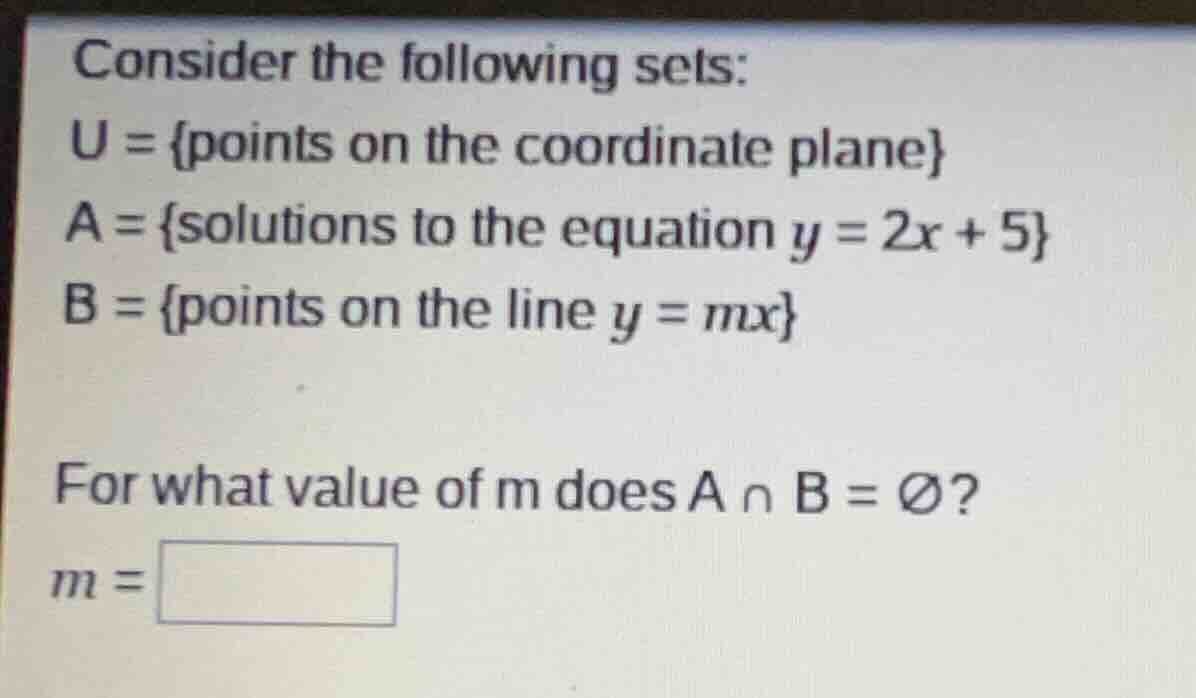
consider the following sets: u = {points on the coordinate plane} a = {solutions to the equation y = 2x + 5} b = {points on the line y = mx} for what value of m does a ∩ b = ∅? m =
Step1: Understand the problem
We need to find the value of \( m \) such that the intersection of set \( A \) (solutions to \( y = 2x + 5 \)) and set \( B \) (points on \( y = mx \)) is empty. This means the two lines \( y = 2x + 5 \) and \( y = mx \) should be parallel (since parallel lines never intersect).
Step2: Recall the slope of parallel lines
For two lines \( y = k_1x + b_1 \) and \( y = k_2x + b_2 \) to be parallel, their slopes must be equal, i.e., \( k_1 = k_2 \), and they must have different y - intercepts (otherwise they would be the same line). The line \( y = 2x+5 \) has a slope of \( 2 \) and a y - intercept of \( 5 \). The line \( y = mx \) has a slope of \( m \) and a y - intercept of \( 0 \).
Since the y - intercept of \( y = 2x + 5 \) (\( 5\)) is not equal to the y - intercept of \( y=mx \) (\( 0\)), we just need the slopes to be equal for the lines to be parallel (and thus have no intersection). So, if the slope of \( y = mx \) is equal to the slope of \( y = 2x+5 \), the lines are parallel. The slope of \( y = 2x + 5 \) is \( 2 \), so \( m = 2 \) would make the lines parallel only if we check the y - intercepts. Wait, no, wait. Wait, if \( m = 2 \), the line \( y = 2x \) and \( y=2x + 5 \) are parallel (different y - intercepts) so they never intersect. If \( m
eq2 \), the lines are not parallel, so they will intersect at some point.
So to have \( A\cap B=\varnothing \), the lines \( y = 2x + 5 \) and \( y=mx \) must be parallel. For two lines \( y = a_1x + b_1 \) and \( y=a_2x + b_2 \) to be parallel, \( a_1=a_2 \) and \( b_1
eq b_2 \). Here, \( a_1 = 2 \), \( b_1=5 \), \( a_2=m \), \( b_2 = 0 \). Since \( b_1
eq b_2 \) ( \( 5
eq0 \) ), we set \( a_1=a_2 \), so \( m = 2 \) would make the lines parallel, hence no intersection. Wait, but let's verify. If \( m = 2 \), the line \( B \) is \( y = 2x \), and line \( A \) is \( y=2x + 5 \). These two lines are parallel (same slope, different y - intercepts) so they never meet. If \( m
eq2 \), the lines are not parallel, so they will intersect at some point (since they are both straight lines in the plane), so \( A\cap B \) will have that intersection point, so \( A\cap B
eq\varnothing \).

Snap & solve any problem in the app
Get step-by-step solutions on Sovi AI
Photo-based solutions with guided steps
Explore more problems and detailed explanations
\( m = 2 \)