QUESTION IMAGE
Question
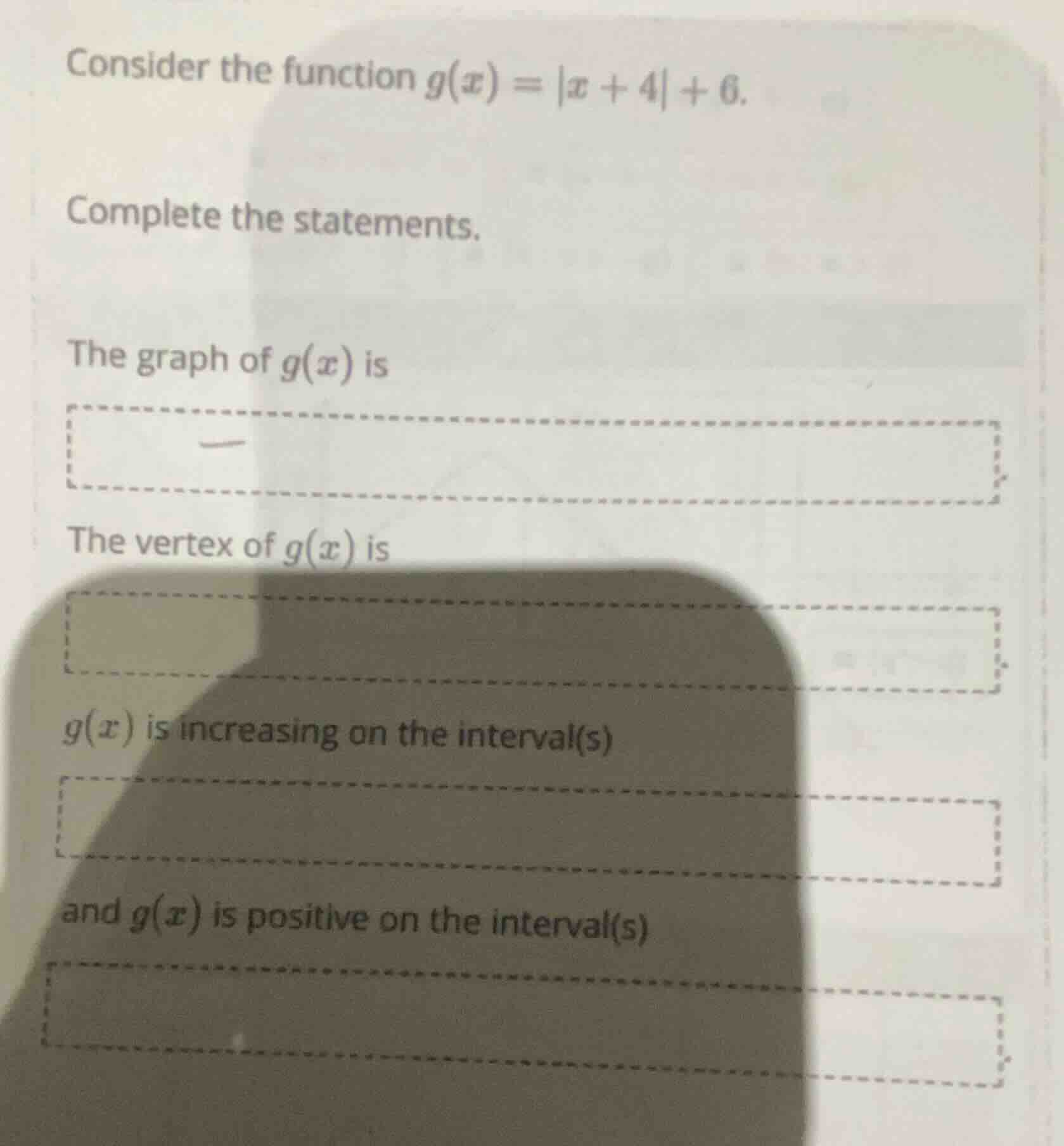
consider the function $g(x)=|x + 4|+6$. complete the statements. the graph of $g(x)$ is blank the vertex of $g(x)$ is blank $g(x)$ is increasing on the interval(s) blank and $g(x)$ is positive on the interval(s) blank
Part 1: The graph of \( g(x) \)
Step 1: Recall the parent function
The parent function of an absolute - value function is \( f(x)=|x| \), which has a V - shaped graph. The function \( g(x)=|x + 4|+6 \) is a transformation of the parent function \( y = |x| \).
Step 2: Analyze the transformations
- The \( |x+4| \) part represents a horizontal shift of the graph of \( y = |x| \). For a function \( y=|x - h| \), if \( h=- 4 \) (since \( x+4=x-(-4) \)), the graph is shifted 4 units to the left.
- The \( +6 \) part represents a vertical shift of the graph of \( y = |x + 4| \) 6 units up.
- Since the coefficient of the absolute - value term is 1 (which is positive), the graph opens upwards, just like the parent function \( y = |x| \). So the graph of \( g(x) \) is a V - shaped graph (the graph of an absolute - value function) that is shifted 4 units to the left and 6 units up from the graph of \( y=|x| \).
Part 2: The vertex of \( g(x) \)
Step 1: Recall the vertex form of an absolute - value function
The vertex form of an absolute - value function is \( y=a|x - h|+k \), where \( (h,k) \) is the vertex of the function.
Step 2: Identify \( h \) and \( k \) for \( g(x) \)
For the function \( g(x)=|x + 4|+6 \), we can rewrite \( x + 4\) as \( x-(-4) \). Comparing with \( y=a|x - h|+k \), we have \( h=-4 \) and \( k = 6 \). So the vertex of \( g(x) \) is \( (-4,6) \).
Part 3: Interval where \( g(x) \) is increasing
Step 1: Recall the behavior of the absolute - value function
The graph of \( y = |x| \) is increasing for \( x>0 \) and decreasing for \( x<0 \). For a function of the form \( y=|x - h|+k \), the axis of symmetry is \( x = h \).
Step 2: Determine the increasing interval for \( g(x) \)
For \( g(x)=|x + 4|+6 \), the axis of symmetry is \( x=-4 \). Since the graph opens upwards (because the coefficient of the absolute - value term is positive), the function is increasing for \( x>-4 \). In interval notation, the function is increasing on the interval \( (-4,\infty) \).
Part 4: Interval where \( g(x) \) is positive

Snap & solve any problem in the app
Get step-by-step solutions on Sovi AI
Photo-based solutions with guided steps
Explore more problems and detailed explanations
Step 1: Recall the range of the absolute - value function
The absolute - value function \( y = |x| \) has a range of \( y\geq0 \). For the function \( g(x)=|x + 4|+6 \), we know that \( |x + 4|\geq0 \) for all real numbers \( x \).
Step 2: Analyze the value of \( g(x) \)
If \( |x + 4|\geq0 \), then \( g(x)=|x + 4|+6\geq0 + 6=6>0 \) for all real numbers \( x \). So the function \( g(x) \) is positive for all real numbers \( x \). In interval notation, the function is positive on the interval \( (-\infty,\infty) \) (the set of all real numbers).
Final Answers:
- The graph of \( g(x) \) is a V - shaped graph (absolute - value graph) shifted 4 units left and 6 units up.
- The vertex of \( g(x) \) is \(\boldsymbol{(-4,6)}\)
- \( g(x) \) is increasing on the interval \(\boldsymbol{(-4,\infty)}\)
- \( g(x) \) is positive on the interval \(\boldsymbol{(-\infty,\infty)}\)