QUESTION IMAGE
Question
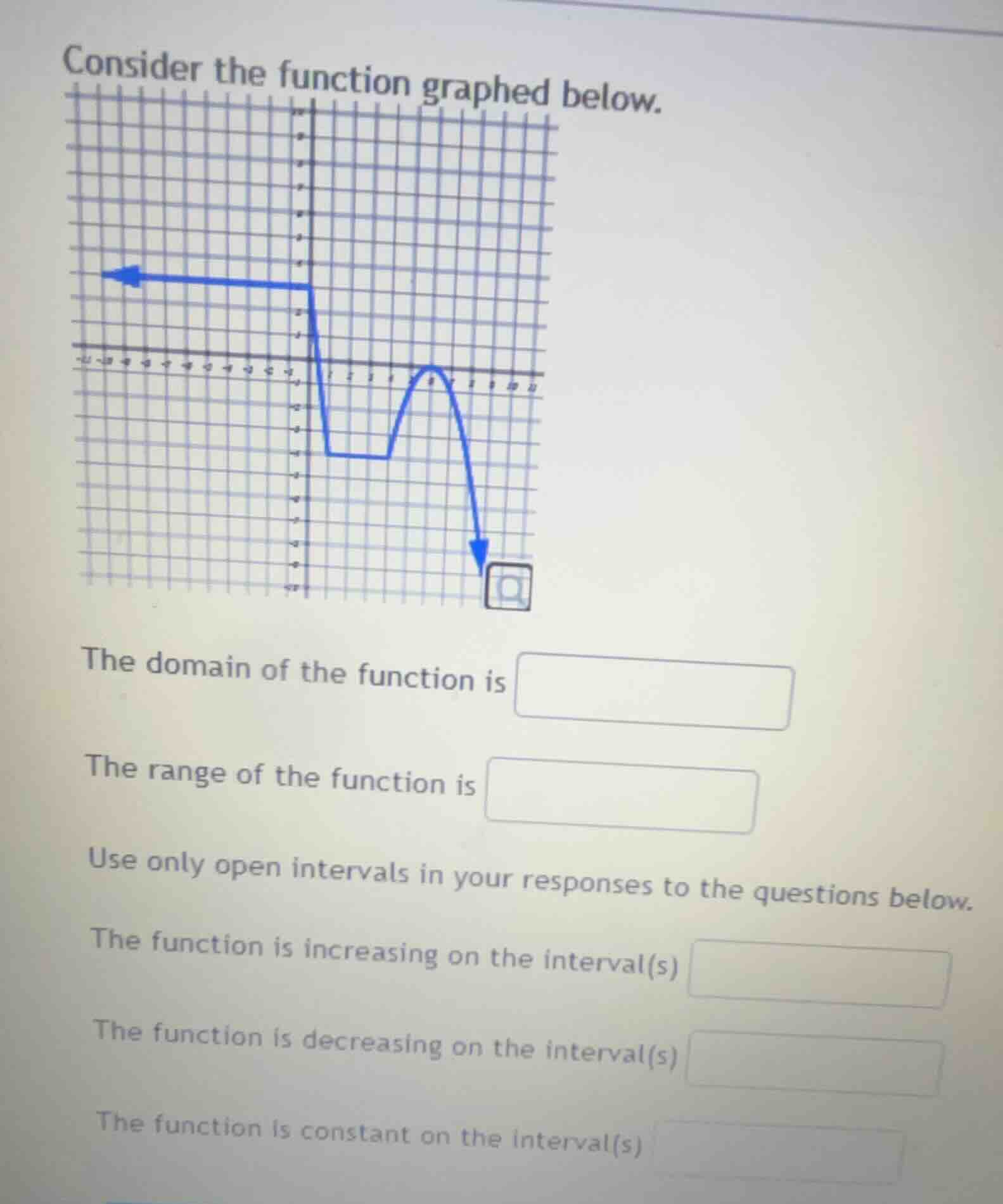
consider the function graphed below.
the domain of the function is
the range of the function is
use only open intervals in your responses to the questions below.
the function is increasing on the interval(s)
the function is decreasing on the interval(s)
the function is constant on the interval(s)
Step1: Identify domain (x-values)
The graph extends left infinitely (arrow) and right to $x=10$ (end of the curve). So domain is $(-\infty, 10)$.
Step2: Identify range (y-values)
The graph goes down infinitely (arrow) and up to $y=3$ (highest horizontal segment). So range is $(-\infty, 3)$.
Step3: Find increasing interval
The function rises from $x=4$ to $x=6$. So interval is $(4, 6)$.
Step4: Find decreasing intervals
The function falls from $x=0$ to $x=2$, and $x=6$ to $x=10$. So intervals are $(0, 2), (6, 10)$.
Step5: Find constant intervals
The function is flat from $x=-\infty$ to $x=0$, and $x=2$ to $x=4$. So intervals are $(-\infty, 0), (2, 4)$.

Snap & solve any problem in the app
Get step-by-step solutions on Sovi AI
Photo-based solutions with guided steps
Explore more problems and detailed explanations
The domain of the function is $(-\infty, 10)$
The range of the function is $(-\infty, 3)$
The function is increasing on the interval(s) $(4, 6)$
The function is decreasing on the interval(s) $(0, 2), (6, 10)$
The function is constant on the interval(s) $(-\infty, 0), (2, 4)$