QUESTION IMAGE
Question
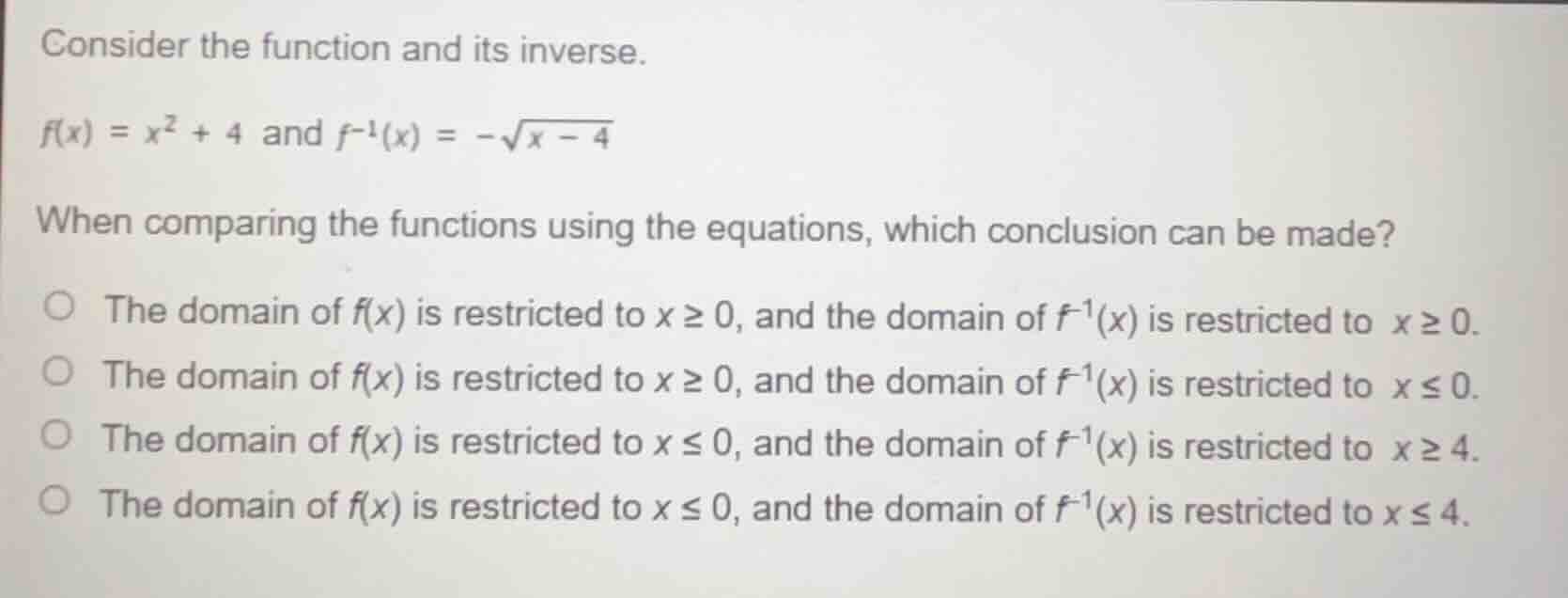
consider the function and its inverse.
$f(x) = x^2 + 4$ and $f^{-1}(x) = -sqrt{x - 4}$
when comparing the functions using the equations, which conclusion can be made?
\\(\bigcirc\\) the domain of $f(x)$ is restricted to $x \geq 0$, and the domain of $f^{-1}(x)$ is restricted to $x \geq 0$.
\\(\bigcirc\\) the domain of $f(x)$ is restricted to $x \geq 0$, and the domain of $f^{-1}(x)$ is restricted to $x \leq 0$.
\\(\bigcirc\\) the domain of $f(x)$ is restricted to $x \leq 0$, and the domain of $f^{-1}(x)$ is restricted to $x \geq 4$.
\\(\bigcirc\\) the domain of $f(x)$ is restricted to $x \leq 0$, and the domain of $f^{-1}(x)$ is restricted to $x \leq 4$.
- Analizar la función \( f(x) = x^2 + 4 \) y su inversa \( f^{-1}(x)=-\sqrt{x - 4} \):
- Para la función original \( f(x)=x^{2}+4 \), si consideramos su inversa \( f^{-1}(x)=-\sqrt{x - 4} \), la función \( f(x) \) debe tener un dominio restringido para ser invertible. La parábola \( y = x^{2}+4 \) es simétrica respecto al eje \( y \). Para que tenga inversa, debemos restringir su dominio a una región donde sea inyectiva (una a una). Dado que la inversa es \( f^{-1}(x)=-\sqrt{x - 4} \) (que es la rama negativa de la raíz cuadrada), la función \( f(x) \) debe tener dominio \( x\leq0 \) (ya que la inversa tiene como rango el dominio de \( f(x) \) y la inversa \( f^{-1}(x) \) tiene rango \( y\leq0 \), entonces el dominio de \( f(x) \) es \( x\leq0 \)).
- Para la función inversa \( f^{-1}(x)=-\sqrt{x - 4} \), el argumento de la raíz cuadrada debe ser no negativo: \( x - 4\geq0\Rightarrow x\geq4 \). Además, la función \( f^{-1}(x) \) es la raíz cuadrada negativa, su rango es \( y\leq0 \), que coincide con el dominio restringido de \( f(x) \) (\( x\leq0 \)).
- Analizar las opciones:
- Opción 1: El dominio de \( f(x) \) no es \( x\geq0 \) (ya que la inversa es la rama negativa, el dominio de \( f(x) \) es \( x\leq0 \)) y el dominio de \( f^{-1}(x) \) no es \( x\geq0 \) (es \( x\geq4 \)), así que está errada.
- Opción 2: El dominio de \( f(x) \) no es \( x\geq0 \) (es \( x\leq0 \)) y el dominio de \( f^{-1}(x) \) no es \( x\leq0 \) (es \( x\geq4 \)), errada.
- Opción 3: El dominio de \( f(x) \) es \( x\leq0 \) (por la inversa ser la rama negativa) y el dominio de \( f^{-1}(x) \) es \( x\geq4 \) (por \( x - 4\geq0 \)), esta opción es correcta.
- Opción 4: El dominio de \( f^{-1}(x) \) no es \( x\leq4 \) (es \( x\geq4 \)), errada.

Snap & solve any problem in the app
Get step-by-step solutions on Sovi AI
Photo-based solutions with guided steps
Explore more problems and detailed explanations
C. The domain of \( f(x) \) is restricted to \( x \leq 0 \), and the domain of \( f^{-1}(x) \) is restricted to \( x \geq 4 \). (Asumiendo que la tercera opción es la correcta, con la numeración de las opciones en el problema: la tercera opción es "The domain of \( f(x) \) is restricted to \( x \leq 0 \), and the domain of \( f^{-1}(x) \) is restricted to \( x \geq 4 \)")