QUESTION IMAGE
Question
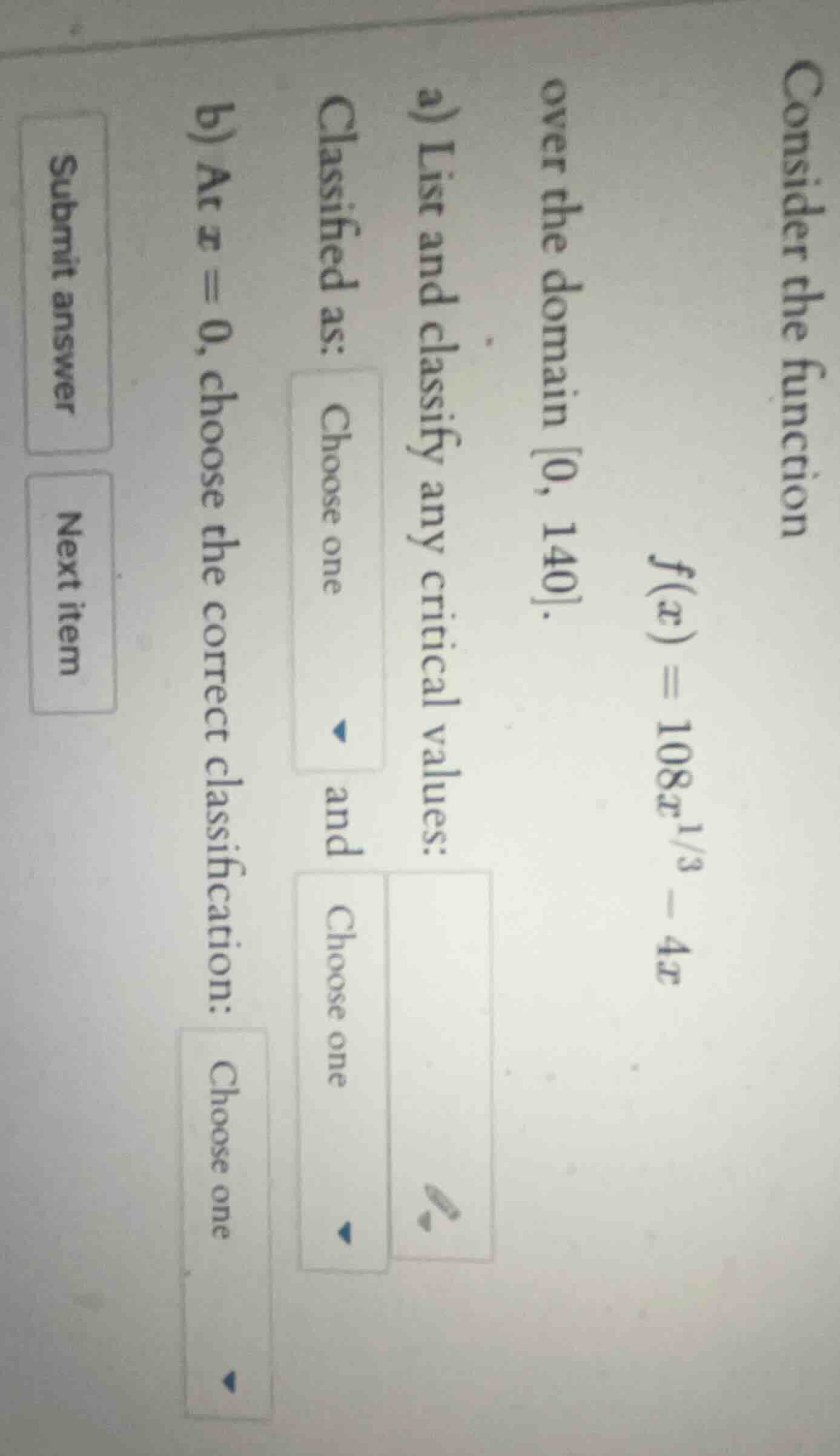
consider the function
$f(x) = 108x^{1/3} - 4x$
over the domain $0, 140$.
a) list and classify any critical values:
classified as:
choose one
and
choose one
b) at $x = 0$, choose the correct classification:
choose one
Part (a)
Step 1: Find the derivative of \( f(x) \)
The function is \( f(x) = 108x^{1/3}-4x \). Using the power rule \( \frac{d}{dx}(x^n)=nx^{n - 1} \), we have:
\( f^\prime(x)=108\times\frac{1}{3}x^{\frac{1}{3}-1}-4= 36x^{-2/3}-4=\frac{36}{x^{2/3}}-4 \)
Step 2: Find critical values
Critical values occur where \( f^\prime(x) = 0 \) or \( f^\prime(x) \) is undefined.
- Case 1: \( f^\prime(x)=0 \)
\( \frac{36}{x^{2/3}}-4 = 0 \)
\( \frac{36}{x^{2/3}}=4 \)
\( x^{2/3}=\frac{36}{4} = 9 \)
Raise both sides to the power of \( \frac{3}{2} \): \( x=(9)^{\frac{3}{2}}=(3^2)^{\frac{3}{2}} = 3^3=27 \)
- Case 2: \( f^\prime(x) \) is undefined
\( f^\prime(x)=\frac{36}{x^{2/3}}-4 \) is undefined when \( x^{2/3}=0 \), i.e., \( x = 0 \) (since \( x^{2/3}=\sqrt[3]{x^2} \), and when \( x = 0 \), the denominator of the first term is 0). Also, we check the domain \([0,140]\), so \( x = 0 \) and \( x = 27 \) are in the domain.
So the critical values are \( x = 0 \) and \( x = 27 \). Now, we classify them:
- For \( x = 0 \): The derivative \( f^\prime(x) \) is undefined here. We can check the behavior around \( x = 0 \). For \( x>0 \) (close to 0), \( f^\prime(x)=\frac{36}{x^{2/3}}-4 \). Since \( x^{2/3}>0 \) for \( x>0 \), \( \frac{36}{x^{2/3}} \) is large positive, so \( f^\prime(x)>0 \) for \( x\in(0,27) \) (we can check at \( x = 1 \), \( f^\prime(1)=36 - 4=32>0 \)). So at \( x = 0 \), the function is defined (\( f(0)=0 \)), and the derivative is undefined (vertical tangent or corner).
- For \( x = 27 \): We found it by setting \( f^\prime(x) = 0 \), so it is a critical point where the derivative is zero.
To classify \( x = 0 \), we use the first - derivative test. We check the sign of \( f^\prime(x) \) in the interval \( (0,\epsilon) \) where \( \epsilon \) is a small positive number (e.g., \( \epsilon = 1 \)).
For \( x\in(0,27) \) (take \( x = 1 \)), \( f^\prime(1)=\frac{36}{1^{2/3}}-4=36 - 4 = 32>0 \). So the function is increasing on \( (0,27) \). At \( x = 0 \), the function is defined (\( f(0)=0 \)), and just to the right of \( x = 0 \), the function is increasing. Since the function is defined at \( x = 0 \) and the derivative to the right is positive, we can also consider the graph: the function \( y = 108x^{1/3}-4x \) at \( x = 0 \) has a vertical tangent (since the derivative is undefined, \( x^{2/3} \) in the denominator makes the derivative blow up as \( x
ightarrow0^+ \)). But from the first - derivative test, for \( x>0 \) near 0, the function is increasing. So at \( x = 0 \), since the function is increasing to the right of 0 and the function value at \( x = 0 \) is \( f(0)=0 \), and there is no interval to the left of 0 in the domain \([0,140]\), we can say that \( x = 0 \) is a point where the function starts its increasing behavior in the domain. If we consider the definition of local extrema, since there is no interval to the left of 0, \( x = 0 \) is not a local maximum or minimum in the traditional sense (but in the domain \([0,140]\), it is the left - hand endpoint). However, from the derivative behavior, at \( x = 0 \), the function has a vertical tangent (derivative is undefined) and the function is increasing immediately to the right.

Snap & solve any problem in the app
Get step-by-step solutions on Sovi AI
Photo-based solutions with guided steps
Explore more problems and detailed explanations
(Part a):
Critical values are \( x = 0 \) (classified as a point where the derivative is undefined) and \( x = 27 \) (classified as a point where the derivative is zero).