QUESTION IMAGE
Question
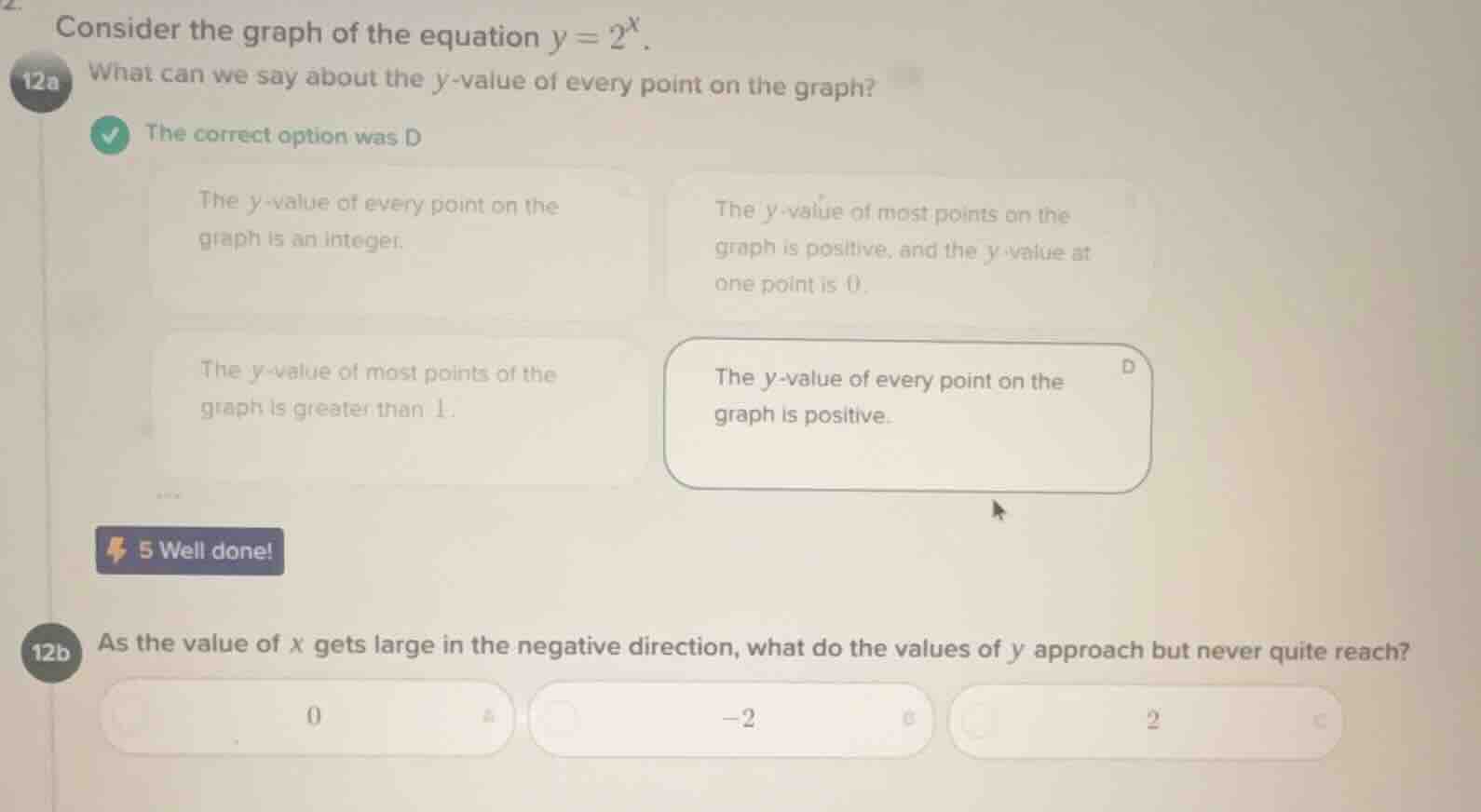
consider the graph of the equation $y = 2^x$.
12a what can we say about the $y$-value of every point on the graph?
the correct option was d
the $y$-value of every point on the graph is an integer.
the $y$-value of most points on the graph is positive, and the $y$-value at one point is 0.
the $y$-value of most points of the graph is greater than 1.
the $y$-value of every point on the graph is positive.
12b as the value of $x$ gets large in the negative direction, what do the values of $y$ approach but never quite reach?
0
-2
2
12b Solution:
Step1: Analyze the function \( y = 2^x \)
The function is an exponential function with base \( 2 \) (a positive number greater than \( 1 \)). The general form of an exponential function is \( y = a^x \), where \( a>0,a
eq1 \). For \( y = 2^x \), when \( x \) is a real number, we analyze the behavior as \( x\to-\infty \).
Step2: Evaluate the limit as \( x\to-\infty \)
We can rewrite \( 2^x=\frac{1}{2^{-x}} \). As \( x \) gets large in the negative direction (i.e., \( x\to-\infty \)), \( -x\to+\infty \). Then \( 2^{-x}=2^{|x|}\to+\infty \) (since the exponential function with base \( 2>1 \) grows without bound as the exponent increases). So, \( \frac{1}{2^{-x}}\to\frac{1}{+\infty}=0 \). But since \( 2^x>0 \) for all real \( x \) (because any positive number raised to a real power is positive), \( y = 2^x \) approaches \( 0 \) but never actually reaches \( 0 \) (because \( 2^x = 0 \) would imply \( x=\log_2(0) \), which is undefined).

Snap & solve any problem in the app
Get step-by-step solutions on Sovi AI
Photo-based solutions with guided steps
Explore more problems and detailed explanations
The values of \( y \) approach \( 0 \) but never quite reach it. So the correct option is the one with \( 0 \) (assuming the options are labeled with \( 0 \), \( -2 \), \( 2 \), and the correct one is the first option with \( 0 \)).